
AI in Daily Technology: A Complete Picture of Where It Stands Today
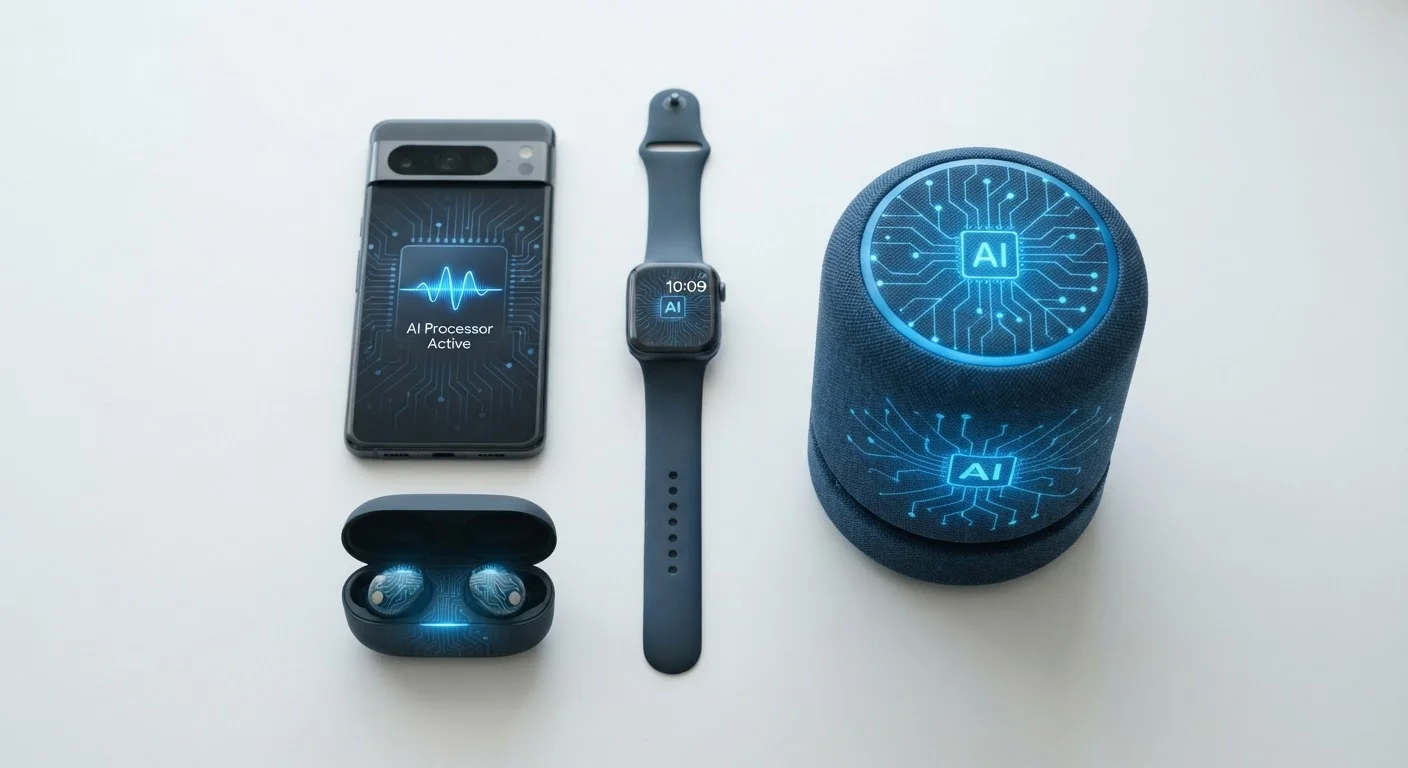
Photo credit: Telecom360.net | Connecting You To The Latest In Telecom
In this article
An end-to-end look at how AI is embedded in smartphones, apps, wearables, and home devices — what it does, how it works, and what to watch for.
Key Takeaways
- AI is already running inside smartphones, wearables, apps, and smart home devices you own today.
- Most AI in consumer tech runs on-device, meaning it processes data locally without sending it to the cloud.
- AI features range from predictive text and photo enhancement to health monitoring and threat detection.
- Understanding where AI operates helps users make informed decisions about privacy and feature trade-offs.
- AI limitations are real - accuracy, bias, and transparency remain active areas of concern.
What 'AI in Your Device' Actually Means
The phrase "AI-powered" now appears in spec sheets, app store listings, and product marketing for nearly every consumer device category. But the term covers a wide range of underlying technologies with meaningfully different capabilities.
At its core, AI in consumer technology refers to software systems that use patterns learned from large datasets to make predictions or decisions - rather than following a fixed set of hand-written rules. In practice, this includes techniques like machine learning, computer vision, and natural language processing (NLP), each of which powers different features in the devices you use daily. For a plain-language breakdown of the specific terms you'll see in product descriptions, see our AI terminology reference guide.
A key distinction worth understanding: some AI runs on-device, processing data entirely within your phone or wearable using a dedicated chip. Other AI is cloud-based, meaning your data travels to remote servers for processing before results are returned. Both approaches have trade-offs around speed, privacy, and capability.
AI on Your Smartphone
Smartphones are the densest concentration of consumer AI most people encounter. Modern flagship devices include dedicated processors - often called a NPU or AI accelerator - specifically designed to run machine learning tasks efficiently without draining the battery.
Here is where AI is actively working on your phone right now:
- Camera systems: Scene recognition, computational HDR, portrait-mode bokeh simulation, and night mode all rely on trained models that analyze pixel data frame by frame.
- Keyboard and predictive text: Next-word suggestions, autocorrect, and smart reply options are generated by language models trained on large text corpora and, in some cases, fine-tuned locally on your typing habits.
- Voice assistants: Wake-word detection runs on-device; more complex query processing typically routes to the cloud.
- Biometric authentication: Face unlock and fingerprint recognition use trained classifiers to match live sensor data against enrolled patterns.
~95%
Flagship phones shipping with dedicated AI chips
Industry analyst reports from 2023-2024 consistently show that virtually all premium smartphones now include a dedicated neural processing unit.
3.5B+
Voice assistant users globally
Estimates from multiple market research firms place global voice assistant adoption above 3.5 billion active users across phones, smart speakers, and wearables.
60-80ms
Typical on-device inference latency
On-device ML inference for tasks like image classification or wake-word detection typically completes in under 100 milliseconds on modern mobile hardware.
AI also plays a significant role in mobile security - detecting malware, filtering spam calls, and flagging phishing attempts - often without any visible interaction from the user. Our companion piece on AI in mobile security covers those mechanisms in depth.
AI in Apps and Software
Beyond the operating system, AI capabilities are embedded throughout the app layer. A few categories where this is most pronounced:
- Streaming and content apps
- Recommendation engines use collaborative filtering and behavioral signals to surface content. These models update continuously as your usage changes.
- Navigation and maps
- Real-time route optimization, arrival-time prediction, and incident detection all use models trained on aggregated traffic data.
- Productivity tools
- Grammar assistants, meeting transcription, and summarization tools now rely on large language models (LLMs) that can generate and edit human-readable text.
- Health and fitness apps
- Caloric estimation from food photos, workout form detection via camera, and mood tracking via journaling patterns are increasingly model-driven.
When evaluating an app's AI features, check its privacy policy specifically for the phrase 'model training' - this often indicates your usage data may be used to improve the underlying model.
Many users assume AI personalization is purely local; in practice, behavioral data frequently contributes to centralized model improvement pipelines unless explicitly opted out.
For health-monitoring AI features on wearables, treat outputs as informational signals rather than clinical measurements - and verify anything medically significant with a qualified professional.
Consumer wearable AI models are validated against population-level accuracy benchmarks, not individual clinical standards, and performance can vary by user physiology.
For a practical overview of how these tools compare, the AI Tools Explained hub provides category-by-category breakdowns oriented toward everyday users.
AI in Wearables and Smart Home Devices
Wearables represent a compelling - and underappreciated - frontier for on-device AI. Smartwatches and fitness trackers run lightweight models locally to continuously analyze sensor data without the latency or battery cost of constant cloud calls.
Common AI functions in wearables include:
- Heart rhythm irregularity detection using ECG sensor data
- Sleep stage classification from accelerometer and heart rate patterns
- Fall detection using motion signature models
- Activity recognition that distinguishes between walking, swimming, cycling, and dozens of other movement types
Smart home devices add another layer. Voice-controlled speakers use wake-word engines that run entirely on-device, only sending audio to cloud servers after the trigger phrase is detected. Smart displays and thermostats use occupancy models and historical usage patterns to automate schedules. Security cameras increasingly incorporate on-device motion classification to reduce false alerts.
Not All AI Health Alerts Are Clinically Validated
AI-generated health insights from consumer wearables - including irregular heart rhythm notifications and sleep quality scores - are designed as wellness indicators, not medical diagnoses. Regulatory clearance (such as FDA clearance in the US) applies to specific device features under specific conditions. Always consult a healthcare professional before acting on any health alert from a consumer device.
Privacy and Transparency Considerations
AI features that process personal data - voice, biometrics, health signals, behavioral patterns - raise legitimate questions about data handling that consumers should understand before enabling them.
Key questions worth asking about any AI feature:
- Where does processing happen? On-device processing generally carries lower data-exposure risk than cloud processing.
- What data is retained? Some features improve over time by sending anonymized usage data back to developers. Opt-out settings vary by platform and jurisdiction.
- Is the model's behavior auditable? Most consumer AI systems are opaque - accuracy claims from vendors are difficult to independently verify.
AI Models Can Reflect Existing Biases
Studies published in peer-reviewed journals, including work examining facial recognition systems, have documented that some AI models perform with lower accuracy on faces of darker skin tones - a direct result of underrepresentation in training data. This is not a hypothetical risk; it has measurable effects on real users today. When a device or app makes consequential decisions using AI, awareness of potential accuracy gaps is warranted.
AI bias is also a documented concern. Models trained on datasets that underrepresent certain demographics can produce systematically less accurate results for those groups. This applies to face recognition, health-monitoring algorithms, and NLP systems alike. The article separating AI hype from reality addresses these and other common misconceptions in detail.
What to Watch For as AI Evolves
Several trends are shaping how AI will develop in consumer technology over the next few years - not as speculation, but as observable trajectories already in motion.
On-device models are growing in capability. Smaller, more efficient model architectures are enabling capabilities previously confined to cloud systems - including generative text and image features - to run directly on smartphone hardware.
Multimodal AI is becoming mainstream. Systems that simultaneously process text, images, audio, and sensor data are moving from research settings into shipping products, enabling richer assistants and more accurate health tools.
Regulatory frameworks are emerging. Jurisdictions including the European Union have enacted AI-specific legislation requiring transparency and risk assessments for certain AI applications. These rules are likely to influence how features are disclosed and governed globally.
For consumers, the most useful posture is informed engagement - understanding what AI features do, what data they use, and how to configure them to match your preferences. The Smartphones and Tablets hub provides additional context on how hardware capabilities intersect with these software trends.
AI Terminology Reference Guide
A plain-language glossary of machine learning and AI terms appearing in smartphone specs and app descriptions - useful for decoding marketing claims.
AI Tools Explained Hub
Category-by-category breakdowns of popular AI tools and how everyday users can benefit from - or evaluate the limitations of - each type.
Smartphones & Tablets Hub
Explores how smartphone hardware and software specifications relate to real-world performance, including the AI chip capabilities now standard in modern devices.

Author
AI & Cloud Editorial Team
AI & Cloud Editorial Team is the collective byline for our editorial team and contributor network. Articles published under this byline or an editorial pen name are researched, written, and reviewed according to our editorial standards for clarity, consistency, and independence before publication.
View all articles →