
5G, LTE, and Wi-Fi 6: What Each Standard Delivers in Practice
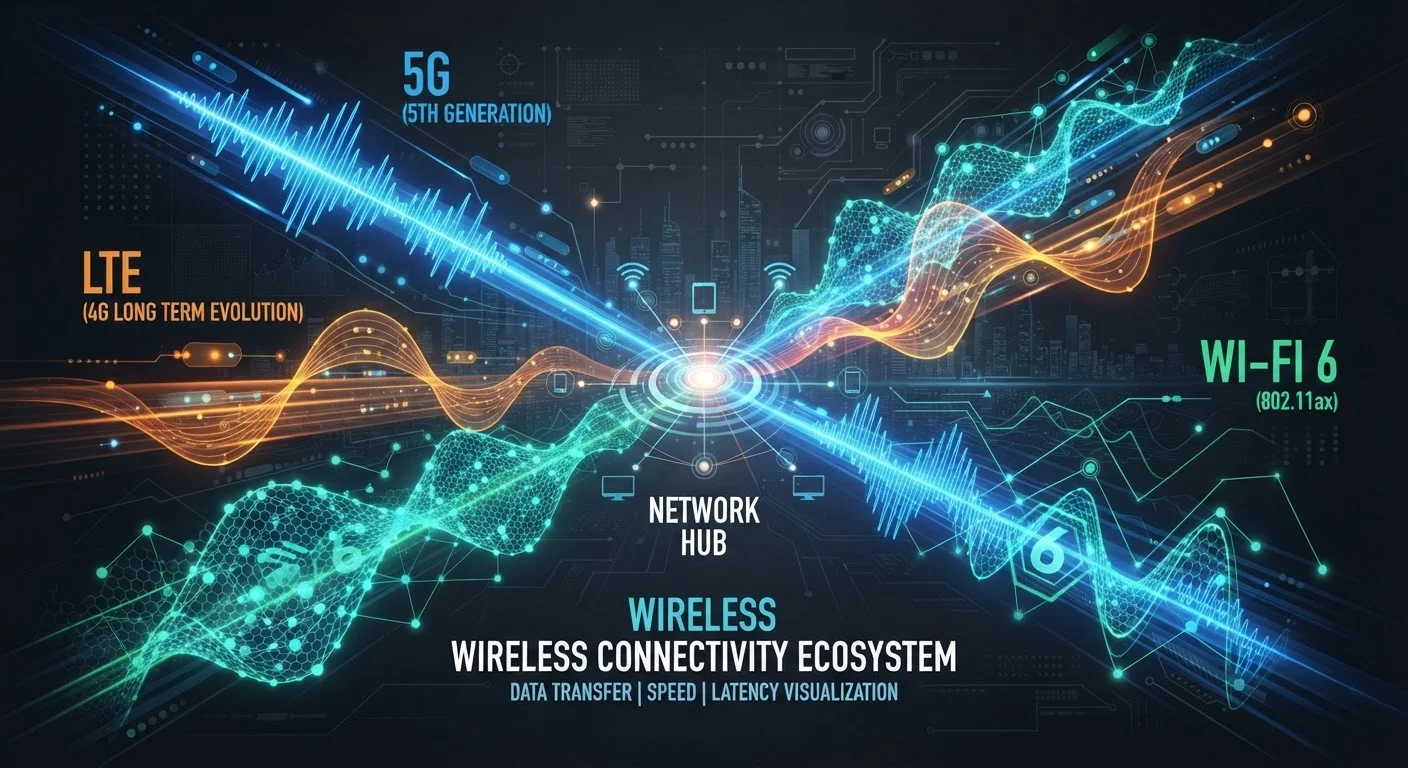
Photo credit: Telecom360.net | Connecting You To The Latest In Telecom
In this article
Cut through the marketing around connectivity standards. Here's what 5G, LTE, and Wi-Fi 6 mean for speed, latency, and battery life.
Key Takeaways
- 5G offers peak theoretical speeds far above LTE, but real-world gains depend heavily on band type and network density.
- LTE remains the most consistently available standard across the US and still handles most everyday tasks reliably.
- Wi-Fi 6 is a local-area standard - it improves home and office performance but does not replace cellular connectivity.
- Latency differences between standards matter most for gaming, video calls, and real-time applications.
- Battery consumption varies across standards; connecting to a weaker signal forces more radio power regardless of the standard.
How These Three Standards Are Fundamentally Different
5G, LTE, and Wi-Fi 6 are often grouped together in marketing as interchangeable upgrades, but they serve distinct purposes. LTE (Long-Term Evolution) and 5G are cellular standards - they rely on carrier-operated towers and licensed radio spectrum to connect devices anywhere coverage exists. Wi-Fi 6 (802.11ax) is a local-area wireless standard, dependent on a router you control, with a practical range measured in meters rather than kilometers.
That distinction shapes everything from how each standard is licensed and deployed to how your device's battery responds to each connection. For a broader look at how these cellular generations relate historically, see what each generation of mobile network actually means.
| LTE | 5G (Sub-6 GHz) | Wi-Fi 6 | |
|---|---|---|---|
| Typical real-world speed | 20-100 Mbps | 100-400 Mbps | 300-1,200 Mbps (local) |
| Typical latency | 30-60ms | 10-30ms | 2-10ms (local) |
| Coverage range | Kilometers | Kilometers (varies by band) | 30-60 meters |
| Congestion handling | Degrades under heavy load | Better spectral efficiency | OFDMA for multi-device efficiency |
| Battery impact | Moderate, well-optimized | Higher, improving with newer modems | Low with TWT feature |
| Infrastructure dependency | Carrier tower required | Carrier tower required | Local router required |
Speed and Latency: Theoretical vs. Practical
Peak speeds for 5G can reach multiple gigabits per second in controlled tests, but typical mid-band 5G (sub-6 GHz) in real-world conditions generally delivers 100-400 Mbps - meaningfully faster than LTE's common 20-100 Mbps range, but far from headline figures. Millimeter-wave (mmWave) 5G can breach 1 Gbps in dense urban deployments, though its range is limited to hundreds of meters and signals do not penetrate buildings well. See how sub-6GHz and mmWave behave differently for a detailed breakdown.
Wi-Fi 6 routers can achieve theoretical throughput exceeding 9 Gbps across all bands combined, with typical single-device connections in the 500-1,200 Mbps range on close-range 5 GHz links. Latency tells a similarly nuanced story: 5G targets under 10ms in ideal conditions; LTE typically delivers 30-60ms; Wi-Fi 6 on a local network can reach under 5ms.
~300ms
LTE latency in congested conditions
Network congestion can push LTE latency well above typical figures, according to telecommunications engineering references.
4x
Wi-Fi 6 capacity improvement over Wi-Fi 5
The IEEE 802.11ax specification targets up to four times the average throughput per user in dense environments compared to 802.11ac.
~75%
US population covered by LTE
LTE maintains broad coverage depth across US carriers, reaching the vast majority of the population as of available network coverage reports.
Battery Life Implications
Connectivity standard affects battery consumption in ways that aren't always intuitive. A device connecting to a strong LTE signal may draw less power than one maintaining a weak 5G connection, because the radio must amplify its signal more aggressively at the edge of coverage. Early 5G modems were notably less power-efficient than their LTE predecessors, though newer integrated modem designs have substantially reduced that gap.
Wi-Fi 6 introduces Target Wake Time (TWT), a protocol feature that lets devices schedule when they communicate with the router - allowing radios to sleep between bursts. This is particularly valuable for tablets, laptops, and IoT devices left connected overnight. Cellular standards lack an equivalent mechanism for end-user devices.
Match Your Standard to Your Environment
When at home or in the office, connecting via Wi-Fi 6 typically yields lower latency and better battery life than maintaining a cellular connection through walls. Reserve cellular standards for mobile use. If your device supports Wi-Fi calling over LTE or 5G, you can maintain phone functionality through Wi-Fi without taxing the cellular modem.
Capacity and Congestion Behavior
One of Wi-Fi 6's most practical improvements over Wi-Fi 5 is its handling of congested environments. OFDMA (Orthogonal Frequency Division Multiple Access) allows a single transmission to serve multiple devices simultaneously, rather than queuing them. In a household with 20-30 connected devices, this reduces latency spikes noticeably.
5G networks use similar spectral efficiency principles at the carrier level, enabling more simultaneous users on a tower before speeds degrade. LTE networks in saturated markets - stadiums, transit hubs, urban cores during peak hours - demonstrate the contrast clearly: speeds can fall below 5 Mbps when a tower is overloaded. This is one reason 5G investment is justified even where coverage gaps exist. For a grounded look at what 5G claims hold up under scrutiny, see common myths about 5G coverage and speed.
Device hardware also plays a role - not every 5G phone supports every 5G band, which affects how often a device actually connects at 5G speeds. Why not every 5G phone performs the same explores this in detail.

Author
Consumer Electronics Editorial Team
Consumer Electronics Editorial Team is the collective byline for our editorial team and contributor network. Articles published under this byline or an editorial pen name are researched, written, and reviewed according to our editorial standards for clarity, consistency, and independence before publication.
View all articles →