
Carrier Comparisons: The Full Framework for Evaluating Any US Phone Plan
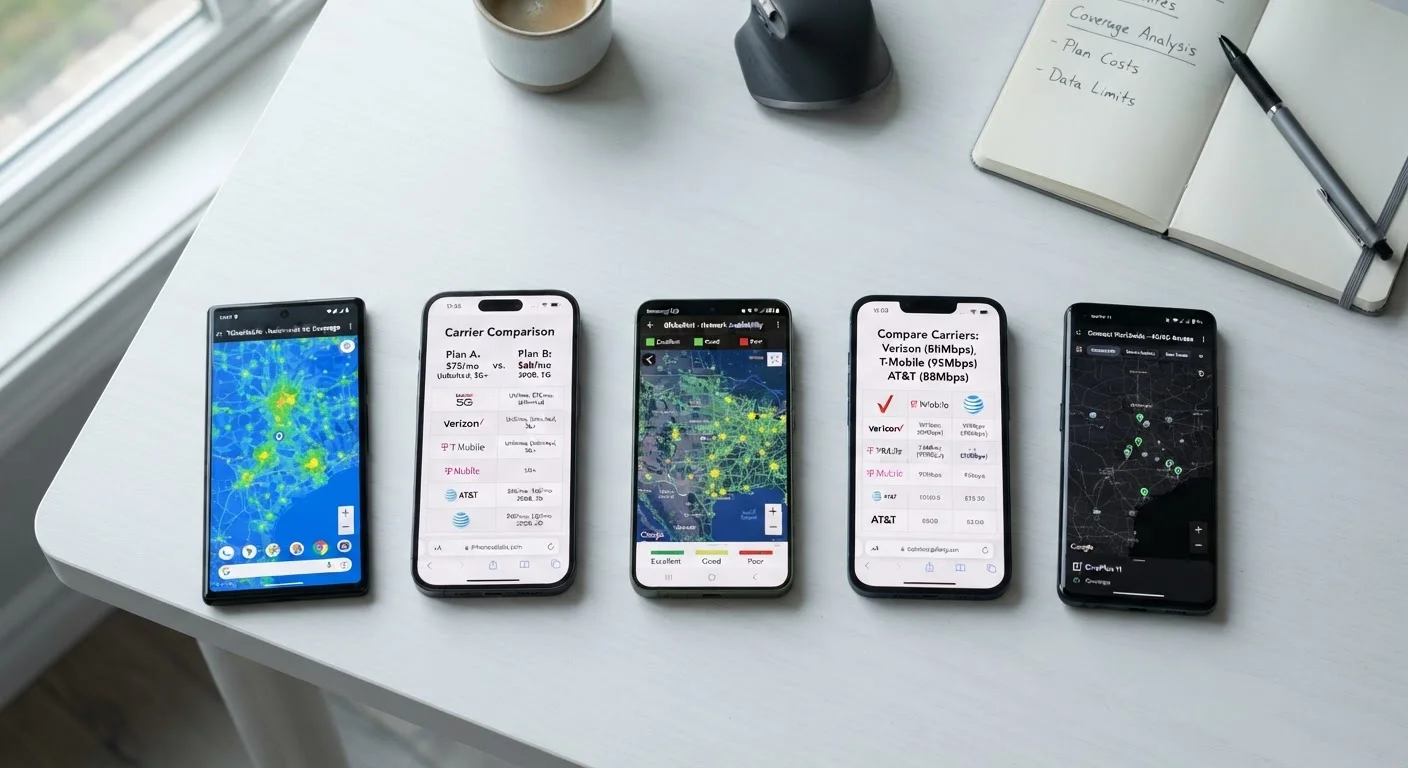
Photo credit: Telecom360.net | Connecting You To The Latest In Telecom
In this article
A comprehensive, end-to-end guide to evaluating US carriers—covering coverage, pricing structure, perks, MVNOs, and how to match a plan to your needs.
Key Takeaways
- Coverage quality varies significantly by geography - always verify with independent tools before committing.
- Advertised prices rarely reflect what you'll pay after taxes, fees, and autopay requirements.
- MVNOs use the same networks as major carriers but deprioritize data during congestion.
- Bundled perks have real value only if they replace services you already pay for.
- Matching a plan to your usage profile matters more than choosing the carrier with the most features.
Why Carrier Comparisons Require a Framework
Comparing US phone plans without a structured approach is a reliable way to make a poor decision. Carriers design their marketing to emphasize strengths and obscure trade-offs - coverage claims use inconsistent methodology, pricing tiers bundle services you may not need, and promotional language frequently changes. A repeatable evaluation framework strips away that noise.
This guide walks through each dimension of a carrier comparison in a logical sequence: coverage first, then pricing mechanics, then the major carrier versus MVNO trade-off, then perks, and finally how to match everything to your actual usage. Before diving into specifics, familiarize yourself with the terminology carriers use - terms like priority data, deprioritization, and hotspot allotment carry precise meanings that affect day-to-day experience. The plain-language glossary of US carrier plan terminology is a useful reference to keep open alongside this guide.
~97%
US population covered by each major carrier
All three major carriers claim near-universal population coverage, though rural geographic coverage - measured in land area - differs significantly.
10-25%
Typical tax and fee addition to phone bills
Federal, state, and local surcharges routinely increase the advertised plan price by this range depending on location.
40%+
US wireless subscribers on MVNOs or sub-brands
Industry estimates suggest a substantial share of US consumers use MVNOs or carrier sub-brands rather than flagship postpaid plans.
Coverage: The Non-Negotiable Foundation
No pricing advantage compensates for a network that drops calls at your home or office. The three major US carriers - Verizon, AT&T, and T-Mobile - each operate their own nationwide infrastructure, but their coverage profiles differ meaningfully by geography. Verizon has historically led in rural breadth; T-Mobile has invested heavily in mid-band 5G density in urban and suburban areas; AT&T occupies a middle position with strong FirstNet infrastructure in certain regions.
Coverage maps published by carriers are self-reported and optimistic by design. Independent verification matters. Speed test aggregators, crowd-sourced signal databases, and carrier trial periods all provide ground truth that maps cannot. For a step-by-step verification process, see what to check before choosing a plan based on coverage claims.
Run speed tests at your specific home address and commute route using a carrier's trial SIM before committing. Coverage maps will not reveal dead zones in your daily path.
Carrier maps aggregate signal predictions over large areas and frequently overstate usable coverage at the street level. Real-world testing during a trial period is the only reliable verification method.
When evaluating MVNO deprioritization risk, ask the MVNO which specific major carrier network it uses - and then check that carrier's network congestion profile in your primary usage area.
Deprioritization impact is highly location-dependent. Urban cores with dense user concentrations experience congestion most acutely, while suburban and rural users on MVNOs often see minimal performance difference.
For frequent international travelers, coverage evaluation extends beyond US borders. The guide to carrier international travel coverage breaks down how each major carrier handles roaming and data speeds abroad.
Pricing Structure: What You're Actually Paying
Carrier pricing has several layers that the headline number conceals. Understanding each layer is essential for an honest comparison.
- Autopay and paperless billing discounts: Most carriers require both to access the advertised per-line rate, typically reducing the price by $5-$10 per line. The discount disappears if payment fails.
- Taxes and regulatory fees: Federal, state, and local charges routinely add 10-25% on top of plan costs depending on location.
- Device financing: Monthly installment plans are separate from service costs but often appear in bundled promotional pricing, obscuring the true plan rate.
- Tier structure: Most carriers offer three or more plan tiers. The entry tier typically caps hotspot data, limits video streaming resolution, and excludes perks. Middle and premium tiers unlock priority data thresholds and streaming bundles.
Calculate Your True Monthly Cost
Before accepting any advertised price, add estimated taxes and fees for your state, subtract any discounts that require autopay or paperless billing, and separate device financing from service costs. The resulting number is your actual monthly obligation - and it often differs substantially from the headline rate.
For a structured look at how unlimited, prepaid, family, and business plan categories differ in billing and data rules, see phone plan types compared side by side.
Major Carriers vs. MVNOs: Trade-offs at a Glance
Mobile Virtual Network Operators (MVNOs) lease capacity from the major carriers' physical networks rather than operating their own towers. This means an MVNO on T-Mobile's network covers the same geography as T-Mobile itself - but with one important caveat: MVNOs are contractually deprioritized during network congestion. In practice, this affects dense urban areas during peak hours more than rural or off-peak usage.
| Dimension | Major Carriers | MVNOs |
|---|---|---|
| Network ownership | Own infrastructure | Lease from majors |
| Priority during congestion | Higher | Lower |
| Monthly cost (typical) | Higher | Lower |
| International roaming | Broader options | Limited or add-on |
| Device compatibility | Wide, including new releases | Varies; bring-your-own common |
| Customer support | Retail stores nationwide | Primarily online/phone |
MVNOs are a strong fit for users with predictable, moderate data consumption in non-congested areas. Heavy streamers, frequent travelers, or anyone relying on consistent hotspot speeds should weigh deprioritization risk carefully.
Deprioritization Is Not the Same as a Data Cap
MVNOs and lower-tier major carrier plans subject data to deprioritization during congestion - meaning speeds are reduced when the network is busy, not blocked entirely. This is distinct from a hard data cap. Users in high-density areas during peak hours are most likely to notice the difference. Understanding this distinction prevents a common source of post-purchase dissatisfaction.
Perks, Add-Ons, and What They're Actually Worth
Premium carrier tiers commonly include streaming service subscriptions, cloud storage, travel data passes, and device protection plans. These bundles are worth evaluating against two questions: Do you already pay for this service independently? And would you choose it if it weren't included?
Streaming subscriptions bundled into plans have standalone retail prices - if you actively use them, the offset can be meaningful. Device protection plans, however, often overlap with existing coverage from credit card purchase protection or homeowner/renter insurance. Add-ons like international day passes vary significantly in value depending on travel frequency.
“The value of a bundled perk is zero if it duplicates something you already pay for and don't plan to cancel. Evaluate each add-on as if it were a standalone line item on your monthly budget.”
— Phone Plans Editorial Team, Mobile carrier analysis, editorial research team
Business users should apply additional scrutiny. Enterprise and business plan perks - including mobile device management integration, pooled data, and priority support - are evaluated in depth in the complete guide to enterprise mobile plans. The business phone plans hub also provides broader context for team deployments.
Matching a Plan to Your Real-World Needs
The final step is mapping your verified usage profile against what each plan tier actually delivers. Consider four variables:
- Monthly data consumption: Review three months of usage history. Many users overestimate and pay for tiers they don't need.
- Geographic coverage requirements: Identify the specific locations where reliable service is essential - home, office, frequent travel corridors - and test each carrier against those locations, not national averages.
- Device strategy: Bring-your-own-device plans reduce cost but require confirming compatibility with the target carrier's band frequencies. Financing a new device through a carrier locks you in for 24-36 months.
- Flexibility needs: Prepaid and month-to-month plans carry no early termination penalties. Postpaid plans with device financing create financial ties that complicate switching.
The coverage and network hub provides additional resources on 5G, LTE, and rural coverage differences that inform this matching process.
FCC Broadband Map
The Federal Communications Commission's publicly available coverage tool provides an independent reference point for comparing carrier coverage claims against government-collected data.
Ookla Speedtest
Crowd-sourced speed test data aggregated by carrier and geography helps estimate real-world performance beyond what coverage maps show.
Phone Plan Types Side by Side
A structured comparison of unlimited, prepaid, family, and business plan categories covering the billing and data dimensions that affect daily use.
US Carrier Plan Terminology Reference
A plain-language glossary explaining autopay discounts, hotspot allotments, priority data caps, and other terms that appear across every carrier plan.
This article is for informational purposes only. Carrier pricing, plan availability, and network performance specifications change frequently. Verify current details directly with carriers before making any commitment.

Author
Phone Plans Editorial Team
Phone Plans Editorial Team is the collective byline for our editorial team and contributor network. Articles published under this byline or an editorial pen name are researched, written, and reviewed according to our editorial standards for clarity, consistency, and independence before publication.
View all articles →