
5G, LTE, and 3G: What Each Generation of Mobile Network Actually Means
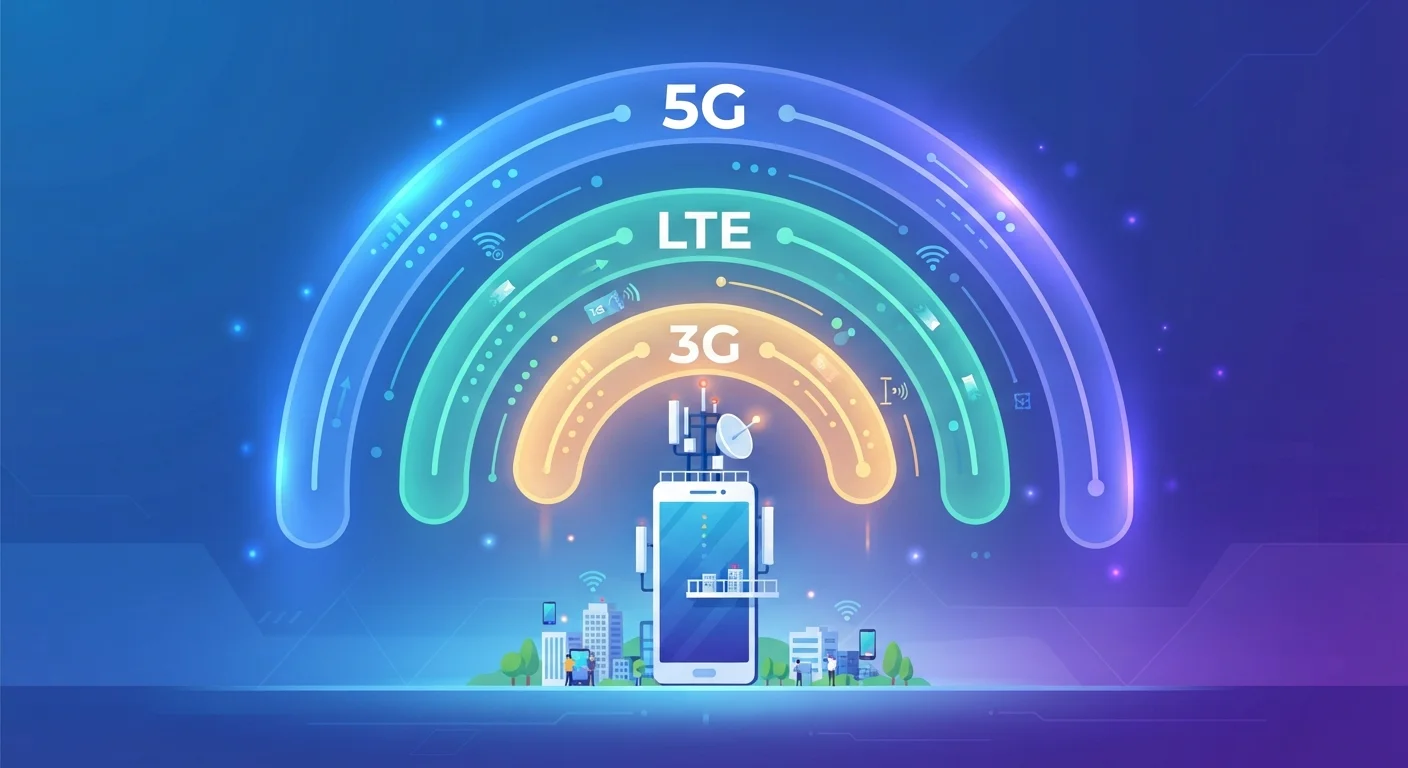
Photo credit: Telecom360.net | Connecting You To The Latest In Telecom
In this article
Cut through the jargon: a plain-language breakdown of what 5G, LTE, and older network standards mean for your daily mobile experience.
Key Takeaways
- 3G is largely being phased out in the US, with most major carriers having already shut down their 3G networks.
- LTE (4G) remains the baseline standard for reliable mobile data across most of the country.
- 5G is not a single experience - low-band, mid-band, and millimeter-wave 5G differ dramatically in speed and range.
- Your phone's supported bands, not just the network label, determine what speeds you actually receive.
- Coverage maps show which generation is available, but terrain, buildings, and network congestion affect real-world performance.
The Basics: What a Network Generation Actually Defines
When carriers advertise 5G or LTE, they are referencing technical standards ratified by international bodies - primarily the ITU and the 3GPP. Each generation defines minimum requirements for speed, latency, and how efficiently a network handles many simultaneous users.
Think of it less like a hardware upgrade and more like a protocol change. The same physical towers can be retooled to broadcast newer standards, which is why carriers can "upgrade" coverage areas without rebuilding infrastructure from scratch. What changes is the radio access technology and the frequency bands in use.
For a broader reference on how these terms appear in phone plans, see the phone plan glossary covering data caps, throttling, and more.
~99%
US population with LTE coverage
According to FCC coverage data, LTE reaches virtually all of the US populated area, making it the de facto baseline for mobile connectivity.
10-50 Mbps
Typical LTE download speed range
Median real-world LTE speeds reported by network testing firms like Ookla and OpenSignal typically fall in this range under normal load conditions.
3
Major US carriers that shut down 3G networks
Verizon, AT&T, and T-Mobile all completed 3G network shutdowns between early and mid-2022, ending service for devices that lacked LTE or 5G support.
3G: The Foundation That Is Now Mostly Gone
Third-generation networks, introduced commercially in the early 2000s, were the first mobile standard capable of delivering usable mobile internet. Typical 3G download speeds ranged from 1 to 8 Mbps - adequate for email and simple web pages, but increasingly inadequate for video streaming or large app downloads.
In the US, all three major national carriers - Verizon, AT&T, and T-Mobile - completed their 3G network shutdowns between early 2022 and mid-2022. Devices that cannot connect to LTE or 5G are now effectively offline on those networks. If you own an older device and notice it has lost service entirely, 3G sunset is likely the cause.
The spectrum previously used for 3G has largely been refarmed to support LTE and 5G deployments, which is part of why newer network coverage has expanded in areas that previously had only 3G.
LTE: The Reliable Baseline Most Users Experience
LTE, the dominant form of 4G, launched in the US around 2010 and now covers a large majority of the populated country. Typical real-world download speeds on LTE range from roughly 10 Mbps to 50 Mbps, though congestion and signal strength influence this considerably. That range supports HD video streaming, video calls, and most cloud-based applications without noticeable friction.
LTE-Advanced and LTE-Advanced Pro - later refinements - introduced carrier aggregation, which bonds multiple frequency bands together to increase throughput. This is why two phones both showing "LTE" can experience meaningfully different speeds depending on which bands they support and which the local tower is broadcasting.
Understanding which frequency bands your device supports is more informative than the network label alone. The band frequencies reference guide breaks down what each range covers and how it performs indoors versus outdoors.
5G: Three Very Different Experiences Under One Label
5G is not a monolithic technology - it encompasses three distinct spectrum tiers that behave quite differently in practice.
- Low-band 5G (below 1 GHz, often 600-850 MHz): Covers large geographic areas including rural regions. Speeds are only modestly faster than LTE - often 30-100 Mbps - but range and building penetration are strong.
- Mid-band 5G (1-6 GHz, including the 2.5 GHz and C-band around 3.7-3.98 GHz): The sweet spot for capacity and speed. Delivers 100-400 Mbps in many real-world deployments and is rapidly expanding in suburban and urban areas.
- Millimeter-wave 5G (above 24 GHz): Capable of multi-gigabit speeds but with very short range and poor obstacle penetration. Currently limited to dense urban venues like stadiums, airports, and city blocks.
When a carrier's coverage map shows 5G, it does not specify which tier. Checking whether a carrier has deployed mid-band in your area gives a more accurate picture of the speeds you can realistically expect. For a deeper look at common misconceptions, see common myths about 5G coverage, speed, and safety.
“The biggest misconception about 5G is that it's a single thing. In reality, low-band, mid-band, and millimeter-wave 5G are so different in performance that they might as well be labeled separately for consumers.”
— Network industry analyst perspective, Composite view reflected across multiple independent network research organizations
What This Means for Your Everyday Mobile Experience
For most people in the US today, LTE remains the workhorse of daily connectivity. Video calls, navigation, music streaming, and app use all run without issue on a stable LTE connection. The practical difference between LTE and low-band 5G is minimal for typical consumer tasks.
Mid-band 5G, where deployed, begins to offer tangible benefits: faster large-file downloads, smoother performance in crowded venues, and reduced latency for real-time applications. If your carrier has mid-band coverage in the areas you frequent and your device supports those bands, you will notice a real improvement.
When evaluating a phone or a plan, look beyond the generation label. Check which specific bands the device supports and compare those against your carrier's frequency deployments in your area. The smartphone specs decoder explains how to read hardware spec sheets, including modem and band support. For a side-by-side look at how cellular and local wireless standards compare, see 5G, LTE, and Wi-Fi 6 compared.
Check Band Support Before Choosing a Plan
Before committing to a carrier, compare the frequency bands that carrier uses in your most-visited locations against the bands your device's modem supports. A phone that doesn't support mid-band 5G will fall back to LTE or low-band 5G even in areas with strong mid-band deployment. Your carrier's coverage map and your device's spec sheet together tell the real story.
Frequently Asked Questions

Author
Phone Plans Editorial Team
Phone Plans Editorial Team is the collective byline for our editorial team and contributor network. Articles published under this byline or an editorial pen name are researched, written, and reviewed according to our editorial standards for clarity, consistency, and independence before publication.
View all articles →