
Smartphone Specs Decoded: What the Numbers on the Box Actually Mean
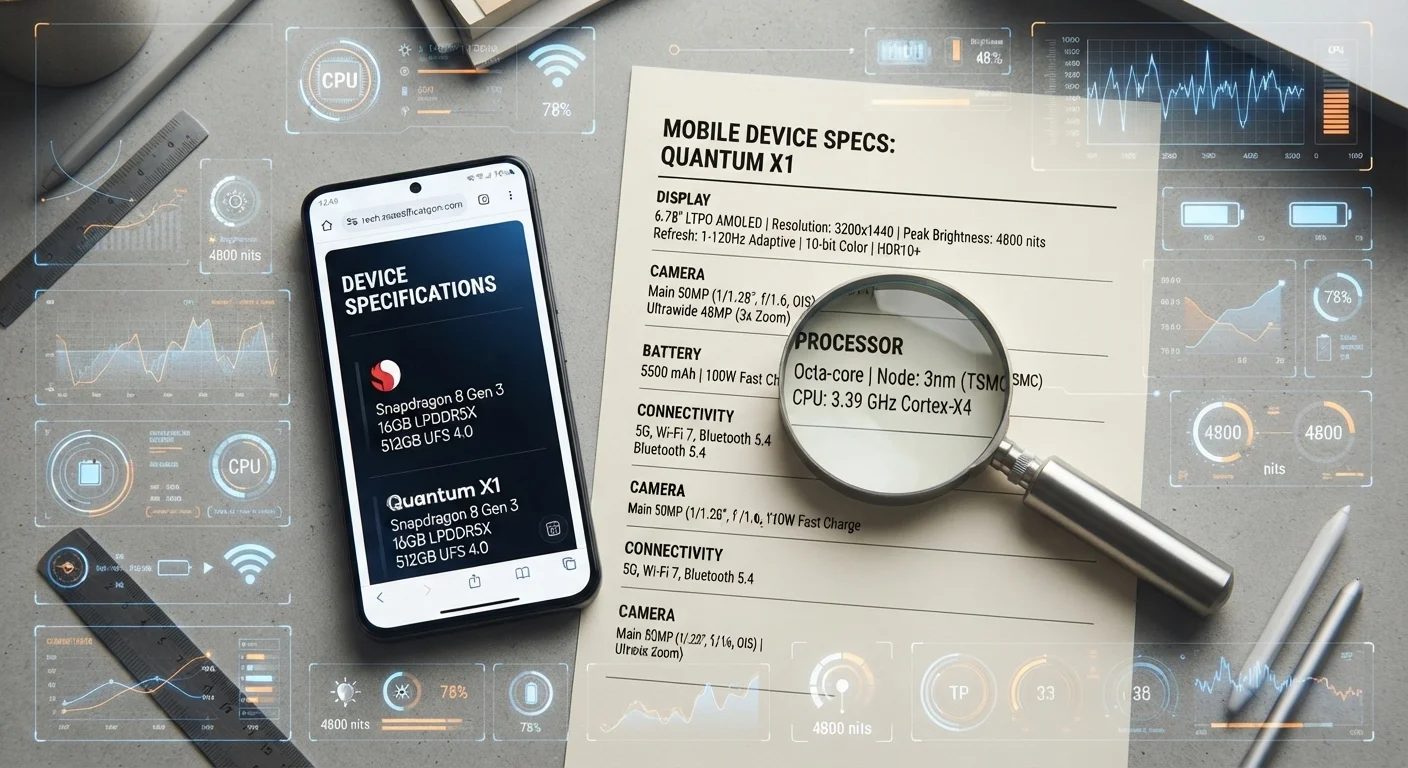
Photo credit: Telecom360.net | Connecting You To The Latest In Telecom
In this article
GHz, nits, nm — spec sheets are full of jargon. Here's what each figure actually tells you about real-world phone performance.
Key Takeaways
- Clock speed (GHz) alone doesn't determine processor performance - core count and process node (nm) matter equally.
- Display brightness (nits) and refresh rate affect real-world usability more than raw resolution in many cases.
- RAM governs multitasking; storage capacity determines how much you can keep on the device.
- Megapixel count is only one camera variable - sensor size and aperture often have greater impact on photo quality.
- Battery capacity (mAh) interacts with software optimization, so identical numbers can yield very different real-world life.
- Connectivity specs like supported bands and Wi-Fi generation directly affect your day-to-day network experience.
Processor Specs: GHz, Cores, and Nanometers
The chipset is the most consequential spec on any smartphone, yet its figures are also the most misread. Three numbers dominate: clock speed in GHz, core count, and the manufacturing process node in nm.
Clock speed (GHz) tells you how many instruction cycles the processor executes per second. A core running at 3.2 GHz completes more cycles per second than one at 2.0 GHz - but only if the architecture is equivalent. Comparing GHz across different chip families is unreliable because each architecture completes a different amount of useful work per cycle.
Core count matters for parallel workloads. Modern mobile chips use a cluster design - a set of high-performance cores for demanding tasks and a set of efficiency cores for background work. The headline core count rarely tells you how those clusters are balanced.
Process node (nm) describes the size of transistors on the chip. Smaller nodes (e.g., 4 nm vs. 7 nm) typically pack more transistors into the same die area, improving performance-per-watt and reducing heat. This translates directly to sustained performance and battery endurance under load.
GHz (Gigahertz)
A measure of processor clock speed - specifically, how many billion cycles per second a CPU core completes. Higher is not always faster when comparing across different chip architectures.
Process Node (nm)
The size of the transistors inside a chip, measured in nanometers. Smaller nodes generally allow more transistors per chip area, improving efficiency and reducing heat generation.
Nits
A unit of display brightness equal to one candela per square meter. More nits means a brighter screen, which improves visibility in sunlight.
Refresh Rate (Hz)
How many times per second a display redraws its image. Higher refresh rates produce smoother scrolling and animations but can increase battery consumption.
RAM (Random-Access Memory)
Temporary working memory that holds active apps and system processes. More RAM allows more apps to stay loaded simultaneously without needing to reload.
Aperture (f-stop)
A measure of how wide a camera lens opens to admit light. Lower f-numbers (e.g., f/1.8) indicate a wider opening and better low-light capability.
mAh (Milliampere-Hours)
A unit of electrical charge capacity used to rate batteries. A higher mAh value means more stored energy, though real-world battery life also depends on how efficiently the device uses that energy.
UFS (Universal Flash Storage)
A standard for internal smartphone storage that defines read/write speed performance. Newer UFS versions (3.1, 4.0) transfer data faster than older generations.
For a structured walkthrough of how these chip specs interact with network modems, see our spec sheet evaluation guide.
Display Specs: Resolution, Refresh Rate, and Nits
Display specs combine three largely independent variables that affect different aspects of your visual experience.
Resolution (e.g., 1080 × 2400) describes the total pixel count. At typical smartphone viewing distances, resolution differences between 1080p and 1440p are difficult to perceive without deliberate scrutiny. What resolution doesn't describe is the quality of the panel, color accuracy, or contrast ratio.
Refresh rate (measured in Hz) determines how many times per second the display redraws its image. A 120 Hz panel refreshes twice as often as a 60 Hz panel, producing smoother scrolling and animations. Many phones use variable refresh rates - scaling down automatically when displaying static content to conserve battery.
Brightness (nits) is one of the more practical outdoor usability indicators. Typical indoor use is comfortable around 400-600 nits. Direct sunlight typically requires 800 nits or above. Peak HDR brightness, often listed separately, applies only during compatible media playback and is not sustained across the full display.
Prioritize Brightness for Outdoor Use
When evaluating display specs for outdoor or travel use, focus on peak sustained brightness rather than maximum HDR brightness. Maximum HDR figures apply only during specific media playback scenarios and are not representative of everyday sunlight legibility. Look for a sustained brightness rating of 800 nits or above as a practical benchmark.
Memory and Storage: RAM vs. Internal Storage
These two figures are frequently conflated, but they serve entirely different functions.
RAM (random-access memory) is temporary working memory. The OS uses it to hold active apps and system processes. More RAM allows more apps to remain loaded simultaneously - reducing reload times when switching between them. However, how the operating system manages memory allocation is just as important as the raw capacity figure.
Internal storage (measured in GB or TB) is where your apps, photos, videos, and files are permanently saved. Storage type matters as much as quantity: UFS 3.1 and UFS 4.0 standards offer meaningfully faster read/write speeds than older UFS 2.x, affecting how quickly large files transfer and how fast apps install or load.
Check whether a device supports expandable storage via microSD if on-device capacity is a concern - many current flagship devices have removed that option.
Camera Numbers: Megapixels and What Else Matters
Camera spec sheets warrant particular skepticism. Megapixel count dominates marketing materials, but sensor physics and optics often matter more for image quality.
Megapixels measure the resolution of the captured image. Higher counts enable larger prints and more aggressive crops, but they say nothing about per-pixel quality, dynamic range, or low-light capability.
Sensor size - usually expressed as a fraction (e.g., 1/1.56") - is a more meaningful indicator of light-gathering ability. Larger sensors capture more light per pixel, which generally improves low-light performance and reduces noise.
Aperture (f-stop) describes the width of the lens opening. A lower f-number (e.g., f/1.8 vs. f/2.4) allows more light to reach the sensor - particularly beneficial in dim conditions. Aperture also influences depth-of-field characteristics in portrait photography.
For a deeper breakdown of camera-specific terminology, the camera spec sheet guide covers f-stop, PDAF, OIS, and more. Manufacturers also have well-documented ways of framing camera specs to obscure meaningful comparisons - the spec sheet traps article identifies the most common patterns.
Battery and Connectivity Specs Explained
Battery capacity is listed in mAh. A larger number means more stored energy - but actual battery life is a product of capacity multiplied by efficiency. A 5,000 mAh battery in a phone with a power-hungry 120 Hz display and a less efficient chip may deliver shorter real-world life than a 4,500 mAh battery in a more optimized device.
Charging speed is expressed in watts (W). Higher wattage chargers refill a battery faster, but only when paired with a compatible cable and power adapter. Note that peak wattage figures typically apply only during a portion of the charging cycle - actual charge curves vary by manufacturer.
Connectivity specs include Wi-Fi generation (e.g., Wi-Fi 6E, Wi-Fi 7), Bluetooth version, and supported cellular bands. These matter more than they appear to at a glance. Wi-Fi generation affects throughput and congestion performance on crowded networks. Supported cellular bands determine which frequency layers your device can access on a given carrier's network - a spec with real geographic and indoor-coverage implications. Our band frequencies reference guide explains how each range behaves in practice, and for a broader overview of what network generation labels actually mean, see the 5G, LTE, and 3G explainer.
Peak Specs Don't Always Reflect Sustained Performance
Many spec sheet figures - peak charging wattage, maximum display brightness, peak clock speeds - represent short-duration capabilities rather than sustained operation. Thermal throttling, battery protection algorithms, and software limits can reduce performance below peak values during extended use. Where possible, look for independent testing data that measures sustained, real-world behavior rather than relying solely on manufacturer-listed maximums.
For a comprehensive look at the smartphones and tablets ecosystem, including how these hardware specs translate across device categories, our hub covers the full landscape.
Frequently Asked Questions

Author
Smartphones Editorial Team
Smartphones Editorial Team is the collective byline for our editorial team and contributor network. Articles published under this byline or an editorial pen name are researched, written, and reviewed according to our editorial standards for clarity, consistency, and independence before publication.
View all articles →