
Band Frequencies and Network Performance: A Reference Guide for Mobile Users
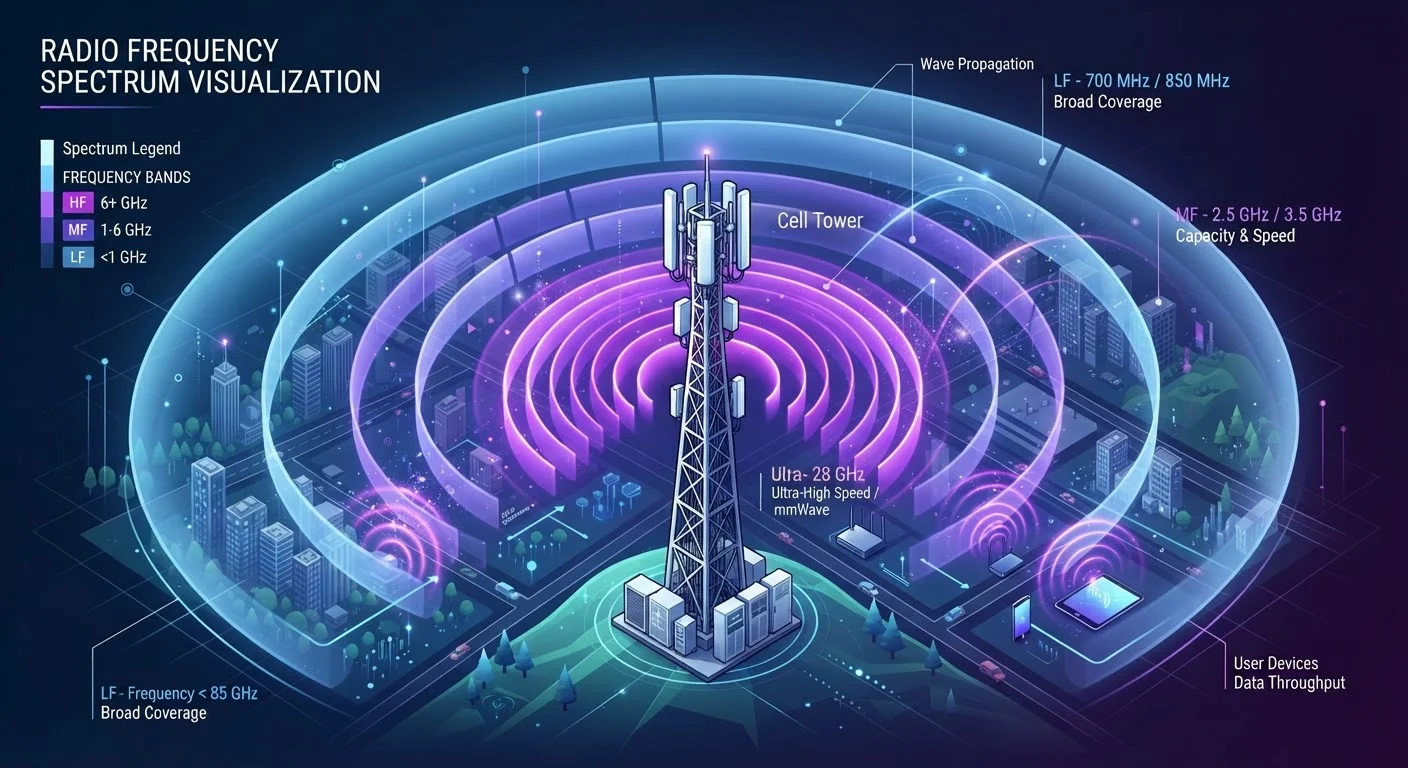
Photo credit: Telecom360.net | Connecting You To The Latest In Telecom
In this article
A lookup guide to mobile frequency bands — what each range covers, how it performs indoors and outdoors, and why your device's supported bands matter.
What Frequency Bands Actually Are
Every mobile call, text, and data transfer travels over radio waves - and the frequency at which those waves oscillate determines how far they travel and how much data they can carry. Carriers divide the radio spectrum into licensed frequency bands, each identified by a band number (e.g., Band 12, Band 66, n77) and measured in megahertz (MHz) or gigahertz (GHz).
Understanding bands matters for two reasons. First, your device must support the specific bands a carrier uses in your area - if it doesn't, you'll see degraded service or no signal at all. Second, different bands behave very differently indoors, in rural areas, and in dense urban environments. For a deeper look at how these bands tie into network generations, see our explainer on 5G, LTE, and 3G.
Frequency Band
A defined range of radio frequencies licensed to carriers for transmitting mobile signals. Each band has a number designation and specific propagation characteristics that affect coverage distance and data capacity.
Low-Band
Frequencies below 1 GHz (e.g., 600-900 MHz) that travel long distances and penetrate buildings well, but carry less data capacity than higher frequency bands.
Mid-Band
Frequencies between roughly 1 GHz and 6 GHz that offer a balance of coverage range and data throughput. C-band (3.7 GHz) is a prominent mid-band used for 5G.
mmWave
Millimeter wave frequencies above 24 GHz capable of very high data speeds but limited to short ranges and easily blocked by physical obstacles.
Carrier Aggregation (CA)
A technology that combines multiple frequency bands simultaneously to increase effective data throughput and connection stability on compatible devices.
Band Compatibility
Whether a specific device's hardware supports the frequency bands operated by a given carrier in a given region. Incompatible bands result in reduced or absent service.
The Three Frequency Ranges and Their Trade-Offs
US carriers operate across three broad frequency ranges, each with distinct performance characteristics:
| Low-band LTE typical download speed | 10-50 Mbps (General industry benchmark range) |
| Mid-band 5G (C-band) typical download speed | 100-400 Mbps (Real-world performance estimates, varies by congestion) |
| mmWave effective range | ~300-500 feet (Approximate; blocked by walls and weather) |
| Low-band frequency range | Below 1 GHz |
| 5G C-band frequency range | 3.7-3.98 GHz (FCC licensed spectrum) |
| mmWave frequency range | 24 GHz and above |
Low-Band (Below 1 GHz)
Bands such as Band 12 (700 MHz), Band 13 (700 MHz), and Band 71 (600 MHz) transmit at long wavelengths, allowing signals to travel tens of miles and penetrate walls, floors, and terrain with relative ease. The trade-off is throughput: low-band LTE typically delivers 10-50 Mbps download speeds, and low-band 5G (sub-1 GHz) offers only a modest improvement over LTE. These bands form the backbone of rural coverage and provide the deepest in-building penetration in suburban areas.
Mid-Band (1-6 GHz)
Bands in this range - including Band 66 (AWS, 1700/2100 MHz), Band 41 (2.5 GHz), and the 5G n77/n78 range (3.7 GHz C-band) - balance reach and capacity. Mid-band 5G on C-band frequencies can achieve 100-400 Mbps in real-world conditions across distances of a few miles. This range is where most urban and suburban 5G deployments are concentrated.
High-Band / mmWave (Above 24 GHz)
Millimeter wave (mmWave) bands such as n260 (39 GHz) can deliver multi-gigabit speeds but propagate only a few hundred feet and are blocked by glass, walls, and even heavy rain. Deployment is limited to dense venues - stadiums, airports, convention centers - where capacity demand is extreme.
Signal bars on your phone don't distinguish between these band types, which is why a full-bar reading on a low-band connection may still feel slow under load.
Why Your Device's Band Support Matters
A phone purchased overseas or unlocked from a different carrier may lack support for key domestic bands. For example, a device missing Band 71 support will lose low-band 5G fallback in rural areas. A phone without C-band (n77) compatibility will never access mid-band 5G regardless of the plan purchased.
To check band support, look up your device's model number against the carrier's device compatibility page, or consult the specification sheet directly. Our article on decoding smartphone specs explains where to find this information on retail listings. Before committing to a plan, the coverage verification guide outlines how to cross-reference your device's band list against a carrier's network map.
Unlocked and International Devices
Phones purchased outside the US or from international carriers may support different band sets than those sold domestically. Even if a device is technically unlocked, missing support for key US bands - such as Band 71 or C-band n77 - can result in significantly degraded performance. Always verify band compatibility against the specific carrier's current frequency deployments before purchasing or porting a device.
MVNO subscribers should pay particular attention: an MVNO running on a host carrier's network still requires the same band support as the host carrier. Compatibility rules don't change based on the reseller.
Carrier Band Assignments at a Glance
Each major US carrier holds licensed spectrum across multiple bands. While exact deployments vary by market, the following patterns are broadly consistent across their networks:
- Low-band LTE anchor bands: Widely deployed nationwide, providing baseline coverage everywhere a carrier has a presence.
- Mid-band LTE (AWS/PCS): Common in suburban and urban markets for capacity relief; often aggregated with low-band via carrier aggregation (CA).
- Mid-band 5G (C-band, 2.5 GHz): The primary driver of 5G performance improvements in populated areas.
- mmWave 5G: Highly localized; typically found in select indoor venues and dense downtown corridors.
Carrier aggregation (CA) allows a device to combine multiple bands simultaneously, which can substantially increase throughput and stability. Phones with broader CA support generally perform better in variable signal conditions. For a full framework on evaluating carrier networks before selecting a plan, see our carrier comparison guide.
~300 ft
Typical mmWave outdoor range
mmWave signals attenuate rapidly and are easily blocked by building materials, limiting practical deployment to dense venue environments.
10-50×
Speed difference: mmWave vs. low-band
Under ideal conditions, mmWave peak throughput can exceed low-band LTE by a factor of 10 to 50, though real-world conditions rarely approach peak values.

Author
Phone Plans Editorial Team
Phone Plans Editorial Team is the collective byline for our editorial team and contributor network. Articles published under this byline or an editorial pen name are researched, written, and reviewed according to our editorial standards for clarity, consistency, and independence before publication.
View all articles →