
Reading a Smartphone Camera Spec Sheet Without Getting Misled
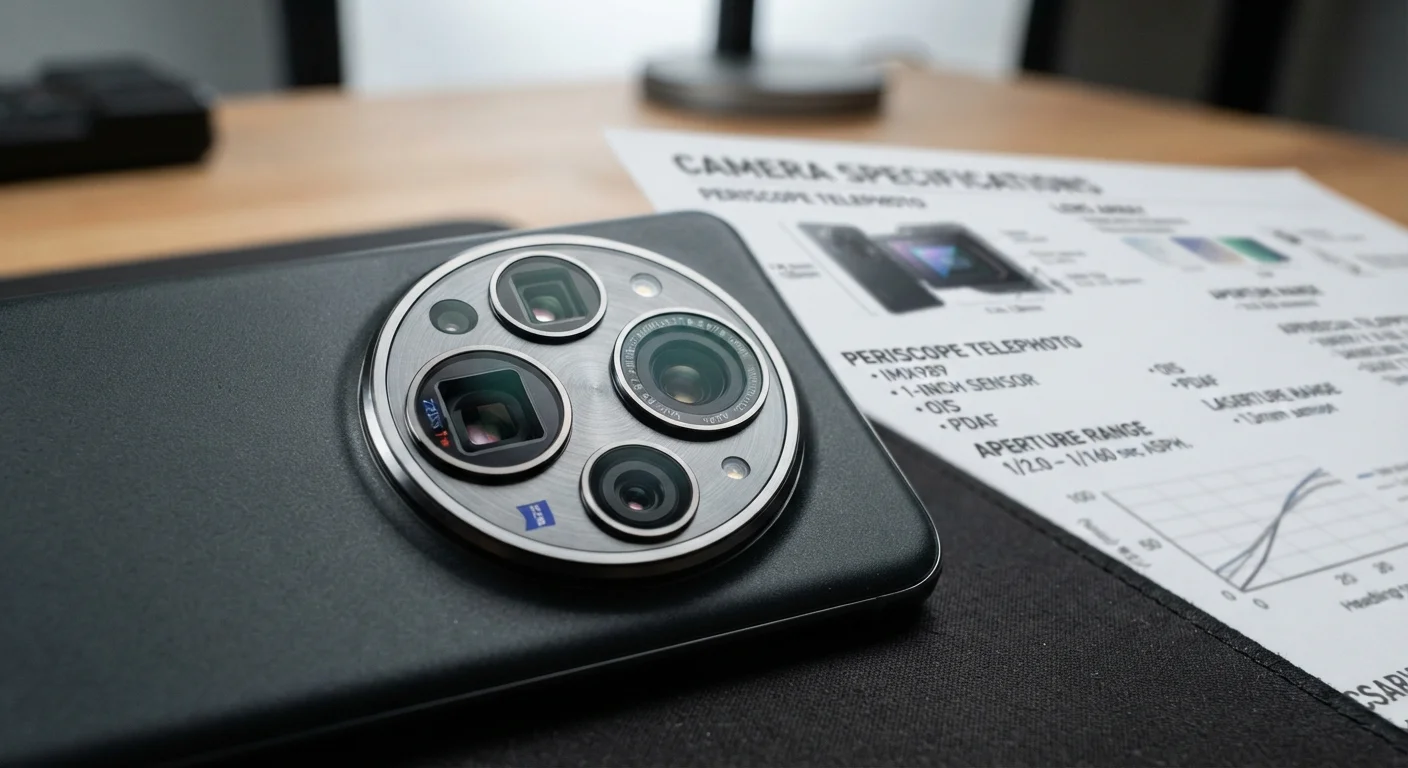
Photo credit: Telecom360.net | Connecting You To The Latest In Telecom
In this article
F-stop, PDAF, EIS, OIS — camera specs are dense with jargon. This reference breaks down the terms you'll actually encounter.
Why Camera Specs Mislead More Than They Inform
Smartphone camera spec sheets are written to impress, not to inform. A manufacturer listing a 200MP sensor or "10x zoom" tells you almost nothing about whether photos will actually look good. Understanding what each figure measures - and what it deliberately omits - is the foundation of any honest camera evaluation.
The specs that headline a camera system (megapixels, optical zoom multiplier, maximum video resolution) are easy to quantify and easy to misrepresent. The specs that genuinely predict image quality - sensor size, pixel pitch, aperture relative to sensor area, autofocus mechanism - are routinely buried or omitted entirely. For a broader look at how manufacturers frame numbers across all spec categories, see how spec sheets obscure key figures.
Aperture (f-number)
A ratio describing how wide the lens opening is relative to focal length. Lower f-numbers (e.g., f/1.6) admit more light, which benefits low-light performance and depth-of-field effects.
Pixel Binning
A technique where adjacent sensor photosites are combined into a single larger effective pixel to improve light sensitivity. A 50MP sensor using 4-in-1 binning outputs approximately 12.5MP images with improved noise characteristics.
PDAF (Phase Detection Autofocus)
An autofocus method using dedicated masked pixel pairs on the sensor to detect the direction and amount of focus error, enabling fast and accurate subject locking.
OIS (Optical Image Stabilisation)
A hardware mechanism that physically shifts lens elements or the sensor to counteract camera shake. It preserves full sensor area and is generally more effective than software-based stabilisation.
EIS (Electronic Image Stabilisation)
A software-based stabilisation method that crops the image frame and shifts it digitally to smooth motion. It reduces effective field of view and can lower resolution.
Sensor Size
The physical dimensions of the image sensor, usually expressed as a fractional inch format (e.g., 1/1.28"). Larger sensors capture more light per unit area, generally improving dynamic range and low-light performance.
Optical Zoom
Magnification achieved by physically adjusting the lens elements, preserving full sensor resolution. Distinct from digital zoom, which crops the captured image and loses detail.
Pixel Pitch
The physical size of an individual photosite on a sensor, typically measured in micrometers (µm). Larger pixel pitch allows each photosite to gather more light, improving signal-to-noise ratio.
The Sensor: What to Actually Read
The image sensor is the single most consequential hardware element in any smartphone camera, yet spec sheets frequently describe it in ways designed to confuse.
| Sensor size notation | Smaller fractions = larger sensor (1/1.28" > 1/2.0") |
| Pixel binning output ratio | 4-in-1 binning: 50MP → ~12.5MP effective |
| Light admitted: f/1.8 vs f/2.5 | f/1.8 captures roughly 2× more light |
| Optical vs digital zoom | Only optical zoom preserves sensor resolution |
| Standard stabilisation types | OIS (hardware), EIS (software), or combined |
Megapixels measure the number of light-capturing photodiodes on the sensor. Higher counts enable larger print sizes and aggressive digital cropping, but beyond a threshold - roughly 12-16MP for typical viewing distances - added pixels shrink individual photosite area, which reduces light-gathering capability and increases noise. Many manufacturers now use pixel binning, combining adjacent pixels to produce lower-resolution output with better low-light performance. A 50MP sensor shooting in binned mode effectively behaves like a 12.5MP sensor with larger photosites. Megapixel counts alone do not predict image quality.
Sensor size is expressed as a fraction (e.g., 1/1.28") - counterintuitively, smaller fractions mean larger sensors. A larger sensor captures more light, produces shallower depth of field, and typically handles dynamic range better. Aperture, expressed as an f-number, controls how much light the lens passes to the sensor; f/1.8 admits roughly twice as much light as f/2.5. Lower f-numbers are preferable in low-light contexts, but aperture must be evaluated alongside sensor size to be meaningful.
Autofocus, Stabilisation, and Zoom: Decoding the Abbreviations
Autofocus and stabilisation abbreviations appear on nearly every camera spec sheet but are rarely explained inline.
PDAF (Phase Detection Autofocus) uses pairs of masked pixels on the sensor to detect focus error direction and magnitude, enabling fast, accurate focus acquisition. CDAF (Contrast Detection Autofocus) is slower but can be more accurate under certain conditions. Many current sensors use hybrid systems combining both. Laser AF assists in very low-light scenes where neither phase nor contrast detection performs reliably.
Stabilisation is listed either as OIS (Optical Image Stabilisation) or EIS (Electronic Image Stabilisation). OIS physically moves lens elements or the sensor to counteract hand movement; EIS crops the image and uses software to compensate. OIS preserves the full sensor area and performs better in low light, while EIS can result in a narrower field of view and reduced resolution. Some devices combine both. For a detailed breakdown of what each system does to your footage, see how OIS and EIS differ in practice.
Optical zoom uses the lens to magnify the subject without degrading resolution. Digital zoom is simply cropping the sensor output - no additional detail is captured. "Hybrid zoom" blends optical and digital methods. Periscope telephoto modules achieve higher optical zoom ratios in a thin chassis by routing the optical path at a 90-degree angle; periscope and standard telephoto lenses differ meaningfully in optical performance.
Video Specs and Computational Photography Labels
Video capability is listed by resolution and frame rate (e.g., 4K/30fps, 1080p/60fps), but the codec used to compress that footage affects quality, file size, and editing compatibility as much as resolution does. H.265 (HEVC) stores more detail at smaller file sizes than H.264 but demands more processing power for playback. Video codec and bitrate choices shape practical quality as much as resolution does.
"AI" and Computational Labels Are Not Standardized
Terms like "AI camera," "scene optimizer," and "computational photography" do not map to measurable, comparable specifications. They describe proprietary software pipelines that vary entirely by manufacturer and device. When evaluating these claims, sample images under controlled conditions are more informative than any label on a spec sheet.
Terms like "AI camera," "computational photography," and "scene optimizer" describe software processing applied after the sensor captures light. These labels are marketing categories, not standardized technical specifications - two phones may use the same terms while producing substantially different results. Understanding how computational processing reshapes every shot helps calibrate those expectations. Similarly, "Night Mode" performance depends on multi-frame stacking algorithms that vary significantly by implementation; for a technical explanation, see how night mode stacking works under the hood.

Author
Smartphones Editorial Team
Smartphones Editorial Team is the collective byline for our editorial team and contributor network. Articles published under this byline or an editorial pen name are researched, written, and reviewed according to our editorial standards for clarity, consistency, and independence before publication.
View all articles →