
Periscope vs Standard Telephoto Lenses in Smartphones
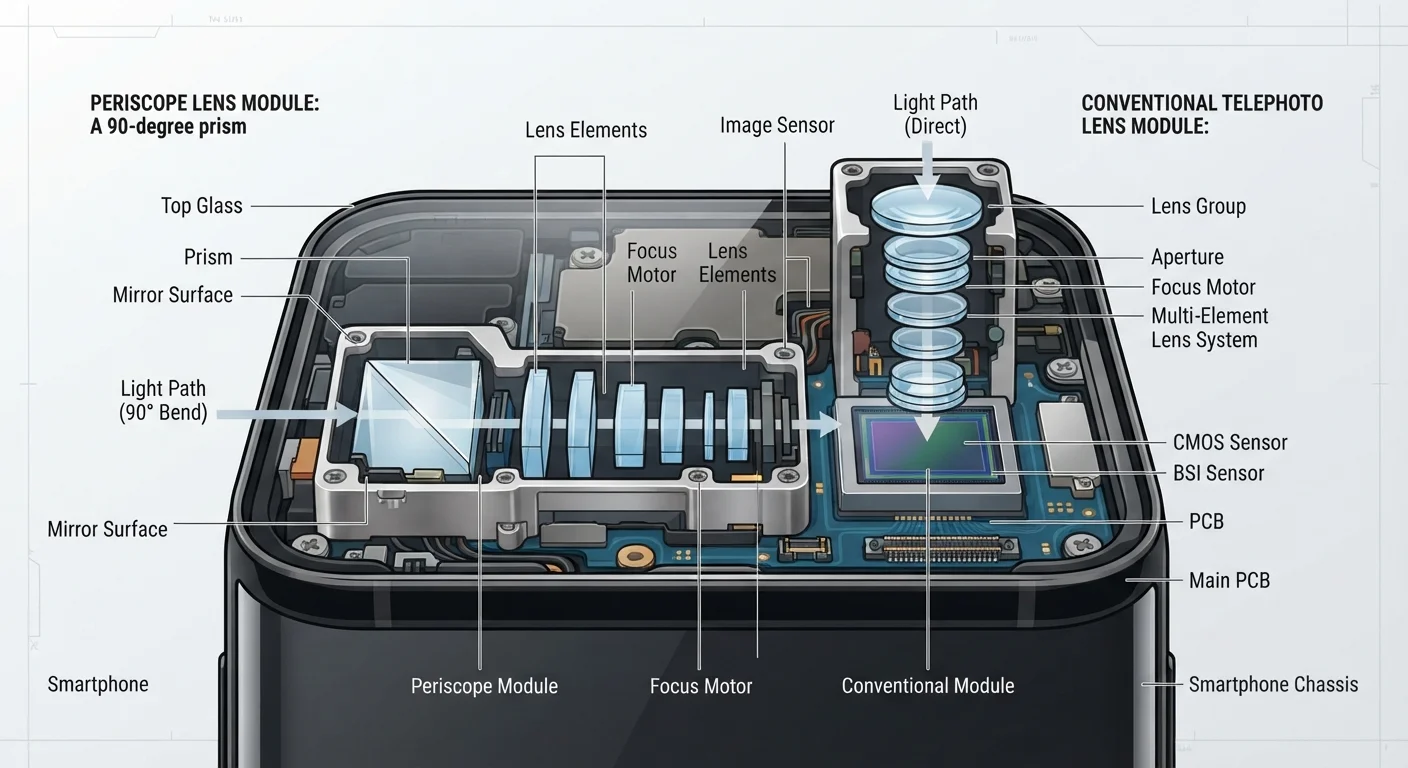
Photo credit: Telecom360.net | Connecting You To The Latest In Telecom
In this article
Periscope lenses achieve higher optical zoom in a slim body. See how they differ from conventional telephoto modules and when it matters.
Key Takeaways
- Periscope lenses use a prism or mirror to fold the optical path horizontally, enabling longer focal lengths in a thin chassis.
- Standard telephoto modules are simpler and less expensive but are physically limited to roughly 3x optical zoom before body thickness becomes a constraint.
- Periscope designs typically deliver 5x to 10x optical zoom; some implementations reach 10x or beyond with sensor-shift zoom tricks.
- Both lens types benefit from optical image stabilization (OIS), but periscope OIS operates on a different axis due to the folded light path.
- Image quality at equivalent zoom levels generally favors periscope systems because they rely more on true optical magnification and less on digital cropping.
How Each Design Works
A standard telephoto lens in a smartphone works much like a miniaturized version of a traditional camera telephoto: the lens elements are stacked vertically behind the aperture, pointing straight out the back of the phone. The depth of the lens assembly is directly proportional to its focal length - longer focal lengths demand longer lens stacks, which push into the phone body and create a thicker chassis or a protruding camera bump.
A periscope telephoto lens solves this constraint by folding the optical path. Light enters through a front aperture, strikes a prism or mirror angled at 45 degrees, and is redirected 90 degrees to travel horizontally through the phone body rather than vertically. The elongated lens assembly that would otherwise stick out the back is now contained within the device's width. This is the same principle that has made submarine periscopes and binoculars compact for over a century, applied to mobile optics.
For a broader grounding in how focal length, aperture, and sensor size interact, see our guide to mobile camera specs.
| Criterion | Periscope Telephoto | Standard Telephoto |
|---|---|---|
| Optical zoom range | Typically 5x-10x | Typically 2x-3x |
| Light path direction | Folded (horizontal via prism) | Straight (vertical stack) |
| Chassis depth impact | Minimal added thickness | Can cause camera bump |
| Typical aperture | f/2.8-f/4.4 | f/1.8-f/2.8 |
| Low-light telephoto performance | Moderate (narrower aperture) | Better at short zoom |
| Manufacturing complexity | Higher | Lower |
| OIS implementation | Prism-shift or sensor-shift | Lens-shift or sensor-shift |
| Relative cost contribution | Higher | Lower |
Zoom Range and Image Quality Implications
The practical consequence of each design is the zoom range it can achieve optically. Standard telephoto modules top out at roughly 2x to 3x optical zoom before the lens stack would need to protrude unacceptably. Periscope systems routinely deliver 5x optical zoom, and some implementations combine periscope optics with sensor-shift positioning to offer continuous optical-quality zoom across a range (commonly called "lossless zoom" in manufacturer literature - though that term warrants scrutiny).
When zoom demand exceeds a lens's optical limit, the camera system falls back on digital zoom: cropping and upscaling the sensor output. The distinction matters because digital zoom degrades sharpness, introduces noise, and loses fine detail. Optical vs digital zoom has a full technical breakdown of why this gap widens as you increase magnification.
5x-10x
Typical periscope optical zoom range
Periscope-equipped flagships commonly advertise between 5x and 10x optical zoom, with some sensor-shift implementations extending lossless zoom beyond that range.
~3x
Maximum practical standard telephoto zoom
Without a folded optics design, lens stack depth constrains conventional telephoto modules to approximately 3x optical zoom in a standard smartphone form factor.
f/4.4
Common periscope aperture (narrow end)
Several commercially available periscope telephoto modules use apertures as narrow as f/4.4, admitting significantly less light than a typical standard telephoto at f/1.8-f/2.8.
Optical image stabilization (OIS) is present in quality implementations of both lens types, but the mechanism differs. In a standard telephoto, OIS typically shifts the lens element or sensor laterally. In a periscope system, the stabilization must account for the folded path - some designs stabilize the prism, others the sensor - and getting this right is non-trivial engineering. Poorly implemented periscope OIS can introduce subtle geometric distortion at high zoom.
Understanding how the sensor behind either lens affects final image quality is equally important. Our smartphone camera sensor explainer covers sensor size, pixel pitch, and what those specs mean for low-light and telephoto performance.
Trade-offs, Spec Sheet Literacy, and What to Look For
Periscope lenses carry real trade-offs. They are mechanically more complex, which raises manufacturing cost and, historically, affected durability in early implementations. The horizontal optical path also means the effective aperture is typically narrower than a standard telephoto - common periscope apertures are around f/2.8 to f/4.4, versus f/1.8 to f/2.8 for standard telephotos. A narrower aperture admits less light, which matters in low-light telephoto shooting even when computational photography partially compensates.
Spec sheets often list zoom ratios and focal lengths without clarifying whether a claimed zoom level is fully optical, partially optical, or digital. Reading a smartphone camera spec sheet explains how to parse these claims accurately so marketing numbers don't substitute for real-world performance data.
In multi-camera systems, the periscope telephoto works alongside wide and ultrawide modules. How those lenses hand off to one another - and how seamless that transition appears when you pinch to zoom - is itself an engineering challenge. Camera array configurations explains how each module in a multi-lens system contributes to the final capture.
"Lossless Zoom" Requires Careful Interpretation
Some manufacturers use the term "lossless zoom" to describe zoom levels where the cropped sensor area still provides enough pixel density to match the camera's output resolution. This is not the same as optical zoom - it is a form of digital crop that avoids obvious degradation at specific zoom increments. The quality advantage over true optical zoom narrows as the scene's light levels drop or fine detail increases. Always check whether a stated zoom level corresponds to a physical focal length change or a sensor crop.
For readers primarily interested in how these specs relate to day-to-day hardware decisions, the Hardware & Specs hub provides additional context across camera and non-camera specifications.

Author
Smartphones Editorial Team
Smartphones Editorial Team is the collective byline for our editorial team and contributor network. Articles published under this byline or an editorial pen name are researched, written, and reviewed according to our editorial standards for clarity, consistency, and independence before publication.
View all articles →