
Camera Array Configurations: What a Triple-Lens Setup Is Actually Doing
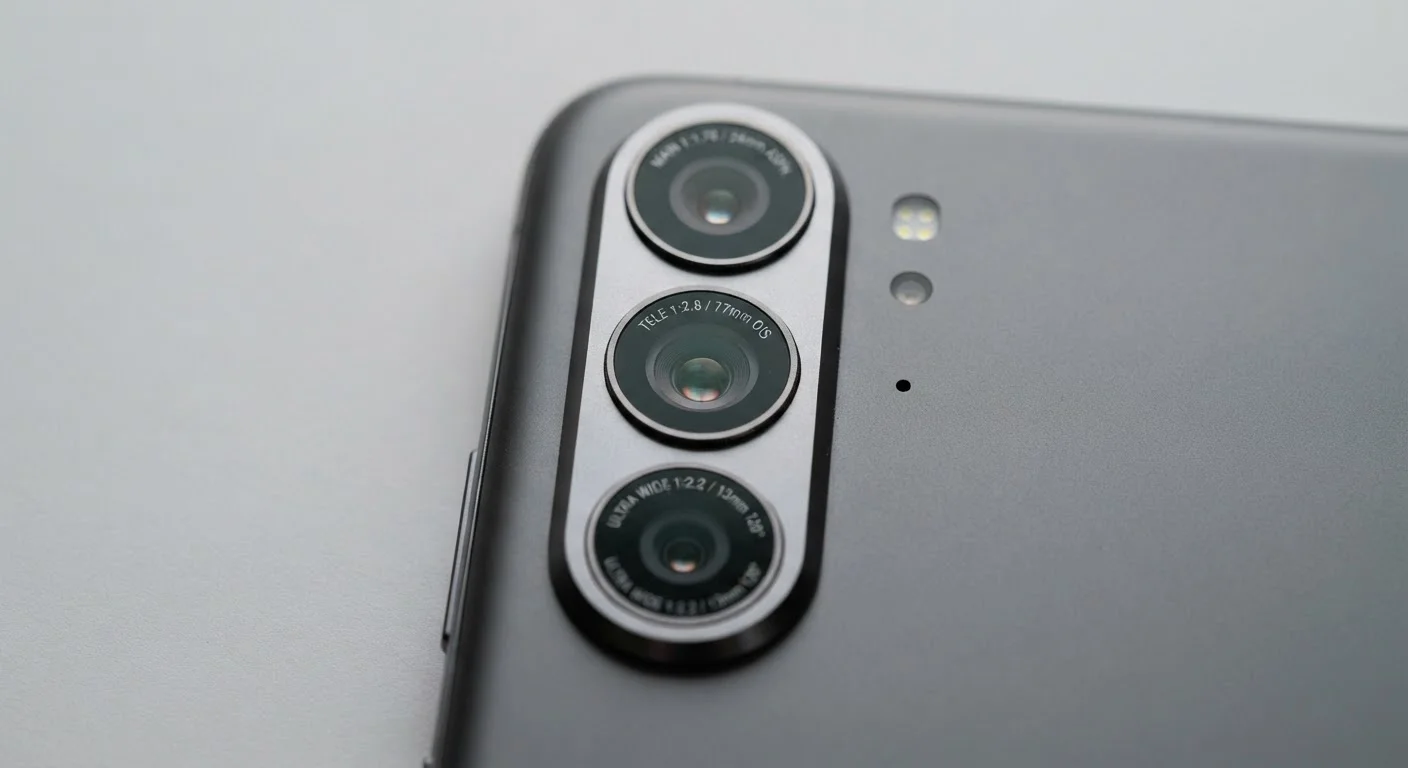
Photo credit: Telecom360.net | Connecting You To The Latest In Telecom
In this article
Wide, ultrawide, telephoto — multi-camera systems work as a team. Learn how each lens contributes to a finished image.
Key Takeaways
- Three lenses cover wide, ultrawide, and telephoto focal lengths independently rather than digitally zooming one sensor.
- The ultrawide lens trades some image quality for dramatically expanded field of view, useful for architecture and tight spaces.
- Telephoto optics use either periscope or traditional prism designs to achieve optical zoom without enlarging the phone.
- Computational photography stitches and blends data from multiple cameras to improve dynamic range, depth, and zoom transitions.
- Sensor size and aperture differ across the three modules, meaning image quality is not uniform at every zoom level.
Why Three Lenses Instead of One
Physics limits how much a single fixed lens can do. A lens optimized for wide-angle landscapes performs poorly at capturing distant subjects, and a telephoto optimized for reach captures a narrow slice of the scene. Digital zoom - simply cropping and enlarging pixels - degrades detail quickly. The multi-camera approach solves this by assigning each task to a physically distinct optic.
A typical triple-lens arrangement pairs:
- Primary (wide) camera - the workhorse, usually carrying the largest sensor and widest aperture for everyday shots
- Ultrawide camera - a shorter focal length lens capturing roughly 110-120 degrees of field of view
- Telephoto camera - a longer focal length providing optical zoom, commonly 2x, 3x, or 5x equivalent
Each module captures light independently. The device's image signal processor then decides which sensor to read from - or in some cases blends data from two simultaneously - depending on your zoom level and scene conditions. See how aperture and sensor size affect each module for more on the underlying optical physics.
~110°
Typical ultrawide field of view
Most smartphone ultrawide cameras capture between 100° and 120° field of view, compared to roughly 75°-80° for a standard primary camera.
5x-10x
Optical zoom range of periscope telephoto
Periscope telephoto designs, which fold the light path internally, allow optical zoom ratios in this range without proportionally increasing device thickness.
f/1.7-f/1.9
Typical primary camera aperture range
The primary wide camera on flagship-class phones commonly carries apertures in this range, giving it a significant light-intake advantage over the ultrawide and telephoto modules.
What Each Lens Is Actually Contributing
Understanding the role of each camera clarifies why switching between them produces visibly different results.
Primary Wide Camera
This is the camera the phone defaults to in most lighting conditions. It typically carries a sensor significantly larger than the other two modules, which translates to better dynamic range and low-light performance. The aperture is usually widest here - often f/1.7 to f/1.9 - admitting more light per unit time. Most portrait processing, night mode stacking, and video stabilization run primarily through this sensor.
Ultrawide Camera
The ultrawide lens compresses perspective and pulls an expansive scene into the frame. Its small sensor and narrow aperture - frequently f/2.2 or smaller - mean it loses ground quickly in dim environments. Barrel distortion (the bowing of straight lines near the frame edges) is an inherent optical property of these short focal lengths; software applies correction profiles automatically. Decoding spec-sheet shorthand for these lenses helps contextualize the field-of-view numbers manufacturers publish.
Telephoto Camera
Telephoto modules come in two broad designs. A conventional telephoto stacks lens elements in a short tube protruding from the phone body. A periscope telephoto folds the optical path 90 degrees with a prism, fitting a much longer effective focal length inside the chassis - enabling 5x, 10x, or higher optical zoom without an impractical camera bump.
Test Each Lens in Consistent Conditions
Before relying on a phone's telephoto or ultrawide for important shots, photograph the same static scene with all three cameras under identical lighting. This side-by-side comparison reveals the actual quality gap between modules - useful context the spec sheet won't provide.
How the System Works as a Team
The cameras don't simply hand off to one another at fixed zoom stops. Modern multi-camera systems use the primary sensor's data as a reference even when the telephoto is active - sharpening edges, correcting color, and managing exposure using information from both. This cross-sensor blending is a form of computational photography: the final image you see is not a raw capture from one lens but a processed composite guided by software.
At intermediate zoom levels - say 2.5x on a phone with 1x and 3x optical cameras - the processor crops the primary sensor, upsamples the telephoto feed, or blends both to minimize the visible quality gap. The transitions are designed to feel seamless, though users comparing crops at 100% will notice resolution differences at these in-between positions.
Depth estimation for portrait-mode background blur is another area where multiple cameras contribute. A telephoto or dedicated depth sensor measures the distance gradient across the scene, while the primary camera provides the high-resolution foreground. The resulting depth map drives selective blur. For a detailed breakdown of the AI techniques layered on top of this hardware, see what computational photography is actually doing.
Zoom Transitions Are Software-Managed
When you drag a zoom slider continuously from 1x to 10x, the phone is not providing a single optical path that extends smoothly across that range. It is switching between discrete hardware cameras and filling in the gaps with digital interpolation. The smoothness of this transition varies by device and is a product of software design as much as optics.
Reading Triple-Lens Specs Without Being Misled
Marketing materials often lead with the telephoto's maximum zoom number or the ultrawide's megapixel count, neither of which reflects overall system quality. A few grounded things to evaluate:
- Primary sensor size - expressed in fractions of an inch (e.g., 1/1.28"). Larger means more light captured, generally better low-light and dynamic range results.
- Telephoto optical zoom ratio - confirmed optical zoom (not "up to" digital zoom). Periscope designs at 5x or above retain more detail at distance than conventional 2x or 3x telephoto modules.
- Ultrawide aperture - a wider aperture (lower f-number) on the ultrawide reduces the quality gap in mixed-light situations.
- Sensor consistency - manufacturers sometimes use identical hardware for two of the three cameras but market them as distinct capabilities. Reading the spec sheet carefully, as covered in this guide to sensor specs, helps identify genuine differentiation.
The best-performing triple-lens systems balance all three modules rather than concentrating investment in one flagship camera and filling out the spec sheet with lower-grade hardware.
Frequently Asked Questions

Author
Smartphones Editorial Team
Smartphones Editorial Team is the collective byline for our editorial team and contributor network. Articles published under this byline or an editorial pen name are researched, written, and reviewed according to our editorial standards for clarity, consistency, and independence before publication.
View all articles →