
Mobile Camera Specs Demystified: Megapixels, Aperture, and Sensor Size
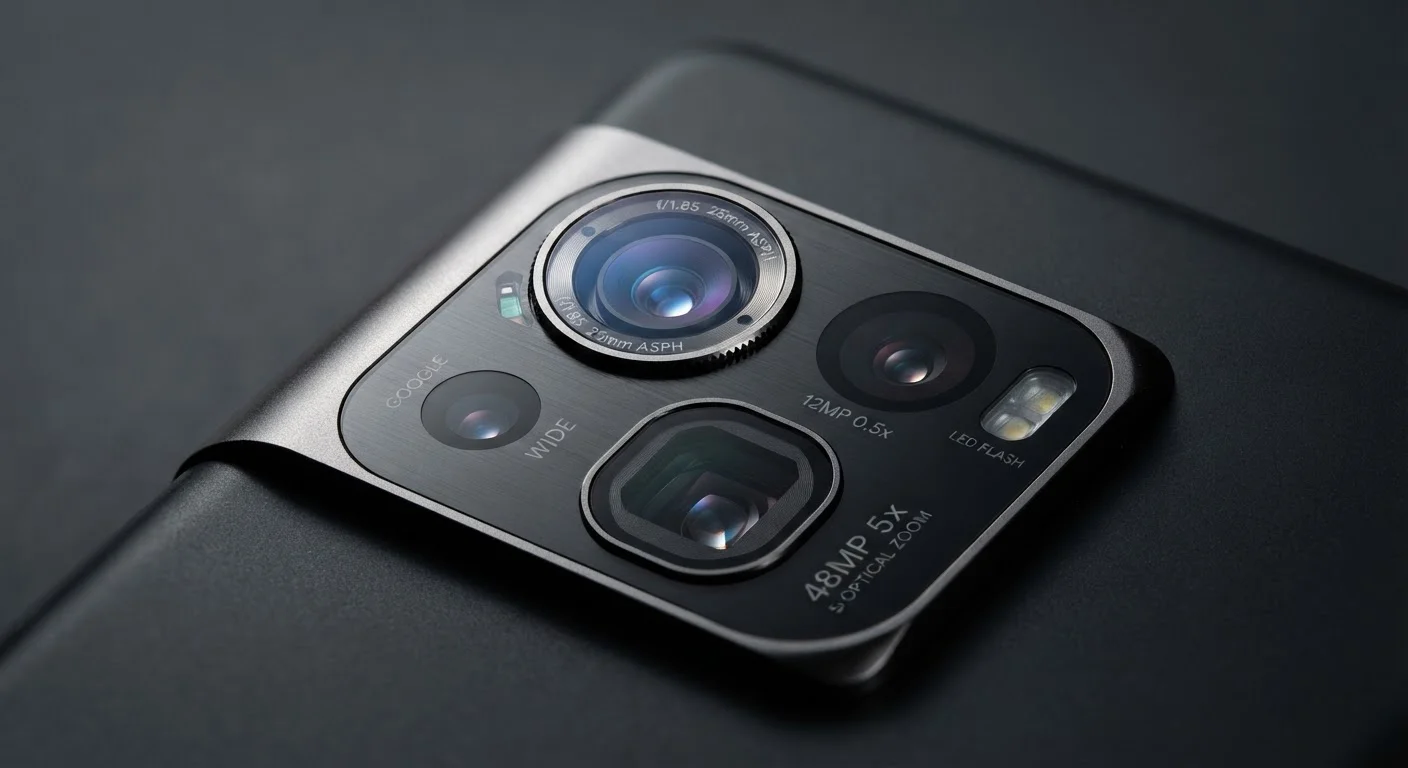
Photo credit: Telecom360.net | Connecting You To The Latest In Telecom
In this article
Why a higher megapixel count doesn't guarantee better photos. This guide explains which camera specs actually drive image quality on smartphones.
Why Megapixels Are a Partial Metric
When comparing smartphone cameras, megapixel count is the figure most prominently displayed in marketing. Yet it measures only one dimension of image quality: the maximum resolution of the sensor grid. A 200MP sensor theoretically resolves finer detail than a 12MP sensor - but only under ideal conditions, with a lens capable of projecting that resolution and enough light for each pixel to collect useful data.
In practice, cramming more pixels onto the same physical sensor area forces each individual pixel to become smaller. Smaller pixels capture less light per exposure, which increases digital noise - the grainy, speckled artifacts visible in dim environments. This is why megapixel count is just one variable in a complex imaging equation, and why many cameras default to outputting merged, lower-resolution images through pixel binning rather than native full-resolution files.
For most subjects and sharing contexts, a well-exposed 12MP image from a large-sensor camera outperforms a noisy 50MP crop from a small-sensor one. Resolution only becomes the limiting factor when making very large prints or performing heavy cropping.
Aperture: Light Intake and Depth of Field
Aperture describes the diameter of the lens opening relative to its focal length, expressed as an f-number. On smartphones, main cameras typically range from f/1.4 to f/2.4. Because the relationship is inverse - a lower f-number means a wider opening - f/1.8 admits more light than f/2.4.
Megapixel
One megapixel equals one million individual pixel sensors on an image sensor. Higher megapixel counts increase potential resolution but do not independently determine image quality.
Aperture (f-stop)
The opening in a lens that controls how much light reaches the sensor, expressed as an f-number (e.g., f/1.8). Lower f-numbers mean a wider opening and more light admitted per unit time.
Sensor Size
The physical dimensions of the image sensor, typically expressed in fractions of an inch (e.g., 1/1.28"). Larger sensors capture more light and generally produce less digital noise, especially in low-light conditions.
Pixel Binning
A process where the camera combines data from adjacent pixels into a single, larger effective pixel. This trades raw resolution for improved low-light performance and reduced noise.
Optical Image Stabilization (OIS)
A hardware mechanism that physically shifts lens elements or the sensor to compensate for hand movement, reducing blur in low-light stills and video.
Depth of Field
The range of distances within a photo that appear acceptably sharp. A wide aperture (low f-number) produces a shallow depth of field, blurring the background relative to the subject.
This matters for two reasons. First, a wider aperture allows the sensor to collect more light in a given exposure time, enabling faster shutter speeds or cleaner results in low light without increasing ISO amplification (which adds noise). Second, wider apertures produce a shallower depth of field, which is why portrait modes achieve background separation even before software processing is applied.
Smartphone apertures are fixed on most modules - unlike interchangeable-lens cameras, the lens does not physically stop down. Some devices implement dual-aperture switching between two discrete f-values, but this is less common. Understanding that a phone's listed aperture is a permanent optical property, not a variable one, clarifies what each camera module is physically capable of.
Sensor Size: The Most Underrated Specification
Sensor size has a more direct relationship to image quality than megapixel count, yet it appears in fewer comparisons. Measured in fractions of an inch, a 1/1.28" sensor is physically larger than a 1/2.55" sensor - a counterintuitive convention where a smaller denominator signals a bigger device.
A larger sensor surface area means individual pixels can be made larger while still packing sufficient resolution. Larger pixels have greater surface area exposed to incoming photons, which translates to a higher signal-to-noise ratio and better dynamic range - the ability to simultaneously retain detail in both bright highlights and dark shadows within the same frame. For a deeper look at how these variables interact, sensor geometry is the foundation on which aperture and pixel count operate.
1/1.28"
Largest common smartphone sensor size
Large-format sensors found in flagship-tier smartphones approach this size, capturing significantly more light than earlier 1/3" designs.
f/1.4
Widest aperture seen in smartphone main cameras
An f/1.4 aperture admits roughly 2.6× more light than an f/2.4 aperture, directly improving low-light exposure.
200MP
Highest smartphone pixel count available
Sensors at this resolution rely heavily on pixel binning to produce usable images, typically outputting 12MP or 50MP final files under default settings.
Sensor size also influences how effectively computational photography algorithms can work. AI-driven features like night mode and HDR processing perform better when the raw data they receive is less noisy to begin with. See how computational photography builds on optical hardware to produce the final image.
Reading Specs in Context: A Practical Framework
When evaluating a smartphone camera, consider these three hardware variables together rather than in isolation:
- Sensor size sets the ceiling for light capture and dynamic range.
- Aperture determines how much of that ceiling is reached at a given shutter speed.
- Megapixel count governs maximum resolution, but only meaningfully if the sensor is large enough to support it without excessive noise.
A practical read of a spec sheet might look like this: a 50MP sensor at 1/1.56" with f/1.9 will likely outperform a 108MP sensor at 1/2.55" with f/2.2 in low-light conditions, even though the second device advertises more than double the megapixels.
Stabilization adds another layer. Aperture, sensor size, and stabilization are the figures that actually shape image quality. OIS physically compensates for handshake during longer exposures, working alongside sensor and aperture quality rather than independently of it.
For those evaluating multi-camera arrays, each lens module carries its own sensor size and aperture - the ultrawide and telephoto modules are almost always smaller-sensored than the main camera. Understanding these differences helps set accurate expectations for each focal length. Explore how each lens in a multi-camera system contributes to a finished image for further context.
| Sensor size notation | Expressed as a fraction (e.g., 1/1.28") - smaller denominator means a larger sensor |
| Aperture range (typical smartphones) | f/1.4 to f/2.8 on main cameras |
| Pixel binning ratio (common) | 4-in-1 or 9-in-1 (e.g., 200MP → 50MP or 12MP output) |
| Focal length equivalent (main lens) | Typically 24-28mm full-frame equivalent |
| OIS effectiveness | Commonly rated for 3-5 stops of exposure compensation |
| Video stabilization | OIS (hardware) + EIS (electronic) often combined for smoother footage |

Author
Consumer Electronics Editorial Team
Consumer Electronics Editorial Team is the collective byline for our editorial team and contributor network. Articles published under this byline or an editorial pen name are researched, written, and reviewed according to our editorial standards for clarity, consistency, and independence before publication.
View all articles →