
Smartphone Camera Sensors Explained: Size, Pixels, and What Actually Matters
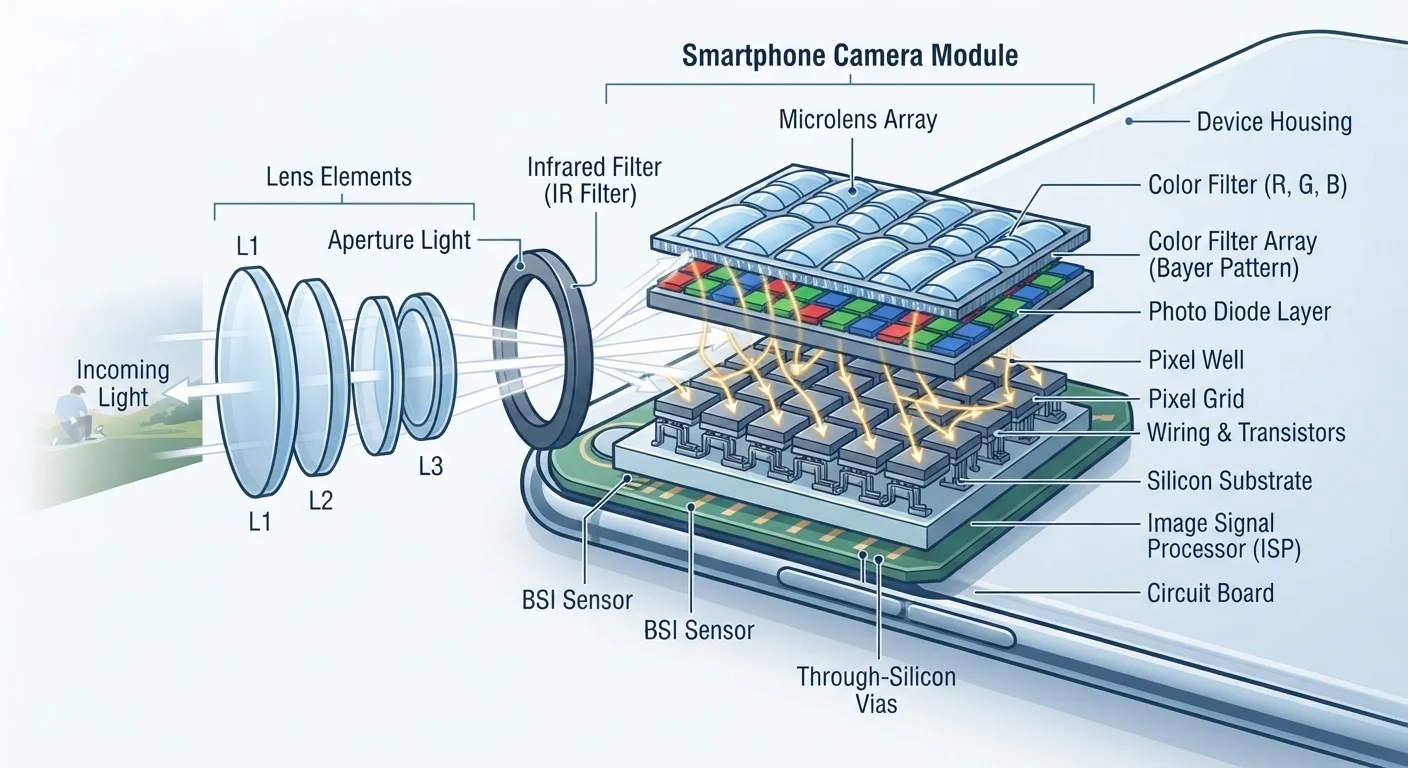
Photo credit: Telecom360.net | Connecting You To The Latest In Telecom
In this article
Understand how sensor size, pixel count, and aperture affect image quality — and why bigger numbers don't always mean better photos.
Key Takeaways
- Sensor size has a greater influence on low-light performance than megapixel count alone.
- Pixel size - measured in micrometers (µm) - determines how much light each individual pixel can collect.
- A wider aperture (lower f-number) admits more light but reduces depth of field.
- Pixel binning combines adjacent pixels to improve sensitivity at the cost of raw resolution.
- Computational photography can compensate for sensor limitations but cannot fully replace optical quality.
- Reading spec sheets critically requires understanding how sensor size, pixel count, and aperture interact.
The Three Pillars of Camera Sensor Performance
When evaluating a smartphone camera, three hardware variables interact to determine what the sensor can actually record: physical sensor size, pixel dimensions, and lens aperture. Marketing materials routinely emphasize only megapixel count - but that figure tells you very little on its own. Understanding how these three elements relate to each other is the foundation for reading any camera spec sheet with confidence. For a broader look at how these specifications are packaged and presented, see how to read a smartphone camera spec sheet without getting misled.
~2×
Light gathered: 1/1.3" vs 1/2.0" sensor
Calculated from comparative sensor area - a 1/1.3" sensor has approximately twice the surface area of a 1/2.0" sensor, directly affecting light collection capacity.
f/1.6
Common flagship main camera aperture
Flagship smartphone main lenses frequently operate at apertures between f/1.6 and f/1.8, admitting significantly more light than mid-range lenses at f/2.2 or narrower.
4-in-1
Typical pixel binning ratio on high-res sensors
Most high-megapixel sensors default to 4-in-1 binning for everyday photography, merging four pixels into one to improve sensitivity while reducing output resolution.
1.0-2.0µm
Typical native pixel size range on flagships
Flagship main sensors generally offer native pixel sizes in this range; larger pixels capture more light per site and are associated with stronger low-light performance.
Sensor size is measured in fractions of an inch and describes the physical area of the imaging silicon. A larger area means more light reaches the sensor per exposure - the single most important factor for image quality in variable lighting conditions. Pixel dimensions, measured in micrometers (µm), describe how large each individual light-collecting site is. Aperture, expressed as an f-number, controls how much of the available light the lens actually passes to the sensor surface.
Sensor Size: Why Physical Area Drives Image Quality
The physics of light collection are straightforward: a larger surface captures more photons in any given exposure window. This directly translates into better signal-to-noise ratios, richer shadow detail, and greater dynamic range - the ability to preserve highlight and shadow detail simultaneously within a single frame.
Sensor dimensions on spec sheets appear as formats like 1/1.28", 1/1.7", or 1/2.55". The notation is counterintuitive - a fraction closer to 1/1 indicates a larger sensor. In practical terms, a sensor in the 1/1.3" range captures roughly twice the light-gathering area of a 1/2.0" sensor under equivalent conditions. That difference becomes most visible when shooting in low light or scenes with extreme contrast. Night mode processing can extend the effective range of any sensor, but works better the more raw signal quality the hardware delivers.
Pixels: Count Versus Size
Every additional megapixel divides the sensor's fixed area into smaller individual pixels. On a small sensor, this trade-off is especially costly: each pixel receives less light, generates more electronic noise, and produces less reliable color data. A 12MP image from a well-sized sensor with large pixels will routinely outperform a 50MP image from a cramped sensor in low-light conditions.
“The megapixel race has produced sensors with remarkable resolving power, but resolution is only useful when the pixel sites themselves are large enough to gather a clean signal. The underlying physics of light collection haven't changed.”
— Smartphones Editorial Team, Camera Technology Analysis, Nexus
Pixel binning partially addresses this trade-off. When a sensor captures a full-resolution frame, the image signal processor (ISP) can merge groups of adjacent pixels - typically 4-in-1 or 9-in-1 patterns - into a single effective pixel with a larger light-gathering area. The 200MP sensors appearing in flagship hardware generally default to 12.5MP or 50MP output using this technique in standard shooting modes. As the real story behind megapixels explains, the resolution headline rarely reflects how the sensor actually operates day-to-day.
Aperture and What the f-Number Means
Aperture describes the diameter of the lens opening relative to focal length. An f/1.6 aperture admits approximately 2.25 times more light than f/2.4 - a meaningful advantage when available light is limited. On smartphone hardware, this number also has depth-of-field implications: wider apertures produce shallower focus planes, which is why many portrait modes aim to simulate the look of a fast lens using depth mapping and computational bokeh.
Comparing Apertures: Lower f-Number Means More Light
When reviewing camera specs, remember that aperture is an inverse scale - f/1.6 is a wider opening than f/2.4, not a narrower one. This is counterintuitive but critical: the lower the f-number, the more light the lens admits per unit of time. Treat the f-number as a denominator when making comparisons.
Unlike dedicated cameras, smartphones cannot mechanically adjust aperture in real time. A phone's aperture is fixed by the physical lens assembly. Some devices simulate variable aperture through exposure controls, but the hardware opening remains constant. This makes the aperture value on a spec sheet a stable, directly comparable figure when assessing how much light a lens system can gather.
How These Variables Work Together
No single specification predicts image quality in isolation. A large sensor paired with a slow (high f-number) lens may underperform a smaller sensor behind a very fast lens in certain conditions. The ISP, which processes raw sensor data, adds another layer: noise reduction, sharpening, tone mapping, and AI scene detection all shape the final output. Computational photography is now deeply integrated into the imaging pipeline, meaning the hardware specs and software capabilities must be evaluated together for any meaningful comparison.
When comparing camera systems, prioritize sensor size as the primary variable, use aperture as a secondary filter, and treat megapixel count as a contextual figure whose significance depends on how the sensor uses those pixels - whether through full-resolution output or pixel binning modes. For a systematic approach to camera spec sheets, the Hardware & Specs hub covers the full range of variables worth scrutinizing before a purchase decision.
Frequently Asked Questions

Author
Smartphones Editorial Team
Smartphones Editorial Team is the collective byline for our editorial team and contributor network. Articles published under this byline or an editorial pen name are researched, written, and reviewed according to our editorial standards for clarity, consistency, and independence before publication.
View all articles →