
Generative AI vs. Traditional Automation: Telling the Difference in Consumer Apps
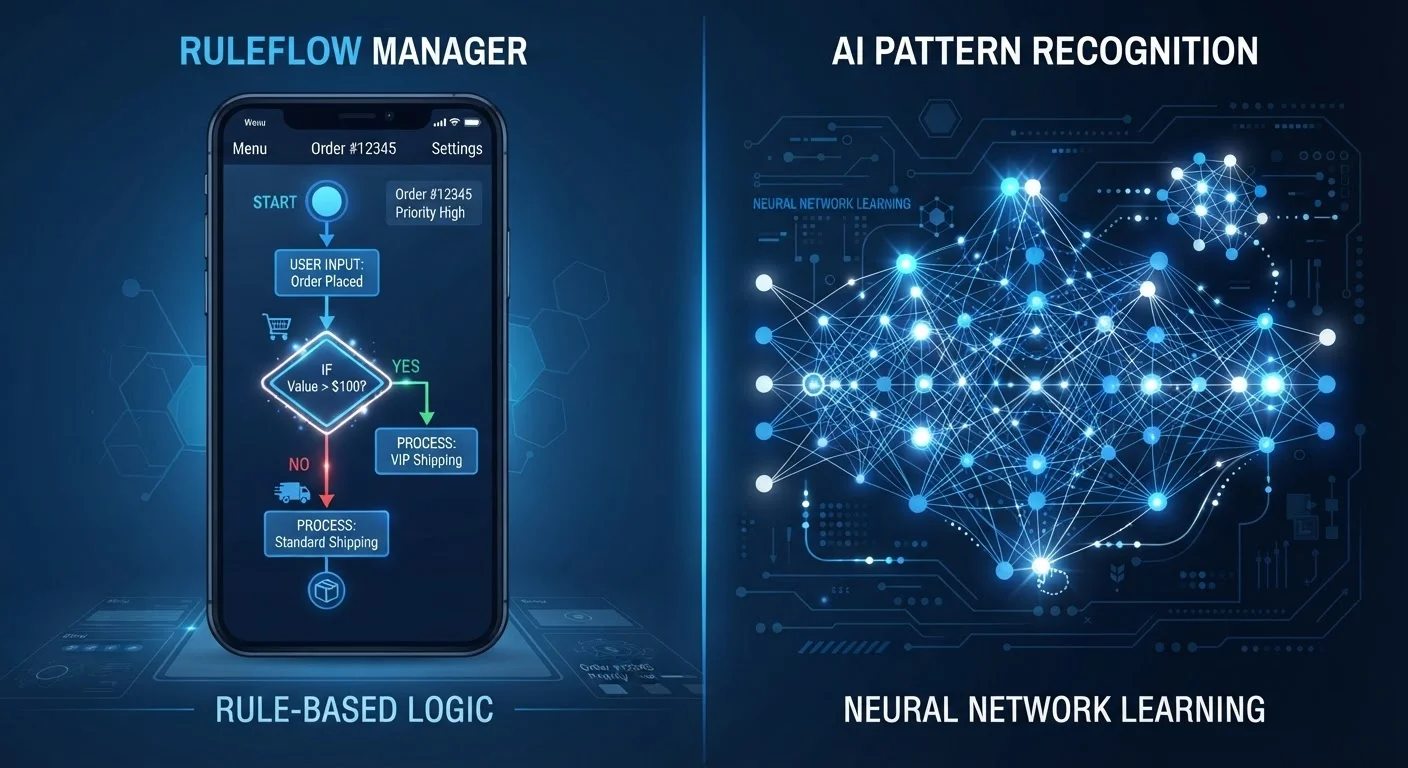
Photo credit: Telecom360.net | Connecting You To The Latest In Telecom
In this article
Not every 'AI' feature uses a language model. Learn the real distinction between rule-based automation and generative AI in the apps on your phone.
Key Takeaways
- Traditional automation follows fixed rules and produces predictable, repeatable outputs.
- Generative AI uses large language or diffusion models to produce novel, context-sensitive content.
- Most apps combine both: automation handles workflow logic while generative AI handles content creation.
- Rule-based features are faster, cheaper to run, and require no GPU; generative models demand significantly more compute.
- Mislabeling automation as 'AI' is common in marketing - knowing the difference helps you set realistic expectations.
Why 'AI' in App Marketing Means Almost Anything
Open any app store listing and you will likely see the word AI somewhere in the description - applied to everything from smart alarm clocks to spam filters to photo editors. The problem is that the term covers two fundamentally different technologies: traditional automation, which executes predefined logic, and generative AI, which uses statistical models trained on large datasets to produce new content. Conflating them leads to misplaced expectations and confusion when a feature behaves nothing like a chatbot.
Understanding the distinction is practical, not academic. It helps you judge which features are trustworthy for sensitive tasks, which ones require an internet connection, and when a so-called AI suggestion is simply a lookup table in disguise. See the AI terms reference guide for plain-language definitions of the jargon you'll encounter along the way.
How Traditional Automation Actually Works
Traditional automation - sometimes called rule-based automation or scripted logic - operates on explicit if-then conditions written by engineers. Your email app's filter that moves newsletters to a folder is automation: it checks the sender address against a list and fires an action. Your phone's Do Not Disturb schedule, autocorrect's dictionary lookups, and the step counter that adds your daily total are all automation. None of them infer, learn, or generate anything novel.
The key properties of rule-based systems are determinism and transparency. Given identical inputs, the output is always the same. Engineers can trace every decision to a specific line of logic. This makes automation dependable for structured, repetitive work - syncing contacts, triggering push notifications, or converting file formats - but brittle when inputs fall outside what was anticipated during design.
| Criterion | Traditional Automation | Generative AI |
|---|---|---|
| Core mechanism | Explicit if-then rules | Probabilistic model trained on data |
| Output consistency | Identical for identical inputs | Variable; same prompt can yield different outputs |
| Compute requirements | Minimal; runs on-device easily | High; usually requires cloud GPU or dedicated chip |
| Handles novel inputs | Poorly; breaks outside defined rules | Well; generalizes to unseen scenarios |
| Error type | Logic bugs; auditable and traceable | Hallucinations; plausible but unverified content |
| Offline capability | Yes, fully offline | Usually requires connectivity unless on-device model |
| Typical app examples | Email filters, alarms, step counters | AI writing assistants, chatbots, image generators |
What Generative AI Actually Does Differently
Generative AI refers to models - most commonly large language models (LLMs) like those powering conversational assistants, or diffusion models used in image generators - that have been trained on massive datasets to predict statistically likely outputs given a prompt. Rather than following a rule, the model assigns probabilities across thousands of possible next tokens (words, pixels, code characters) and samples from that distribution.
This is why generative AI can draft a birthday message in your writing style, summarize a 40-page PDF, or explain a concept differently each time you ask. It is also why it can confidently produce errors: the model optimizes for plausible-sounding output, not verified truth. AI writing tools built into apps you already use explores this in detail for email and document contexts.
~1.8T
Parameters in large frontier language models
Estimates for some of the largest publicly discussed LLMs suggest parameter counts in the hundreds of billions to low trillions - orders of magnitude beyond any rule-based system.
10-100×
More energy per query vs. a keyword search
Researchers at institutions including the University of Massachusetts have estimated that inference on large neural models consumes substantially more energy than a traditional database query.
~50ms
Typical rule-based filter response time
On-device automation tasks such as email filtering or contact matching commonly resolve in under 50 milliseconds with negligible battery impact.
Spotting Each Type Inside Real Apps
In practice, most consumer apps blend both approaches. A ride-share app uses deterministic routing algorithms (automation) but may use an LLM to answer natural-language support queries (generative AI). A streaming service's recommendation engine often relies on collaborative-filtering algorithms (a form of traditional machine learning, not generative AI) while its search-query interpretation might use a language model.
Quick heuristics for identifying each type:
- Consistent, instant results with no loading indicator → likely automation or a lightweight on-device model.
- Variable outputs to the same prompt, slight delay, or a 'generating…' spinner → likely a generative model, often cloud-hosted.
- Binary or categorized outputs (spam/not spam, category tags) → likely a classifier, which is traditional ML rather than generative AI.
The difference between cloud-hosted and on-device processing also affects your privacy. Cloud-based AI vs. on-device AI explains what happens to your data in each scenario.
Traditional ML vs. Generative AI: A Quick Clarification
Not every machine-learning model is generative. Spam classifiers, fraud detectors, and recommendation engines are trained on data but produce a label or score, not new content. Generative AI specifically refers to models that output novel artifacts - text, images, audio, or code. When an app markets a 'machine learning' feature, it may be neither generative nor simply rule-based; it sits in a third category worth knowing about.
Setting Realistic Expectations for Each
Treating a generative AI feature like an automation - expecting it to produce the same answer every time - leads to frustration when outputs vary. Equally, expecting automation to handle open-ended creativity sets users up for disappointment. Knowing which technology underlies a feature calibrates trust appropriately.
For decision-critical tasks - calculating a loan payment, scheduling a meeting, flagging a duplicate file - rule-based automation is preferable precisely because it is auditable. For exploratory tasks - brainstorming ideas, rephrasing a complaint email, generating a first draft - generative AI adds genuine value that automation cannot replicate. The risk of over-delegation is real: signs you're over-relying on AI features covers the habits worth watching. For a deeper look at where these technologies diverge at an architectural level, Generative AI vs. Traditional Automation: Where the Line Really Falls provides a thorough breakdown.

Author
AI & Cloud Editorial Team
AI & Cloud Editorial Team is the collective byline for our editorial team and contributor network. Articles published under this byline or an editorial pen name are researched, written, and reviewed according to our editorial standards for clarity, consistency, and independence before publication.
View all articles →