
T-Mobile vs. Verizon: Mid-Band 5G Reach vs. Low-Band Reliability
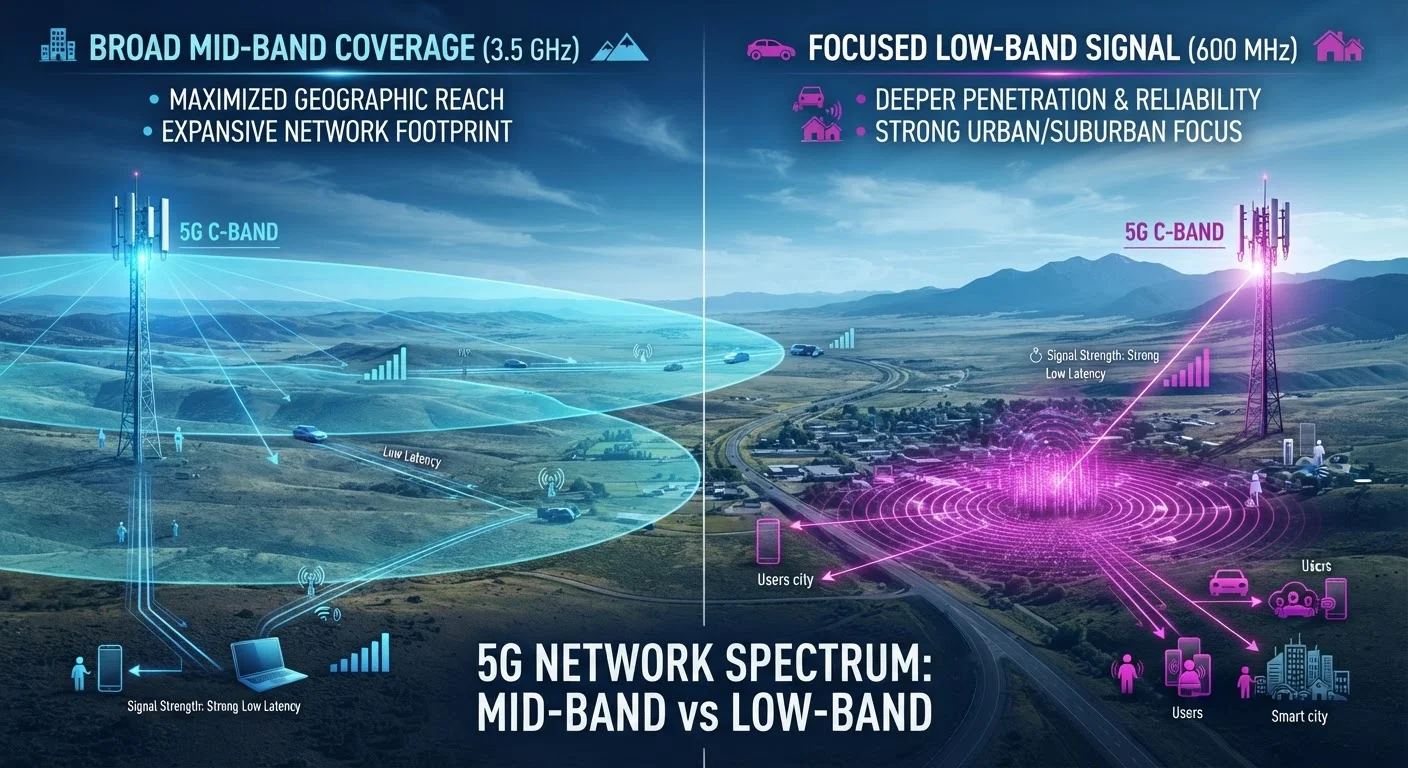
Photo credit: Telecom360.net | Connecting You To The Latest In Telecom
In this article
T-Mobile leads in 5G breadth; Verizon emphasizes reliability. A side-by-side look at how their 5G strategies affect everyday users.
Key Takeaways
- T-Mobile's mid-band spectrum (2.5 GHz) gives it broader 5G geographic coverage than Verizon.
- Verizon's low-band 5G (700-850 MHz) penetrates buildings and terrain more effectively than mid-band signals.
- T-Mobile's mid-band delivers faster median 5G speeds in areas where coverage exists.
- Verizon's mmWave deployments offer extreme speeds in select dense urban locations.
- The right carrier depends heavily on where you live and how you use your phone.
Two Carriers, Two 5G Philosophies
T-Mobile and Verizon both operate nationwide 5G networks, but the engineering decisions behind each network lead to meaningfully different real-world experiences. Understanding why the two carriers diverge requires a quick look at spectrum strategy.
T-Mobile acquired a deep reservoir of 2.5 GHz mid-band spectrum through its 2020 merger with Sprint. Mid-band spectrum (roughly 1-6 GHz) strikes a balance: it travels farther than millimeter-wave (mmWave) frequencies and carries significantly more data than low-band signals. T-Mobile deployed this 2.5 GHz layer aggressively, giving it a mid-band 5G footprint that spans well beyond major cities. For a deeper look at how these spectrum layers behave in practice, see how Sub-6GHz and mmWave 5G differ.
Verizon's 5G strategy has evolved in phases. Early on, Verizon leaned heavily on mmWave - extremely fast but short-range - then expanded with low-band 5G on the 700-850 MHz band, which prioritizes signal propagation over speed. More recently, Verizon has deployed C-Band mid-band spectrum (3.7-3.98 GHz), incrementally narrowing the coverage gap, though T-Mobile's mid-band head start remains substantial.
Coverage Breadth: Where Each Network Reaches
Coverage maps from both carriers claim vast nationwide reach, but the quality of that coverage differs by frequency layer. T-Mobile's 2.5 GHz mid-band signal covers a significant majority of the U.S. population, according to the company's own network reporting, and independent drive-test data from firms like Ookla and Opensignal has consistently shown T-Mobile leading in 5G availability - meaning the percentage of time users spend connected to a 5G signal.
Verizon's low-band 5G (often labeled "Nationwide 5G") reaches broadly too, but low-band 5G speeds frequently overlap with advanced LTE performance, making the 5G label less meaningful in practice. Where Verizon's C-Band mid-band has deployed, speeds improve considerably - but that rollout is concentrated in specific metro and suburban markets.
| Criterion | T-Mobile 5G | Verizon 5G |
|---|---|---|
| Primary 5G band | 2.5 GHz mid-band | 700-850 MHz low-band + C-Band |
| 5G availability (population) | Broad mid-band reach nationwide | Wide low-band; C-Band in select markets |
| Median 5G download speed | Higher nationally (mid-band advantage) | Lower on low-band; faster where C-Band deployed |
| Peak urban speeds | Strong mid-band throughput | Extreme via mmWave in select nodes |
| Building/indoor penetration | Moderate (mid-band) | Strong (low-band foundation) |
| Rural 5G footprint | Stronger mid-band rural presence | Low-band 5G, often near LTE speeds |
Rural users face a particularly stark divergence. T-Mobile's mid-band footprint extends into many smaller markets where Verizon's 5G may revert to low-band or LTE. See how these carriers compare in rural markets for a detailed breakdown. More broadly, why urban and rural 5G experiences differ so dramatically comes down to spectrum economics and infrastructure density.
Speed and Performance: What the Data Shows
Independent benchmarking consistently shows T-Mobile leading in median 5G download speeds across the U.S. as a whole. This advantage traces directly to mid-band deployment density - more towers broadcasting on 2.5 GHz means more users spending more time on the faster layer.
#1
T-Mobile 5G availability ranking
Opensignal's U.S. Mobile Network Experience reports have repeatedly ranked T-Mobile first in 5G availability among major U.S. carriers.
~4x
Mid-band speed advantage over low-band 5G
Industry network analyses indicate mid-band 5G typically delivers roughly four times the median throughput of low-band 5G under comparable conditions.
~500m
Typical mmWave effective range
Millimeter-wave 5G signals generally reach effective distances of around 500 meters or less in real-world outdoor deployments, per FCC technical documentation.
Verizon's mmWave deployments remain the fastest 5G available in the specific dense urban nodes where they exist - stadiums, transit hubs, certain city blocks - capable of multi-gigabit throughput. But mmWave's range is measured in hundreds of meters, not miles, so this advantage is highly localized. For most Verizon subscribers outside those zones, 5G performance is governed by low-band or C-Band mid-band, depending on market.
Not all 5G-capable phones support every frequency band, which affects how much of either network a given device can actually access. 5G bands and device compatibility explains why hardware matters alongside network coverage.
Reliability and Indoor Performance
Coverage breadth and raw speed are only part of the picture. Low-band signals - Verizon's foundational 5G layer - propagate through walls, floors, and terrain more effectively than mid-band or mmWave. This physical property means Verizon's low-band 5G signal can be more consistent in deep indoor environments: basements, dense apartment buildings, or areas with significant topographic obstacles.
T-Mobile's 2.5 GHz mid-band is better at building penetration than mmWave, but it does not match low-band for deep-indoor reliability. In practice, T-Mobile compensates with LTE fallback on low-band frequencies, and its overall network architecture is robust - but users in challenging indoor environments may notice more variability compared to Verizon's low-band baseline.
Network Layers Work Together
Neither T-Mobile nor Verizon relies on a single frequency band. Both carriers use multiple spectrum layers simultaneously, and your phone automatically connects to the strongest available signal. The distinction between "mid-band" and "low-band" networks reflects which layer you're most likely to land on given each carrier's deployment density, not a binary on/off distinction.
For users who want to understand the full network picture - including how both carriers layer their spectrum - the Coverage & Network hub provides broader context on 5G, LTE, and coverage trade-offs across all major carriers.

Author
Phone Plans Editorial Team
Phone Plans Editorial Team is the collective byline for our editorial team and contributor network. Articles published under this byline or an editorial pen name are researched, written, and reviewed according to our editorial standards for clarity, consistency, and independence before publication.
View all articles →