
Indoor Coverage Problems: Why Buildings Block Your Signal and What Helps
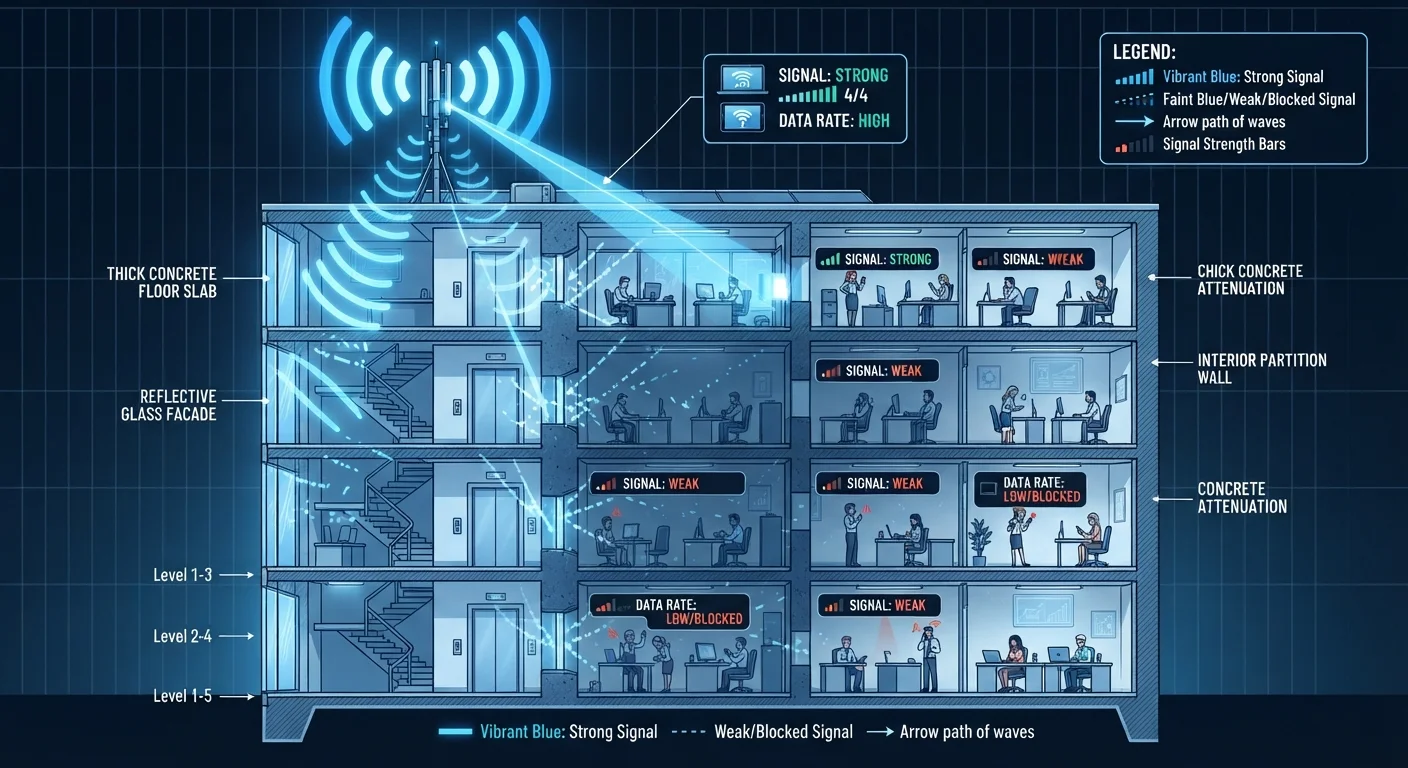
Photo credit: Telecom360.net | Connecting You To The Latest In Telecom
In this article
Walls, windows, and building materials can cripple mobile signals. Here's the physics behind indoor dead zones and the practical options for improving reception.
Key Takeaways
- Building materials - especially concrete, metal, and Low-E glass - are the primary cause of poor indoor mobile reception.
- Higher-frequency bands like mmWave 5G carry more data but penetrate buildings far less effectively than lower frequencies.
- A carrier's outdoor coverage map tells you little about what signal you'll actually get inside a specific building.
- Wi-Fi Calling and carrier-grade signal boosters are the most reliable remedies for persistent indoor dead zones.
- Building age, construction type, and floor level all meaningfully affect how well signal reaches any given room.
The Physics of Why Buildings Block Signals
Mobile phones communicate with cell towers using radio waves - electromagnetic energy that travels through air at the speed of light but interacts very differently with solid matter. When a signal wave strikes a wall, three things happen simultaneously: some energy passes through (transmission), some bounces back (reflection), and some is converted to heat (absorption). The net result is attenuation - a measurable reduction in signal power on the other side.
The degree of attenuation depends on the material's electrical properties and thickness, as well as the signal's frequency. Lower frequencies (600-900 MHz) have longer wavelengths that pass through materials more readily. Higher frequencies (2.5 GHz and above) carry more data capacity but lose energy far more quickly when encountering obstacles.
40 dB
Signal loss through Low-E coated glass
Metal-oxide coatings on energy-efficient windows can attenuate radio signals by up to 40 dB - a 99.99% reduction in signal power compared to uncoated glass.
~26%
US homes with persistent indoor dead zones
Industry research has consistently found that roughly one in four US households experiences at least one area of significant indoor signal loss regardless of carrier.
10x
Greater penetration: low-band vs. mmWave
Low-band frequencies (sub-1 GHz) penetrate building materials approximately 10 times more effectively than millimeter-wave 5G frequencies under typical construction conditions.
This frequency-penetration trade-off explains why carriers that have invested heavily in low-band spectrum - particularly the 600 MHz and 700 MHz bands - often deliver more consistent indoor coverage, even if their peak outdoor data speeds are lower than competitors leaning on mid- or high-band infrastructure.
Building Materials and Their Signal Impact
Not all construction materials attenuate signals equally. Understanding the hierarchy helps explain why some buildings are near-impossible to get a signal in, while others present no problem at all.
- Standard glass: Relatively transparent to radio waves, causing roughly 2-3 dB of loss.
- Drywall and wood framing: Minimal impact - typically 2-5 dB loss per wall.
- Brick: Moderate attenuation, around 10 dB per layer.
- Concrete (reinforced): Significant loss - 15-30 dB or more, depending on thickness and rebar density.
- Low-emissivity (Low-E) glass: A major culprit in modern construction. The metallic coating designed to reflect heat also reflects radio waves, with losses of 25-40 dB - comparable to a thick concrete wall.
- Metal panels and foil insulation: Can create near-complete signal blockage in affected areas.
Modern energy-efficient buildings are, paradoxically, some of the worst environments for cellular reception. Low-E glass is now standard in commercial construction and increasingly common in residential buildings, and its radio-blocking properties are rarely considered during design. As noted in our coverage on common coverage assumptions that cost mobile users, assuming a strong outdoor signal translates to indoor reliability is one of the costliest mistakes a subscriber can make.
Coverage Maps Don't Reflect Indoor Reality
Carrier coverage maps are built from propagation models that estimate signal strength at ground level outdoors. They do not account for building materials, interior layout, or floor level. A location shown as 'excellent coverage' on a map may have virtually no usable signal in a basement or interior room. For a deeper look at how these models are constructed and what they omit, see our article on how mobile network coverage maps are built.
Practical Options for Improving Indoor Reception
Once you've identified an indoor coverage problem, several approaches can meaningfully improve the situation - ranging from free software settings to hardware installations.
Wi-Fi Calling
Enabling Wi-Fi Calling in your phone's settings routes calls and SMS over your broadband connection when cellular signal is weak. All major US carriers support it, and the feature is built into virtually every smartphone sold in the last several years. For most home and office scenarios with reliable broadband, this is the lowest-effort, highest-impact fix available.
FCC-Certified Signal Boosters
Consumer signal boosters - also called repeaters or amplifiers - use an external antenna to capture the outdoor signal, amplify it, and rebroadcast it inside. FCC regulations require certified boosters to include automatic gain control that prevents interference with carrier networks. Installation complexity ranges from plug-and-play desktop units to professionally mounted multi-antenna systems for larger buildings.
Carrier-Deployed Small Cells and Femtocells
Some carriers offer femtocell devices (essentially a miniature cell tower that uses your broadband connection) for subscribers with persistent in-home coverage problems. Availability and eligibility vary by carrier. Large commercial buildings may negotiate directly with carriers for dedicated Distributed Antenna Systems (DAS) installations.
Strategic Positioning
Moving closer to a window - particularly one facing the nearest tower - can recover meaningful signal in mild attenuation scenarios. Upper floors typically perform better than ground level in buildings without basement antenna infrastructure, though this varies by tower geometry.
Test Before You Invest in Hardware
Before purchasing a signal booster, spend a few minutes mapping signal levels around your space using your phone's field test mode (accessible via dialer codes on both iOS and Android) or a third-party signal meter app. If the outdoor signal at your roofline or nearest window is already weak - below roughly -100 dBm on LTE - a booster will have limited headroom to work with, and addressing the underlying coverage gap may require a different approach.
Before investing in hardware, it's worth verifying whether the problem is truly indoor attenuation or a broader coverage gap. Carrier coverage maps are a starting point, but as our analysis of how coverage maps are built and where they fall short explains, those maps model predicted outdoor signal - not the experience inside specific structures.
Frequently Asked Questions

Author
Phone Plans Editorial Team
Phone Plans Editorial Team is the collective byline for our editorial team and contributor network. Articles published under this byline or an editorial pen name are researched, written, and reviewed according to our editorial standards for clarity, consistency, and independence before publication.
View all articles →