
Family Plans: How Shared Lines, Data Pooling, and Account Controls Work
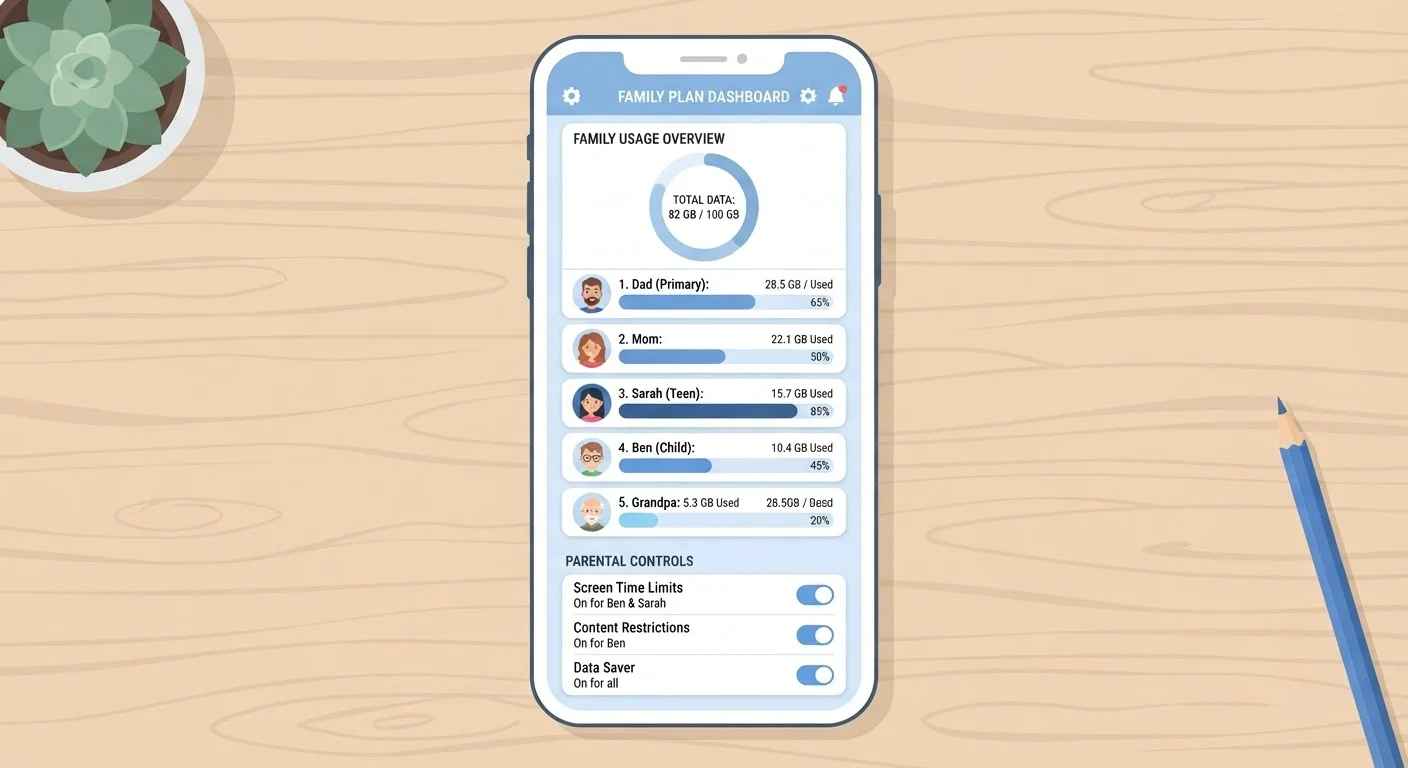
Photo credit: Telecom360.net | Connecting You To The Latest In Telecom
In this article
Family phone plans bundle multiple lines under one account, but the structure varies widely. Learn how pooled data, line limits, and controls actually work.
Key Takeaways
- Family plans consolidate multiple lines into one bill, typically reducing per-line cost as more lines are added.
- Data pooling and per-line allocations are structurally different - one shared bucket behaves very differently from individual caps.
- Account controls let the primary holder set data limits, content filters, and screen time rules for other lines.
- Line limits vary by carrier and plan tier, with most consumer family plans capping between four and six lines.
- Adding lines mid-cycle usually prorates the charge but may reset billing dates depending on the carrier.
How Lines Are Structured Under One Account
A family plan creates a single billing account that houses multiple phone lines. The primary account holder signs the agreement, owns the account, and is ultimately responsible for the bill. Additional lines - sometimes called secondary or sub-lines - are added to that account and billed together each cycle.
Per-line pricing typically decreases as more lines are added. A two-line account might pay more per line than a four-line account on the same plan tier. This tiered discount structure is the core financial incentive for bundling lines. For a broader view of how family plans compare to other plan structures, see a structured look at every major plan category.
Lines on a family account are linked for billing but can behave independently for most day-to-day usage. Each line has its own phone number, device, and - depending on the plan - its own data allowance. What connects them is the account itself: one login, one bill, one primary contact for the carrier.
Verify Who Is Financially Responsible
The primary account holder is legally and financially responsible for all lines on a family plan - including any device installment balances. Before adding someone to your account, clarify who owns which devices and how disputes over billing would be handled.
Data Pooling vs. Per-Line Allocations
Not all family plans distribute data the same way. The two dominant models are pooled data and per-line allocations, and the difference matters practically.
With pooled data, all lines draw from a single shared bucket - say, 30 GB total. A teenager streaming video heavily can consume data that would otherwise be available to other lines. Once the pool is empty, every line is affected. This model rewards households with consistent, moderate usage spread across lines.
Per-line allocations assign each line its own data cap. If one line hits its limit, only that line slows down; others continue normally. This structure suits households with uneven usage patterns. Unlimited family plans add a third variation: each line has no hard data cap but may face speed throttling during congestion after a defined priority threshold.
For a deeper technical breakdown of these structures, individual, shared, and pooled data models explained covers how each behaves in practice.
4-6
Typical line limit on consumer family plans
Most major US carriers cap standard consumer family plans at four to six lines before requiring a business or extended account structure.
~20-35%
Estimated per-line savings vs. individual plans
Adding multiple lines to a family plan generally reduces the per-line cost relative to separate individual plans, though exact savings depend on the carrier and plan tier chosen.
Account Controls and Parental Features
Family plans typically give the primary account holder administrative controls that secondary lines don't have. These controls are managed through the carrier's app or web portal and generally fall into a few categories.
- Data limits: Cap how much data a specific line can use before it slows down or stops, regardless of what remains in the shared pool.
- Content filters: Block categories of websites or apps at the network level, applied per line.
- Screen time and pause controls: Some carriers allow the account holder to pause data on a line entirely - useful during school hours or bedtime.
- Usage visibility: The primary holder can see data, call, and text usage broken down by line, while secondary users typically only see their own activity.
These controls vary significantly by carrier and plan tier. Higher-tier unlimited plans often include more granular controls than entry-level family plans. It's worth verifying what's available on a specific plan before assuming these features are included.
Network-Level Controls Have Limits
Carrier-provided content filters and data pausing tools operate at the network level, not on the device itself. They can be bypassed by switching to Wi-Fi or using a VPN. These tools are useful supplements to digital safety practices but are not a comprehensive solution on their own. For broader context on privacy and data practices, online privacy resources cover additional considerations.
Line Limits, Adding Members, and Billing Mechanics
Consumer family plans typically cap at four to six lines, though some carriers offer expanded options. When you add a line mid-billing cycle, the new line is usually prorated - charged only for the remaining days in the current period.
Device financing complicates line removal. Each line can carry an independent device installment plan, and the remaining balance on a financed phone is owed regardless of whether the line stays on the family account. Leaving a family plan - or removing a member - generally requires settling any outstanding device balance first.
Family plans and business multi-line accounts share structural similarities but differ in terms, tax treatment, and available features. If the account is for a team rather than a household, business phone plan structures address those distinctions. For a carrier-by-carrier comparison of how family plan discounts and fine print differ in practice, see family plan structures across major US carriers.
Frequently Asked Questions

Author
Phone Plans Editorial Team
Phone Plans Editorial Team is the collective byline for our editorial team and contributor network. Articles published under this byline or an editorial pen name are researched, written, and reviewed according to our editorial standards for clarity, consistency, and independence before publication.
View all articles →