
Predictive Text Has Changed Completely - Here's the Technology Behind It
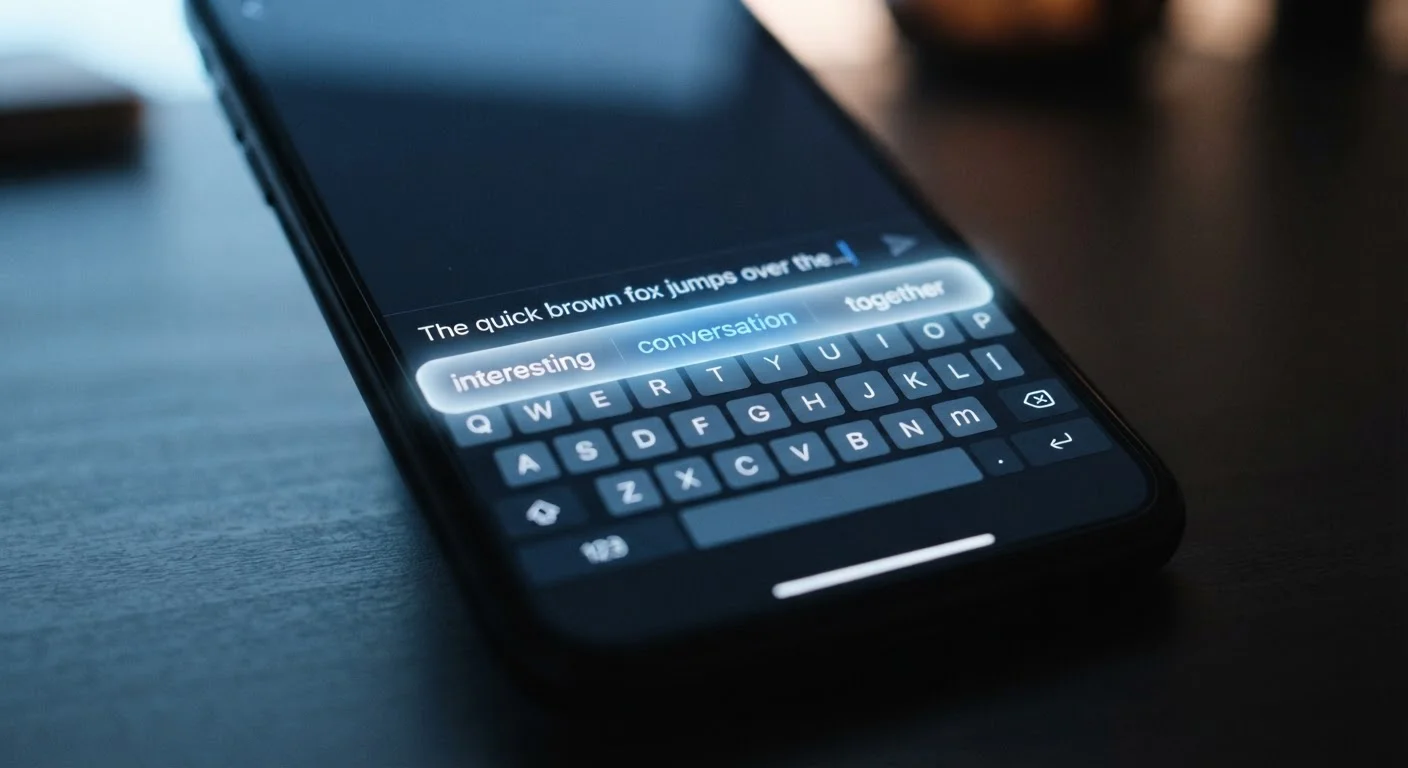
Photo credit: Telecom360.net | Connecting You To The Latest In Telecom
In this article
Modern keyboard suggestions use language models, not simple dictionaries. Discover how predictive text evolved and what powers it today.
Key Takeaways
- Predictive text evolved from simple word-frequency dictionaries to neural language models over roughly two decades.
- Modern keyboards analyze context across your entire sentence, not just the last word you typed.
- On-device AI processing keeps your typed text private by avoiding cloud round-trips for basic suggestions.
- Personalization layers adapt suggestions to your vocabulary, contacts, and writing style over time.
- The same transformer architecture behind ChatGPT influences how high-end mobile keyboards generate suggestions.
From Word Lists to Language Models
Early predictive text systems, like T9 on feature phones in the late 1990s, worked by mapping numeric keypad presses to the statistically most common word that matched that letter combination. There was no understanding of context - just a lookup table of word frequencies drawn from a fixed dictionary. If you typed 4-6-6-3, the system chose "home" over "good" based purely on corpus frequency counts.
By the smartphone era, keyboards advanced to n-gram models - algorithms that predict the next word by examining the one or two words immediately before it. If you typed "I'll be," the model could reasonably suggest "there" or "home" based on how often those word sequences appeared in training text. This was a meaningful improvement, but context remained shallow.
The leap to neural language models changed the equation entirely. Instead of counting co-occurrences in a fixed table, neural models learn distributed representations of language - capturing meaning, grammar, and context in a way that scales across sentence length. Today's on-device keyboards run compressed versions of these models, small enough to fit on a phone's storage while still outperforming the n-gram approaches they replaced.
“The shift from n-gram models to neural language models for keyboard prediction wasn't just a performance improvement - it was a fundamental change in how machines represent the meaning of language.”
— Paraphrase of consensus position in computational linguistics literature, Reflected across published NLP research on mobile language modeling
What Powers the Suggestion Bar Today
The suggestion strip above your keyboard is fed by a model that evaluates your entire in-progress sentence - not just the last word. When you type "Can we reschedule the," the model doesn't just look at "the"; it processes the full semantic intent of the sentence to weight suggestions like "meeting" or "call" far above unrelated words.
This works through transformer-style attention mechanisms - the same conceptual architecture behind much larger AI systems. On mobile, the models are heavily quantized and pruned, reducing their memory footprint from gigabytes to tens of megabytes while preserving most of their predictive accuracy. Apple's on-device language model for keyboard suggestions and Google's Gboard both use variants of this approach.
~30MB
Typical on-device keyboard language model size
On-device neural keyboard models are heavily compressed to fit in tens of megabytes while retaining strong prediction accuracy across millions of devices.
~36%
Typing speed increase with predictive suggestions
Research published in the journal <em>International Journal of Human-Computer Studies</em> found measurable typing efficiency gains when users actively use suggestion-bar completions.
Personalization adds another layer. The keyboard maintains a private, local user model tracking which suggestions you accept, words from your contacts, and domain-specific vocabulary you use often. This is why your keyboard may correctly suggest a colleague's unusual name or a technical term specific to your work - data points the general model was never trained on. For a broader look at how this kind of AI is embedded across your device, see the AI systems already embedded in modern smartphones.
Privacy, Personalization, and the Limits of Prediction
On-device processing is the key privacy safeguard in modern predictive text. Because inference happens locally, your keystrokes are never transmitted to a server to generate suggestions - a significant improvement over earlier cloud-dependent approaches. The tradeoff is model size: on-device models are substantially smaller than cloud-hosted ones and can miss nuanced context that a larger model would catch.
Reset Suggestions If They Go Off-Track
If your keyboard's suggestions feel persistently wrong - especially after borrowing your phone to someone else or typing in an unusual style for an extended period - most keyboards let you reset the learned dictionary. On iOS, go to Settings > General > Transfer or Reset iPhone > Reset > Reset Keyboard Dictionary. On Android, find the option in your keyboard app's settings under Personal Dictionary or Learning.
The limits of predictive text are worth understanding. Language models predict statistically likely continuations - they don't understand what you mean. This distinction matters when you're writing something unusual, emotionally precise, or domain-specific. The model will suggest the most probable word given your context, which is often right but occasionally confidently wrong.
Predictive text also reflects the biases present in its training data. Models trained predominantly on certain types of text may perform better on standard registers and struggle with dialects, code-switching between languages, or informal styles. Most keyboard developers are aware of this and continue to refine training datasets, but it remains an active challenge rather than a solved problem.
As AI writing assistance expands beyond the suggestion bar into full email drafts and document completions - explored in our guide to AI writing tools built into apps you already use - it's worth noting that the same underlying technology also powers less benign applications. The fluency that makes predictive text useful is part of what makes modern scam messages harder to detect, a dynamic covered in our piece on why scam texts feel so convincing now.
Frequently Asked Questions

Author
AI & Cloud Editorial Team
AI & Cloud Editorial Team is the collective byline for our editorial team and contributor network. Articles published under this byline or an editorial pen name are researched, written, and reviewed according to our editorial standards for clarity, consistency, and independence before publication.
View all articles →