
Device Classes for Different Business Roles: A Practical Reference
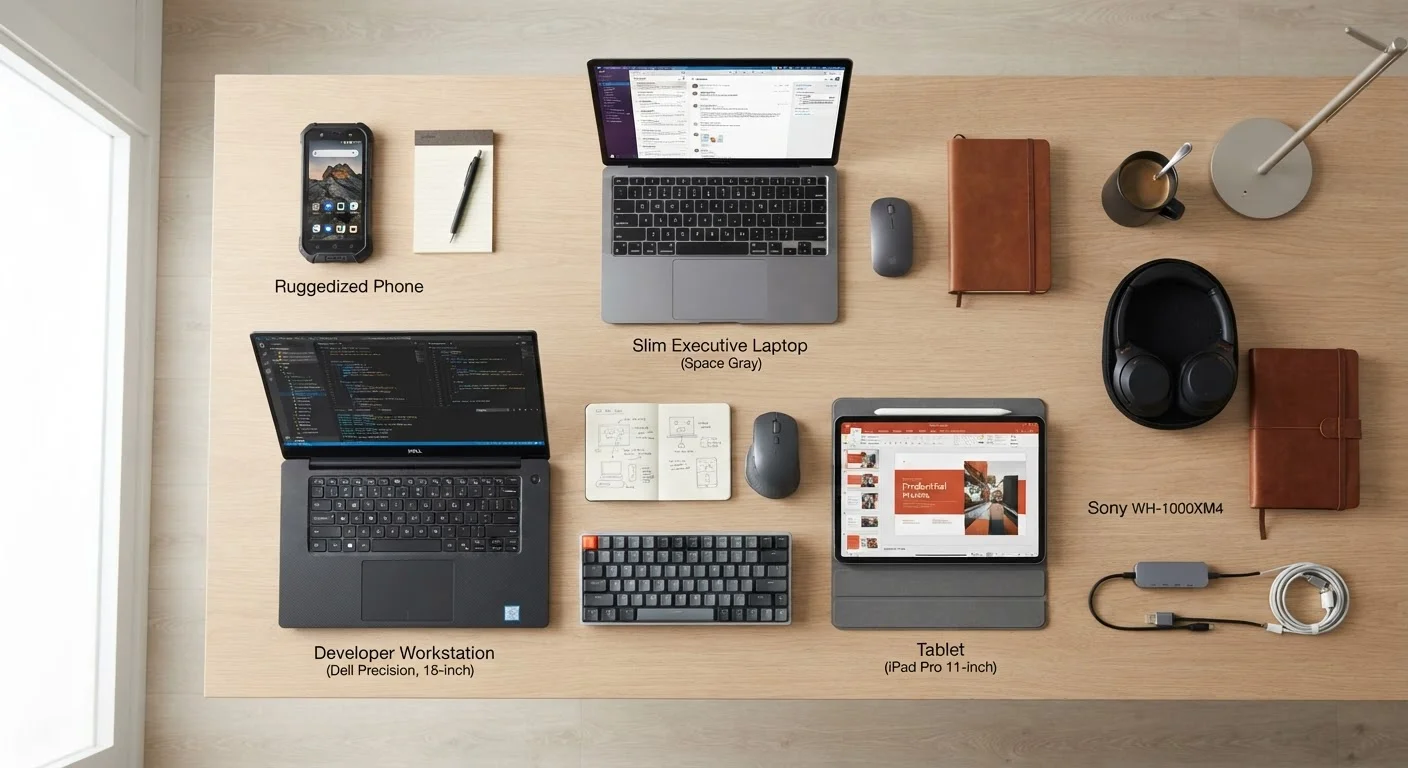
Photo credit: Telecom360.net | Connecting You To The Latest In Telecom
In this article
Field workers, executives, developers, and frontline staff all have different hardware needs. This reference maps roles to device requirements.
Why Role-Based Device Classification Matters
Assigning identical hardware across an organization is a common procurement shortcut - and a persistent source of inefficiency. A warehouse associate running inventory scans has fundamentally different requirements than a software engineer compiling code or a C-suite executive managing sensitive communications. When device specs don't align with job function, the result is either overspending on capabilities nobody uses or underequipping staff with hardware that creates daily friction.
Role-based device classification is the practice of mapping hardware specifications to job function requirements before procurement begins. It produces cleaner MDM (MDM) policies, more predictable support costs, and better security posture because each device class can be locked down appropriately. See our introduction to business device management for the broader framework this fits into.
| Field Worker Priority | Durability (MIL-SPEC), IP67+, 12-hr battery |
| Executive Priority | Security, eSIM/dual-SIM, hardware encryption |
| Developer Priority | High RAM (16GB+), processing power, I/O ports |
| Admin Staff Priority | Mid-range specs, MDM compatibility, longevity |
| Typical Field Device Refresh Cycle | 2-3 years (Industry standard based on physical wear patterns) |
| Typical Admin Device Refresh Cycle | 4-5 years |
Device Classes by Business Role
The following breakdown covers four primary role clusters found in most mid-to-enterprise organizations. Each maps to a device class with specific hardware priorities.
Field and Frontline Workers
Roles: delivery drivers, field technicians, warehouse staff, retail associates. These workers need durability above all. Device priorities include MIL-SPEC drop resistance, IP67 or higher water/dust ingress ratings, extended battery life (minimum 12 hours active use), and large high-contrast displays readable in direct sunlight. Cellular connectivity (LTE/5G) is essential; Wi-Fi dependency is impractical. Barcode scanning and NFC support are commonly required for logistics workflows. For context on how enterprise hardware differs from consumer-grade alternatives, see how business smartphones differ from consumer models.
Executives and Mobile Professionals
Roles: C-suite, regional managers, sales directors. The priority here shifts to security, connectivity, and form factor. These users typically require hardware-level encryption, secure enclave processors, support for dual-SIM or eSIM configurations, and premium display quality for document review. Thin and light form factors matter for travel. MDM enrollment should enforce full-disk encryption and remote wipe capability from day one.
Developers and Power Users
Roles: software engineers, data analysts, IT administrators. This class demands maximum processing power, high RAM ceilings (16GB minimum for complex local builds), and large-display or multi-monitor support. For mobile devices used in testing or development, unlockable bootloaders and broad OS compatibility may be required. Storage capacity and I/O port selection (USB-C, Thunderbolt) are more critical than portability.
Desk-Based and Administrative Staff
Roles: customer support agents, HR staff, back-office operations. These roles are served adequately by mid-range devices with reliable wireless connectivity, standard security compliance support, and comfortable input peripherals. Overpowering this segment drives up fleet costs with no productivity return. Focus procurement on longevity, warranty coverage, and ease of MDM enrollment rather than top-tier specs.
MIL-SPEC
Short for Military Specification. Refers to standardized durability tests (often MIL-STD-810) covering drop resistance, temperature extremes, and vibration. Devices meeting these standards are considered ruggedized for demanding environments.
IP Rating
Ingress Protection rating, a standard defined by IEC 60529 that classifies a device's resistance to solid particles and liquids. IP67, for example, means dust-tight and submersion-resistant to 1 meter for 30 minutes.
MDM
Mobile Device Management. Enterprise software that allows IT administrators to enroll, configure, monitor, and remotely wipe corporate devices from a central console.
eSIM
An embedded SIM that is built into a device and can be activated remotely without a physical SIM card. Commonly used in executive-class devices to support multi-carrier or multi-country connectivity.
Secure Enclave
A dedicated hardware component on a device processor that isolates cryptographic operations and stores sensitive data such as biometric credentials or encryption keys, separate from the main operating system.
Procurement and Lifecycle Considerations
Role classification only delivers value when it feeds directly into procurement decisions. Before finalizing any device order, run each class through compatibility checks - particularly around your existing MDM platform, VPN client support, and corporate app ecosystem. Software choices compound hardware decisions significantly; our guide on keeping business phones performant covers this interaction in detail.
Plan refresh cycles by role class rather than by calendar year. Field devices typically require replacement every 2-3 years due to physical wear, while administrative desktops may sustain 4-5 year cycles with proper maintenance. For a complete procurement-to-decommission framework, refer to the full lifecycle of a business device. And before placing any order, the hardware procurement checklist provides a structured pre-purchase review covering compliance and support contracts.
Security Policies Should Track Device Class
Different device classes carry different risk profiles. Field devices are more likely to be lost or damaged; executive devices handle more sensitive communications. MDM policies, VPN enforcement rules, and remote-wipe triggers should be configured per class, not applied uniformly across the fleet. This reduces both over-restriction for low-risk roles and under-protection for high-risk ones. Explore device security fundamentals for a deeper look at securing each class.

Author
Business Tech Editorial Team
Business Tech Editorial Team is the collective byline for our editorial team and contributor network. Articles published under this byline or an editorial pen name are researched, written, and reviewed according to our editorial standards for clarity, consistency, and independence before publication.
View all articles →