
Five-Line Plans vs. Unlimited Corporate Tiers: Understanding the Real Cost Structure
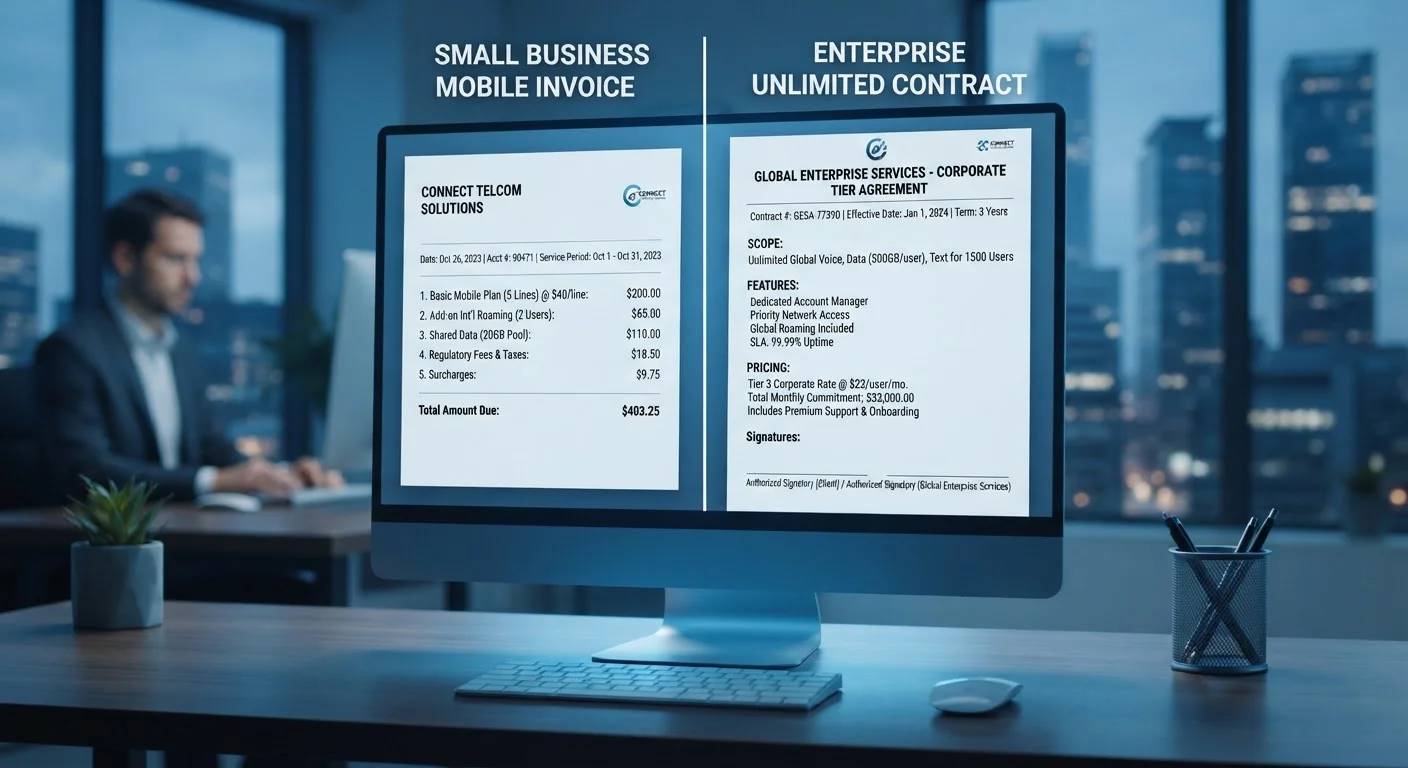
Photo credit: Telecom360.net | Connecting You To The Latest In Telecom
In this article
Break down how entry-level multi-line plans and unlimited corporate tiers differ in pricing logic, overage handling, and scalability.
Key Takeaways
- Five-line plans offer predictable per-line pricing but may carry hard data caps and overage charges that inflate costs at scale.
- Corporate unlimited tiers typically include deprioritization thresholds, not true unlimited data, which affects performance during network congestion.
- Contract length, device financing bundling, and admin tooling are cost factors that rarely appear in advertised per-line rates.
- Scalability economics often favor corporate tiers once a business exceeds eight to ten lines with consistent heavy data usage.
- Overage handling logic - hard cutoff versus speed throttling - is one of the most consequential structural differences between these plan types.
How Each Plan Structure Is Built
Five-line plans - often marketed to small businesses - are essentially scaled-up consumer multi-line packages. They apply a per-line rate that decreases incrementally as lines are added, typically bottoming out at line five. Beyond that threshold, adding a sixth line often requires either a new plan tier or a separate account, creating an artificial ceiling that has real administrative consequences.
Corporate unlimited tiers operate on a fundamentally different logic. Rather than stacking discrete per-line rates, carriers structure these as pooled or per-seat agreements negotiated at the account level. Pricing is influenced by total committed lines, contract term, and often the volume of devices financed through the carrier. For context on how these structures diverge from consumer-facing options, see what sets enterprise plans apart from consumer plans.
The implication: five-line plans are priced for simplicity, while corporate tiers are priced for negotiation. Decision-makers who treat corporate plan rates as fixed are likely leaving leverage unused.
Overage Handling: Hard Caps vs. Throttling
One of the most operationally significant differences between these plan types is what happens when a user hits their data limit. Five-line plans frequently impose hard data caps - usage stops or incurs per-gigabyte overage charges once the allotment is exhausted. For field teams or employees with unpredictable data needs, this creates both a performance risk and a billing variable that's difficult to forecast.
Corporate unlimited tiers generally substitute throttling for hard cutoffs. When a user surpasses a defined threshold (often 50-100 GB depending on the carrier), their speeds are reduced during periods of network congestion rather than their data being cut entirely. This approach preserves functionality at the cost of performance - a meaningful distinction for business continuity.
"Unlimited" Doesn't Mean Unthrottled
Corporate unlimited tiers universally include deprioritization language in their terms of service. During peak congestion on shared network infrastructure, users above the defined high-usage threshold can experience significant speed reductions. For roles dependent on real-time data transfer - field technicians, video-conferencing-heavy roles - this throttling behavior can have operational consequences that the advertised plan name does not reflect.
Understanding the full vocabulary of these structures - including what "unlimited" actually guarantees - is foundational. What each plan type actually means provides a clear breakdown of how carriers define these terms contractually.
True Cost Comparison: What the Per-Line Rate Omits
| Five-Line Plans | Corporate Unlimited Tiers | |
|---|---|---|
| Pricing Model | Fixed per-line rates, tiered by line count | Negotiated per-seat or pooled account pricing |
| Data Overage Handling | Hard cap or per-GB overage charges | Speed throttling above threshold, no hard cutoff |
| Scalability Beyond Plan Limit | Requires new plan or separate account | Flexible line additions within contract framework |
| Admin & MDM Tooling | Limited or unavailable | Typically included or deeply integrated |
| Contract Flexibility | Month-to-month or short-term common | Multi-year commitments standard; early exit fees apply |
| Cost-Efficiency Threshold | Favorable at 1-7 lines with moderate usage | Favorable at 8+ lines with high or variable usage |
Advertised per-line rates are an incomplete picture. Both plan types carry cost components that appear only in contract schedules or usage reports. Device financing - often bundled with corporate tier agreements - can reduce upfront hardware costs while extending the effective contract commitment. Administrative platform access (mobile device management integration, consolidated billing portals, usage alerts) may be included in corporate tiers but unavailable or separately priced in five-line structures.
For teams evaluating shared data pools vs. individual line allocations, the data architecture choice also affects cost exposure: pooled data can smooth out individual heavy users, while per-line allocations make each seat's overage risk independent.
Request a Usage Audit Before Renegotiating
Before committing to either plan structure, pull three to six months of actual per-line data consumption from your current carrier. Usage audits routinely reveal that 20-30% of lines are significantly underutilized, which affects which plan architecture delivers the better per-seat cost. This data also strengthens your negotiating position when approaching carriers about corporate tier pricing.
Scalability and the Line-Count Inflection Point
Five-line plans are structurally optimized for their stated capacity. Organizations that anticipate growth beyond that ceiling face a forced migration - either renegotiating mid-cycle or managing parallel accounts, both of which carry administrative and financial friction. The per-line economics also rarely improve beyond the five-line package without stepping into a dedicated business or corporate product.
Corporate unlimited tiers typically include volume commitment structures that reward scale. As committed line counts increase, per-line effective rates decrease - sometimes substantially. This means the cost-per-seat comparison between the two plan types shifts meaningfully around the eight-to-ten line threshold, where corporate tier economics often become more favorable on a blended basis.
For a broader framework on how to evaluate plan categories side by side, a structured look at every major plan category provides a useful reference across billing, data rules, and flexibility dimensions. Organizations building long-term mobile strategies should also consult the complete guide to enterprise mobile plan management for contract structure and lifecycle considerations.

Author
Business Tech Editorial Team
Business Tech Editorial Team is the collective byline for our editorial team and contributor network. Articles published under this byline or an editorial pen name are researched, written, and reviewed according to our editorial standards for clarity, consistency, and independence before publication.
View all articles →