
The Architecture of US Carrier Networks: How Verizon, AT&T, and T-Mobile Actually Differ
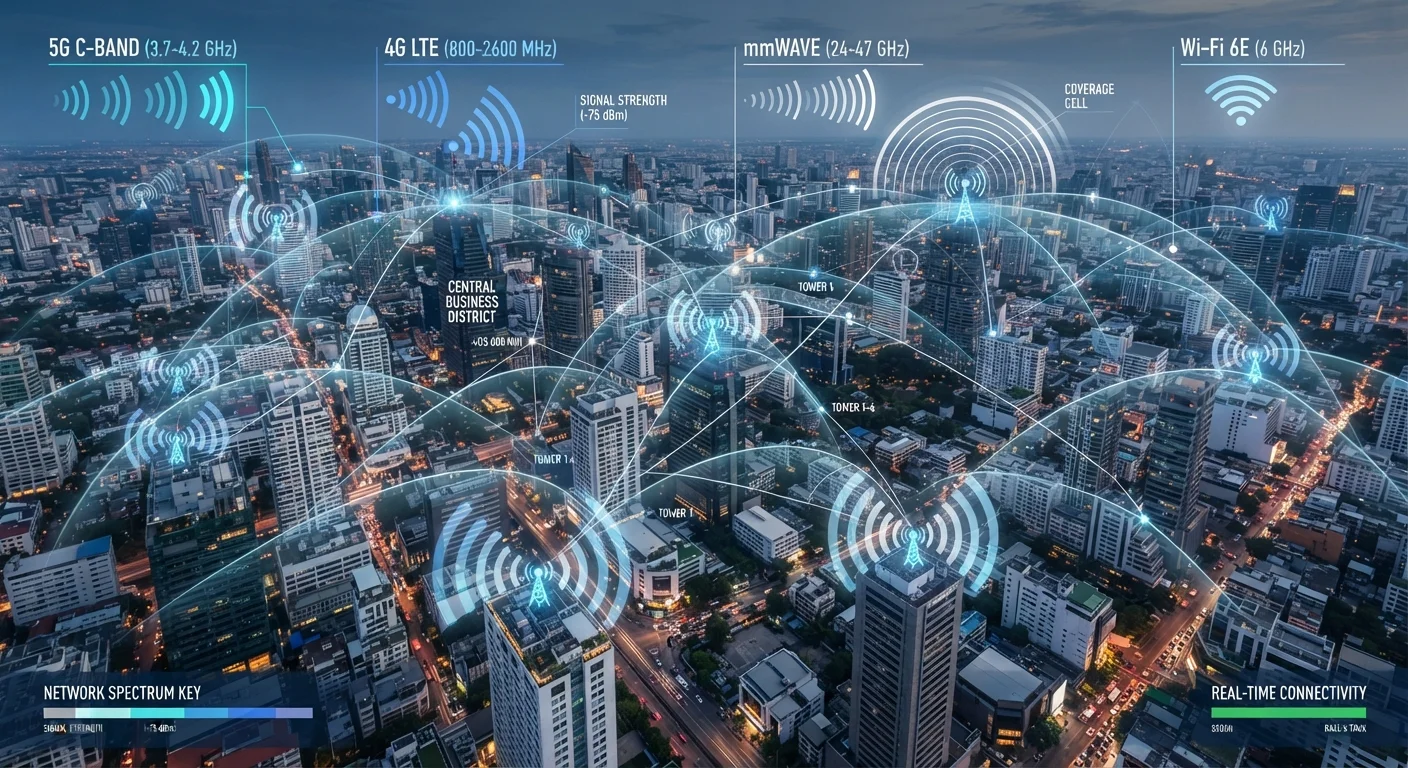
Photo credit: Telecom360.net | Connecting You To The Latest In Telecom
In this article
Understand the structural differences between the three major US carriers—spectrum holdings, tower density, and what that means for your signal.
Key Takeaways
- Verizon, AT&T, and T-Mobile hold different spectrum portfolios that directly shape their coverage and speed profiles.
- Low-band spectrum travels farther and penetrates buildings better; mid-band offers a balance of speed and range; mmWave delivers peak speeds over very short distances.
- T-Mobile holds the largest mid-band 5G spectrum position, while Verizon and AT&T have invested heavily in C-band to close that gap.
- Tower density matters as much as spectrum - denser deployments reduce congestion and improve reliability in urban areas.
- MVNOs lease capacity from these same networks, meaning the underlying signal quality is inherited from the host carrier.
Spectrum: The Foundation Nobody Sees
Before a single call connects or a megabyte of data moves, a carrier must hold a government license to transmit on specific radio frequencies - what the industry calls spectrum. The Federal Communications Commission (FCC) auctions these licenses, and the three major carriers have accumulated very different portfolios over decades of bidding.
Spectrum is generally grouped into three tiers. Low-band frequencies (below 1 GHz) carry signals over long distances and penetrate buildings efficiently, making them essential for rural coverage and indoor reliability. Mid-band frequencies (roughly 1-6 GHz) balance range with throughput, enabling faster data across moderate distances - this is the workhorse of modern 5G deployments. High-band or mmWave frequencies (above 24 GHz) deliver peak data speeds but lose range within a few hundred feet and are blocked by most solid surfaces.
~270 MHz
T-Mobile's mid-band 5G spectrum depth (2.5 GHz)
T-Mobile's 2.5 GHz holdings, inherited from the Sprint merger, represent one of the largest single mid-band spectrum positions held by any US carrier.
~100 MHz
C-band spectrum acquired by AT&T and Verizon (each)
Both Verizon and AT&T acquired approximately 100 MHz of C-band spectrum each in the FCC's 2021 auction, used to build out mid-band 5G coverage.
~500 ft
Effective range of mmWave 5G in open conditions
Millimeter wave signals degrade rapidly with distance and are absorbed by building materials, limiting practical deployment to dense urban small-cell grids.
T-Mobile entered its 2020 merger with Sprint holding a substantial mid-band position, particularly at 2.5 GHz - a frequency range now widely considered the backbone of competitive 5G. Verizon and AT&T initially focused mmWave deployments in dense urban zones, then moved aggressively into C-band (3.7-3.98 GHz) spectrum acquired in a 2021 FCC auction to build out their own mid-band 5G layers. AT&T also holds considerable FirstNet-adjacent spectrum through its 850 MHz and WCS band holdings.
Tower Infrastructure and Deployment Strategy
Owning spectrum without deploying hardware to use it produces nothing. Each carrier has taken a different approach to tower density, network sharing, and infrastructure investment, and those decisions shape real-world performance as much as the spectrum itself.
Verizon has historically emphasized a dense, high-quality infrastructure model in urban and suburban markets, prioritizing network reliability metrics. Its tower count in major metropolitan areas is substantial, and it has invested heavily in small-cell deployments - compact transmitters mounted on streetlights or building facades - to extend mmWave coverage and reduce congestion on macro towers.
AT&T's infrastructure footprint is extensive, bolstered by the FirstNet build-out, a dedicated public safety broadband network it operates under federal agreement. That construction expanded AT&T's physical infrastructure in areas that might not otherwise justify commercial investment alone, including rural corridors and highway routes.
T-Mobile's post-merger integration with Sprint consolidated two separate tower footprints into a single network, eliminating redundant sites while redeploying spectrum more efficiently. This allowed T-Mobile to activate 2.5 GHz mid-band 5G on existing tower infrastructure at scale faster than building new sites would have permitted.
Check Coverage at Your Specific Locations
National coverage statistics can obscure significant local variation. Before selecting a carrier or plan, verify coverage at the specific addresses where you spend the most time - home, workplace, and regular commute routes. Independent network testing reports and carrier coverage maps both offer address-level lookup tools that are more reliable than broad regional claims.
For coverage and network comparisons that go deeper into 5G and LTE geographic reach, the carrier's own coverage maps and independent drive-test reports from firms like Ookla or RootMetrics offer granular, location-specific data - no single national summary captures local variation.
What Architecture Means for the Signal in Your Pocket
These structural differences translate into measurable, everyday outcomes. A device on a carrier with deep low-band holdings will typically hold a signal longer as a user moves into a basement, a rural road, or an elevator. A device on a carrier with dense mid-band deployment in a given city will generally achieve faster download speeds during peak hours because the available bandwidth per user is greater.
Congestion management is another consequence of architecture. When many users share a tower sector simultaneously, speeds drop. Carriers with more spectrum in a given band - or with more tower sectors serving the same area - can distribute load more effectively. This is why two users on the same street can have noticeably different experiences at a crowded stadium or transit hub depending on their carrier.
Understanding these layers also clarifies why MVNOs - which resell capacity on these same physical networks - inherit the host carrier's coverage geography but may receive lower priority during congestion. The full MVNO explainer details how that priority relationship works in practice. For a structured framework covering all these variables together, see our carrier comparison framework.
For those evaluating business phone plans, network architecture becomes especially relevant: enterprise contracts often include priority data tiers that interact directly with the host carrier's spectrum and tower capacity. And for a focused look at how mid-band strategy plays out between two of the biggest players, our T-Mobile vs. Verizon 5G comparison breaks down the trade-offs in detail.
Frequently Asked Questions

Author
Phone Plans Editorial Team
Phone Plans Editorial Team is the collective byline for our editorial team and contributor network. Articles published under this byline or an editorial pen name are researched, written, and reviewed according to our editorial standards for clarity, consistency, and independence before publication.
View all articles →