
OLED vs LCD: The Real Differences Behind the Panel Technology
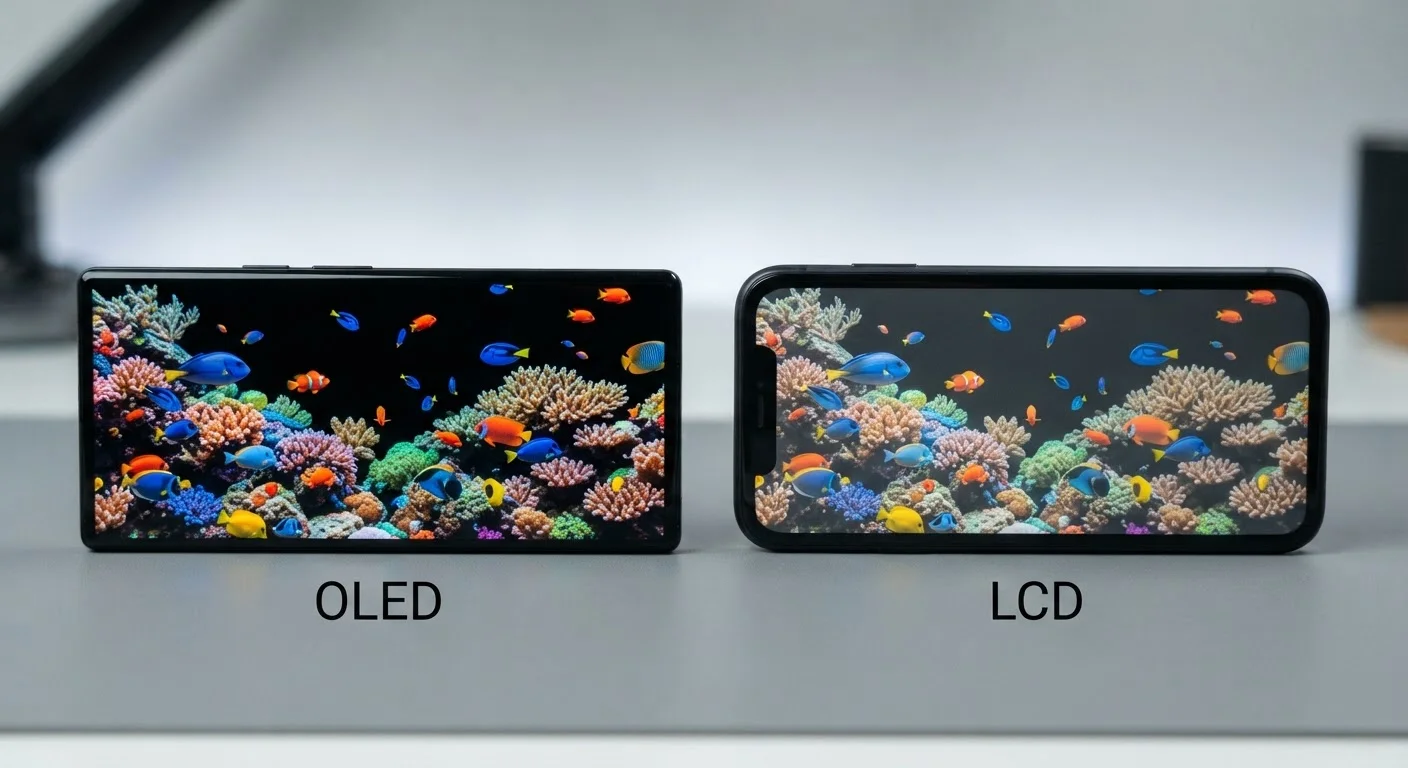
Photo credit: Telecom360.net | Connecting You To The Latest In Telecom
In this article
OLED and LCD panels differ in more than just price. Explore how each technology affects colour, battery life, and outdoor visibility.
Key Takeaways
- OLED pixels produce their own light; LCD pixels are illuminated by a separate backlight layer.
- OLED delivers true blacks and higher contrast ratios; LCD cannot fully block its backlight.
- LCD panels tend to sustain higher peak brightness levels, aiding outdoor readability in direct sunlight.
- OLED efficiency advantages apply mainly at low-to-medium brightness; at peak brightness, power draw is comparable.
- Long-term OLED use carries a risk of permanent image retention, known as burn-in, with static UI elements.
How Each Technology Actually Works
Understanding the core architecture of each panel type is essential before evaluating their trade-offs. An LCD (Liquid Crystal Display) uses a fluorescent or LED backlight that shines through a layer of liquid crystals. Those crystals act as shutters - they twist or align to control how much light passes through colour filters to produce each pixel. Critically, the backlight is always on; even in a pitch-black scene, some light bleeds through.
An OLED (Organic Light-Emitting Diode) panel eliminates the backlight entirely. Each pixel contains organic compounds that emit light independently when electric current is applied. To display a black pixel, the display simply turns that pixel off, drawing zero power for that element and producing no light whatsoever.
This fundamental difference - backlit passive pixels versus self-emissive active pixels - drives nearly every performance divergence between the two technologies. For a broader comparison that also covers AMOLED variants and Mini-LED, see Display Technologies Compared.
| Criterion | OLED | LCD |
|---|---|---|
| Light source | Self-emissive pixels | Separate backlight layer |
| Black level | True black (pixel off) | Dark grey (backlight bleeds) |
| Contrast ratio | Theoretically infinite | Thousands-to-one range |
| Sustained peak brightness | Lower full-panel sustained nits | Higher sustained full-panel nits |
| Colour gamut | Wide (DCI-P3 coverage) | Varies; QLED closes the gap |
| Battery efficiency | Efficient at low-medium brightness | Consistent draw regardless of content |
| Burn-in risk | Yes, with static UI elements | Not susceptible |
| Typical cost | Higher manufacturing cost | Lower manufacturing cost |
Contrast, Colour, and Brightness: Where Each Excels
Contrast ratio - the difference between the brightest white and darkest black a panel can render - is where OLED holds a structural advantage. Because black pixels are fully off, OLED contrast ratios are theoretically infinite. LCD contrast ratios, even with advanced local dimming zones (where sections of the backlight are individually dimmed), are typically measured in the thousands-to-one range. Residual backlight glow, often called blooming, appears as a halo around bright objects on dark backgrounds.
Colour volume also favours OLED in most implementations. OLED panels commonly cover the DCI-P3 colour space, the standard used in cinema production, more completely than standard LCD panels. However, high-end LCDs with quantum-dot enhancement (QLED) have closed this gap considerably.
Where LCD regains ground is peak brightness. Many LCD panels can sustain high nit levels across the entire screen surface for extended periods. OLED displays can reach comparable or higher peak brightness in small highlight areas, but sustained full-panel brightness is typically lower, partly to manage heat and organic material longevity. This matters in direct sunlight, where outdoor legibility depends on sustained, uniform luminance. Reading display specs like nits and contrast ratios is covered in more depth in our dedicated spec guide.
∞:1
OLED contrast ratio (theoretical)
Because OLED pixels switch off completely for black, the contrast ratio has no measurable upper ceiling, unlike LCD panels with finite backlight control.
~100%
DCI-P3 colour gamut coverage
Many flagship OLED smartphone displays are calibrated to cover near-complete DCI-P3 colour space, the cinema production standard, per manufacturer published specifications.
0W
Power draw for a fully black OLED pixel
A pixel displaying pure black on an OLED panel requires no current, making dark-mode and dark-content scenarios measurably more power-efficient.
Battery Life, Burn-In, and Long-Term Reliability
The power efficiency story for OLED is nuanced. At low-to-medium brightness - typical for indoor or evening use - OLED consumes less power because dark or black pixels draw little to no current. This is why dark mode genuinely extends battery life on OLED-equipped devices in ways it does not on LCD devices. At maximum brightness, however, the efficiency gap narrows considerably.
Burn-in is the most significant durability concern specific to OLED technology. Organic compounds degrade over time, and pixels that display static elements - navigation bars, keyboard outlines, status icons - for thousands of hours can permanently retain a faint ghost image. Modern OLED displays use pixel-shift algorithms and varied refresh patterns to mitigate this, but the underlying physics cannot be fully engineered away. LCD panels are not vulnerable to burn-in.
For a side-by-side look at how OLED compares to AMOLED - which is a variant of OLED using active-matrix addressing - see OLED, AMOLED, and LCD Screens Side by Side.
AMOLED Is a Subset of OLED
AMOLED (Active Matrix Organic Light-Emitting Diode) is not a separate technology from OLED - it refers to OLED panels that use an active-matrix addressing scheme, which is how virtually all modern smartphone OLED displays are constructed. When a manufacturer lists a phone as having an AMOLED screen, it is an OLED display. The distinction matters when comparing specs across device categories, as AMOLED is the industry-standard implementation for mobile.

Author
Smartphones Editorial Team
Smartphones Editorial Team is the collective byline for our editorial team and contributor network. Articles published under this byline or an editorial pen name are researched, written, and reviewed according to our editorial standards for clarity, consistency, and independence before publication.
View all articles →