
Display Technologies Compared: OLED, AMOLED, LCD, and Mini-LED on Smartphones
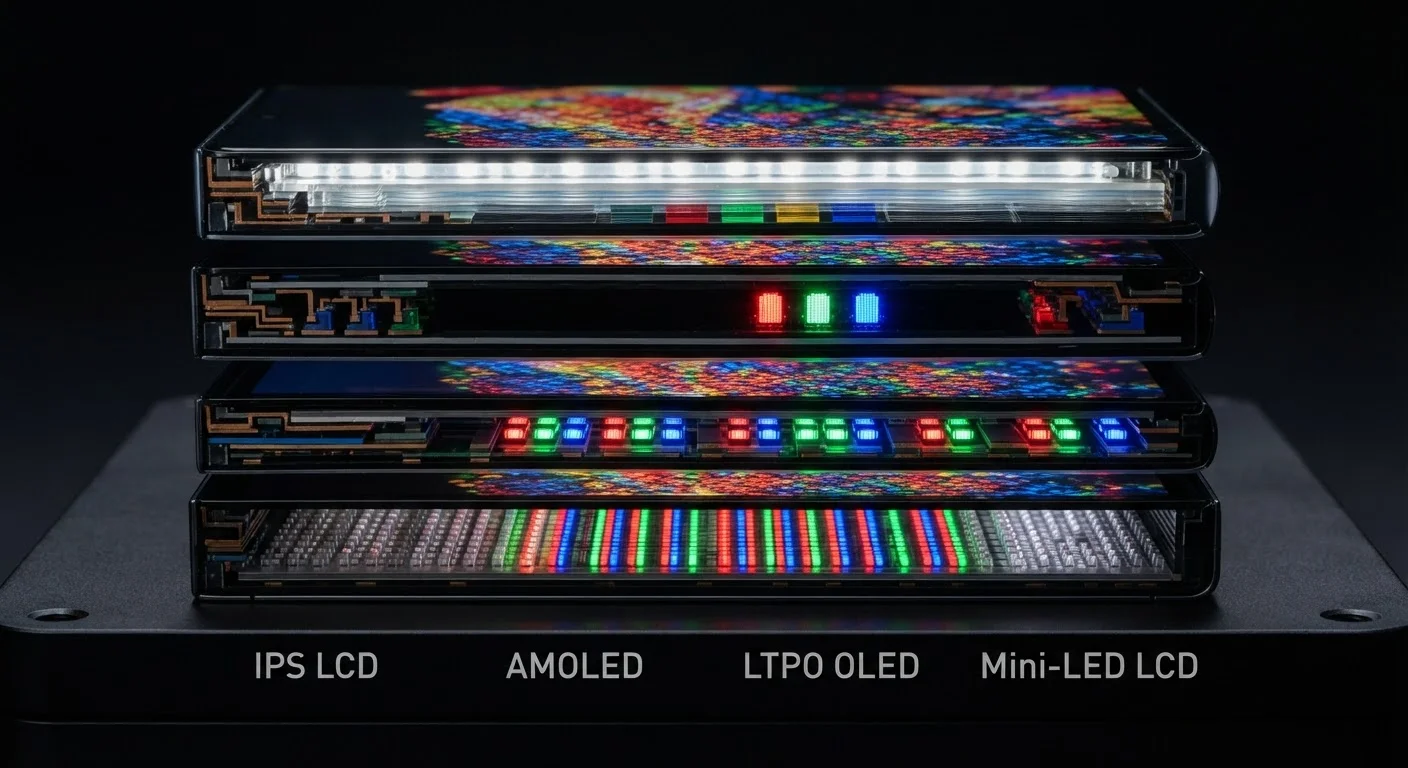
Photo credit: Telecom360.net | Connecting You To The Latest In Telecom
In this article
Each display technology makes different trade-offs in contrast, power use, and outdoor visibility. This comparison maps out the key differences.
Key Takeaways
- OLED and AMOLED panels produce true blacks by switching off individual pixels, delivering superior contrast ratios.
- LCD panels rely on a backlight, which limits contrast but typically offers consistent brightness across the display.
- Mini-LED improves on standard LCD by using thousands of smaller dimming zones, narrowing the gap with OLED contrast.
- AMOLED is a subset of OLED technology - the 'AM' refers to the active-matrix addressing used to control pixels.
- Power consumption varies significantly by content type: OLED saves battery on dark interfaces, LCD does not.
How Each Technology Produces Light
Understanding display trade-offs starts at the physics layer. Each panel type generates images through a different mechanism, and those mechanisms determine everything downstream - contrast, power draw, color accuracy, and outdoor legibility.
LCD (Liquid Crystal Display) uses a white backlight that shines through a layer of liquid crystals. The crystals act as shutters, blocking or allowing light through color filters to produce each pixel. Because the backlight is always on, true black requires blocking light mechanically - an imperfect process that results in light bleed.
OLED (Organic Light-Emitting Diode) eliminates the backlight entirely. Each pixel generates its own light using organic compounds that emit photons when current passes through them. A pixel displaying black simply draws no power and emits no light - producing an absolute black and a theoretically infinite contrast ratio.
AMOLED (Active-Matrix OLED) is the same organic emissive technology, but with an active-matrix thin-film transistor (TFT) layer controlling each pixel independently. This architecture is what most modern flagship smartphones use. The distinction between "OLED" and "AMOLED" is more about marketing nomenclature than a fundamental difference in light emission. For a deeper dive on OLED versus LCD panel mechanics, see our dedicated OLED vs. LCD breakdown.
Mini-LED keeps the LCD structure but replaces the traditional backlight with thousands of much smaller LEDs arranged in local dimming zones. More zones mean finer control over which parts of the screen are bright or dark, significantly improving contrast compared to standard LCD without abandoning the backlight model.
Key Performance Trade-offs
| OLED | AMOLED | LCD (IPS) | Mini-LED | |
|---|---|---|---|---|
| Contrast ratio | Infinite (pixel-off blacks) | Infinite (pixel-off blacks) | Limited by backlight bleed | Very high, zone-dependent |
| Peak brightness | High, varies by panel | High, varies by panel | Moderate to high | Very high, competitive outdoors |
| Power efficiency | Excellent on dark content | Excellent on dark content | Uniform draw regardless of content | Higher draw than OLED |
| Burn-in risk | Present over long term | Present over long term | Not applicable | Not applicable |
| Blooming / halo artifacts | None | None | Minimal | Possible near bright objects |
| Typical device segment | Mid-range to flagship | Flagship and premium mid-range | Budget to mid-range | Flagship and premium tablets |
Each technology makes concrete compromises. OLED and AMOLED deliver unmatched contrast and are highly power-efficient when displaying dark content - an important consideration given how widely dark mode is now adopted across apps and operating systems. However, OLED panels are susceptible to permanent image retention (burn-in) over extended periods of displaying static elements like navigation bars.
Mini-LED's dense backlight array allows peak brightness levels that can exceed most OLED panels - an advantage in direct sunlight. However, light from adjacent dimming zones can "halo" around bright objects on dark backgrounds, a phenomenon known as blooming. This artifact is less common on OLED, where each pixel is independent.
LCD panels, particularly those using IPS (In-Plane Switching) technology, offer wide viewing angles and consistent color uniformity across the panel surface. They are less prone to burn-in and tend to carry lower manufacturing costs - factors that keep them relevant in mid-range and budget devices. For context on how brightness specs like nits relate to real-world readability, our display specs guide covers those metrics in depth.
Use Dark Mode to Measure OLED Gains
If you're evaluating an OLED or AMOLED device for battery life, try enabling system-wide dark mode and observing screen-on time over a full day. Because dark pixels draw minimal power on self-emissive displays, the savings can be meaningful - particularly for heavy users. This effect does not apply to LCD or Mini-LED devices, where the backlight draws constant power regardless of on-screen content.
Which Display Type Fits Which Use Case
Display choice intersects with how and where you use your phone. A few practical scenarios illustrate the differences:
- Media consumption and gaming: AMOLED panels with high refresh rates produce vivid, high-contrast images well-suited to video and games. See how refresh rate interacts with panel type for the full picture.
- Outdoor use: Mini-LED displays can sustain higher sustained brightness, making them easier to read in sunlight. Some AMOLED panels now achieve comparable brightness in auto-brightness mode, though sustained peak brightness varies by implementation.
- Battery longevity: OLED and AMOLED consume significantly less power when rendering dark backgrounds, making dark mode a practical battery-saving tool - not just an aesthetic preference. LCD power draw is more uniform regardless of on-screen content.
- Long-term durability: LCD and Mini-LED panels are not susceptible to organic compound degradation or burn-in. OLED panels may show uneven aging on pixels that display static elements at high brightness over thousands of hours.
When reading a spec sheet to evaluate these factors, this structured spec sheet walkthrough provides a useful framework for the full hardware context.
Don't Rely Solely on Panel Type for Quality
Panel type is a starting point, not a guarantee of display quality. Color calibration, peak brightness, and local dimming implementation vary significantly between manufacturers - two AMOLED screens from different vendors can look markedly different. Always cross-reference independent display measurement data rather than inferring quality from the panel category alone.

Author
Smartphones Editorial Team
Smartphones Editorial Team is the collective byline for our editorial team and contributor network. Articles published under this byline or an editorial pen name are researched, written, and reviewed according to our editorial standards for clarity, consistency, and independence before publication.
View all articles →