
Closed vs Open: The Philosophy Behind iOS Walled Gardens and Android's Openness
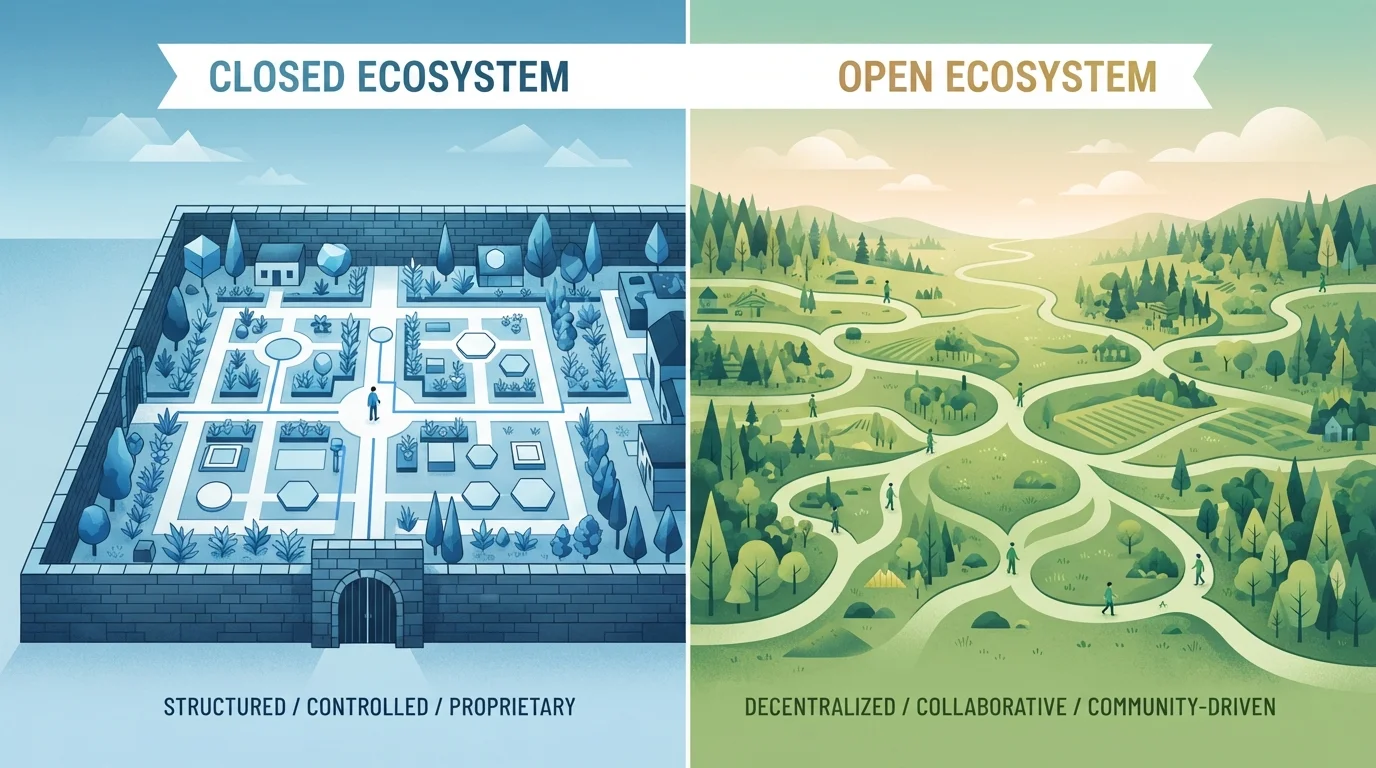
Photo credit: Telecom360.net | Connecting You To The Latest In Telecom
In this article
A balanced look at the trade-offs between Apple's tightly controlled ecosystem and Android's open-source foundations.
Key Takeaways
- iOS enforces uniform standards through a centralized App Store, while Android permits sideloading and multiple app stores.
- Apple's closed model produces tighter security and consistent performance; Android's openness enables greater hardware and software diversity.
- Neither approach is objectively superior - the right choice depends on how you prioritize control, privacy, and flexibility.
- Open-source roots give Android manufacturers and developers more customization latitude than iOS allows.
Uniform security standards across all iOS devices
Because Apple controls both hardware and software, security patches reach every supported device simultaneously without manufacturer intermediaries delaying deployment.
Consistent app quality through centralized review
App Store review catches a range of policy violations before software reaches users, reducing - though not eliminating - the prevalence of malicious or low-quality apps.
Longer, more predictable software support cycles
Apple typically supports iPhones with major OS updates for five or more years, giving users a clearer picture of long-term device viability than most Android hardware offers.
Deep hardware-software integration improves performance
Designing chips, firmware, and the OS in-house allows Apple to optimize performance and power efficiency in ways that general-purpose Android builds cannot always match.
Restricted sideloading limits software sources
On standard iOS configurations, users cannot install applications outside the App Store, removing access to software Apple has declined to approve regardless of the user's informed consent.
Developer constraints can reduce app innovation
Prohibitions on certain APIs - such as requiring all browsers to use WebKit - prevent developers from shipping features that competing implementations might offer on other platforms.
Fragmented update delivery on Android hardware
Because Android OEMs maintain separate software branches, security patches that Google ships can take weeks or months to reach end users on non-Pixel devices.
Sideloading exposes Android users to unvetted software
The ability to install APKs from arbitrary sources bypasses Play Store malware screening entirely, placing the burden of vetting squarely on the user.
Ecosystem lock-in limits cross-platform portability
Tightly integrated services - such as iMessage, AirDrop, and iCloud Keychain - create switching costs that can make leaving the Apple ecosystem more disruptive than changing Android devices.
Two Philosophies, One Market
The most consequential divide in consumer mobile technology is not screen size or camera resolution - it is the foundational philosophy governing how each operating system relates to its users, developers, and hardware partners. Apple's iOS operates as a closed ecosystem: Apple controls the hardware, the operating system, the primary app distribution channel, and the APIs developers may use. Google's Android is built on the Android Open Source Project (AOSP), a publicly available codebase that any manufacturer or developer can inspect, modify, and redistribute.
These are not accidental differences. They reflect divergent answers to a core question: who should hold authority over what runs on a device? For deeper technical context on how these diverging decisions affect memory management, security architecture, and hardware access, see how Android and iOS core architectures differ.
The iOS Walled Garden: Control as a Feature
Apple's control extends across every layer of the stack. Developers must submit apps through the App Store review process, which applies guidelines on privacy, performance, and content. Payment processing for in-app purchases flows through Apple's billing infrastructure. On iOS, third-party browsers must use Apple's WebKit rendering engine rather than their own. This uniformity has practical consequences.
Uniform security standards across all iOS devices
Because Apple controls both hardware and software, security patches reach every supported device simultaneously without manufacturer intermediaries delaying deployment.
Consistent app quality through centralized review
App Store review catches a range of policy violations before software reaches users, reducing - though not eliminating - the prevalence of malicious or low-quality apps.
Longer, more predictable software support cycles
Apple typically supports iPhones with major OS updates for five or more years, giving users a clearer picture of long-term device viability than most Android hardware offers.
Deep hardware-software integration improves performance
Designing chips, firmware, and the OS in-house allows Apple to optimize performance and power efficiency in ways that general-purpose Android builds cannot always match.
Security researchers generally regard iOS's attack surface as narrower than Android's precisely because fewer pathways exist for untrusted code to execute. Apple can push OS updates directly to all supported devices simultaneously, bypassing carrier or manufacturer intermediaries. The trade-off is that developers and users operate within clearly bounded constraints - constraints that have, at times, been the subject of regulatory scrutiny in the US and EU.
Android's Open Foundation: Flexibility and Fragmentation
AOSP's permissive licensing allows manufacturers to build heavily customized Android variants - from Samsung's One UI to Amazon's Fire OS - without requiring Google's approval. Users can install applications from outside the Play Store through a process called sideloading (APK installation), and multiple competing app stores can coexist on the same device.
Restricted sideloading limits software sources
On standard iOS configurations, users cannot install applications outside the App Store, removing access to software Apple has declined to approve regardless of the user's informed consent.
Developer constraints can reduce app innovation
Prohibitions on certain APIs - such as requiring all browsers to use WebKit - prevent developers from shipping features that competing implementations might offer on other platforms.
Fragmented update delivery on Android hardware
Because Android OEMs maintain separate software branches, security patches that Google ships can take weeks or months to reach end users on non-Pixel devices.
Sideloading exposes Android users to unvetted software
The ability to install APKs from arbitrary sources bypasses Play Store malware screening entirely, placing the burden of vetting squarely on the user.
Ecosystem lock-in limits cross-platform portability
Tightly integrated services - such as iMessage, AirDrop, and iCloud Keychain - create switching costs that can make leaving the Apple ecosystem more disruptive than changing Android devices.
This openness accelerates hardware diversity and lowers barriers for developers experimenting with new interaction models. It also means the responsibility for timely OS updates is distributed across dozens of manufacturers, each maintaining their own software branches. Security patches that Google releases may take weeks or months to reach devices from other manufacturers - a structural gap that closed ecosystems are largely insulated from. For a closer look at how app behavior diverges as a result of these platform differences, the app ecosystem explainer covers real-world implications.
AOSP vs. Google Android: An Important Distinction
The Android Open Source Project and the version of Android that ships on most consumer devices are not identical. Google's consumer Android includes proprietary apps and services - such as the Play Store and Google Play Services - that are licensed separately from the open-source core. Manufacturers who want to ship these services must meet Google's compatibility requirements, creating a layer of de facto control that sits above the AOSP baseline.
Security, Privacy, and Trust Models
Both platforms use sandboxing to isolate applications from one another and from the core OS - a concept explored in depth in the sandboxing explainer. Where they diverge is in how aggressively they enforce sandbox boundaries and what escape routes exist.
~72%
Share of mobile malware targeting Android
Security firm analyses consistently attribute the majority of mobile malware samples to Android, reflecting both its market share and the accessibility of sideloading.
5+ years
Typical iOS major update support window
Apple has extended software support for several iPhone models across five or more major OS versions, a benchmark that most Android OEMs have not matched as a standard practice.
iOS restricts background execution and inter-app communication more tightly than stock Android, limiting the vectors available to malicious software. Android's permission model has matured considerably - runtime permissions introduced in Android 6.0 and the stricter scoped storage model in Android 10 narrowed many historical gaps. Still, the presence of sideloading means that a user who installs an APK from an untrusted source bypasses all store-level vetting. Neither platform can fully protect users from deliberate circumvention of its own safeguards.
What the Debate Means for Everyday Users
For most people, the philosophical divide surfaces as a practical one: how much friction are you willing to accept in exchange for autonomy, and how much autonomy are you willing to cede in exchange for a managed, consistent experience? Power users who want to run unapproved software, switch default apps at every system level, or deploy devices without Google services have a clearer path on Android. Users who want a device that behaves predictably, receives updates for many years, and integrates tightly with other Apple hardware will find fewer rough edges on iOS.
Understanding the vocabulary underlying these choices - terms like open-source, API restrictions, sideloading, and sandboxing - is a prerequisite for evaluating trade-offs clearly. The mobile OS glossary provides concise definitions of these and related terms. For a broader comparison of how the two operating systems diverge beyond ecosystem philosophy, see how Android and iOS take fundamentally different approaches.

Author
Smartphones Editorial Team
Smartphones Editorial Team is the collective byline for our editorial team and contributor network. Articles published under this byline or an editorial pen name are researched, written, and reviewed according to our editorial standards for clarity, consistency, and independence before publication.
View all articles →