
AI Health Features on Wearables: Capability, Context, and Caution
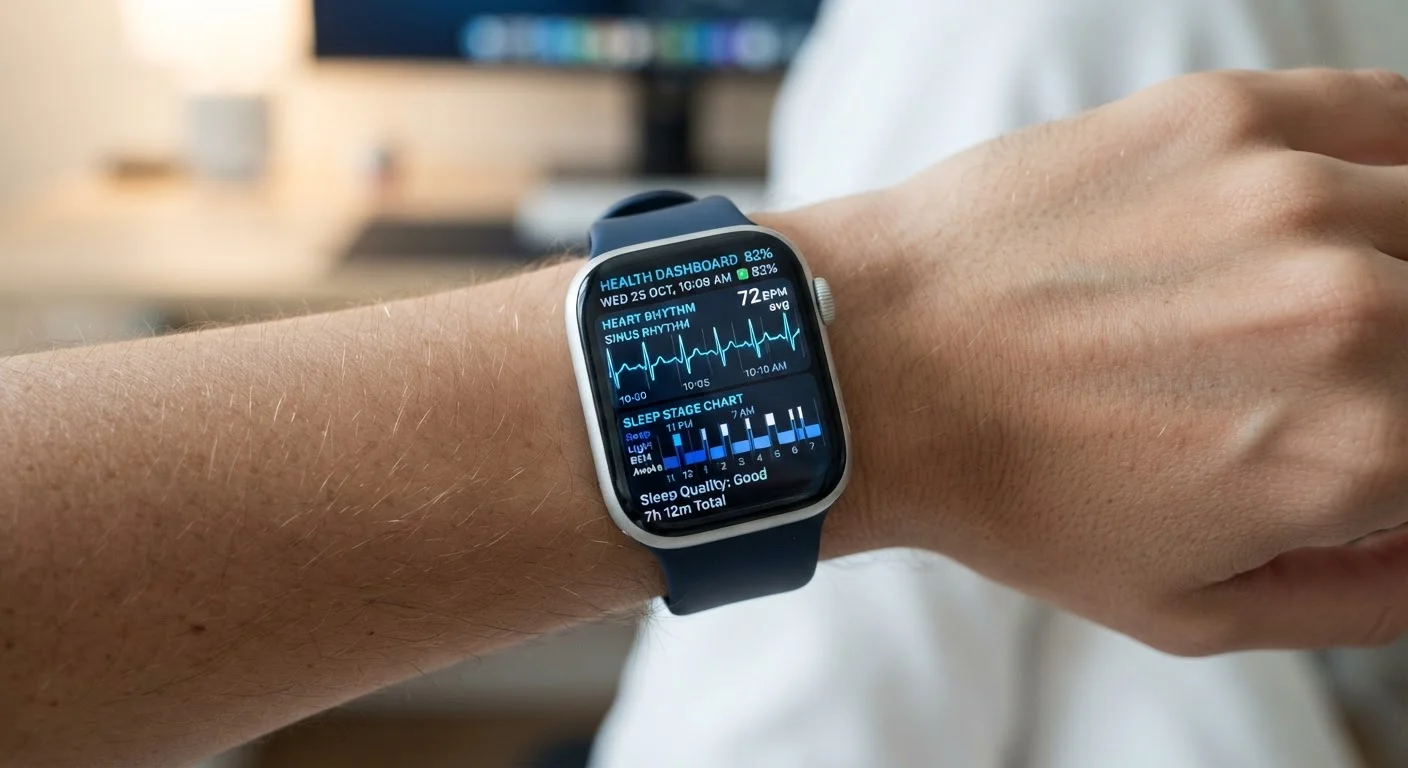
Photo credit: Telecom360.net | Connecting You To The Latest In Telecom
In this article
Smartwatches now flag irregular heart rhythms and estimate sleep stages using AI. Understand what these features measure — and their real-world limits.
Key Takeaways
- Wearable AI models detect patterns in sensor data; they do not diagnose medical conditions.
- Features like AFib detection have regulatory clearance in some markets, but most health scores do not.
- Sensor accuracy - affected by fit, skin tone, and movement - directly limits AI output quality.
- AI health alerts should prompt consultation with a clinician, not replace one.
- Understanding what a feature actually measures helps users interpret results without over-relying on them.
What AI Actually Does Inside Your Wearable
The term "AI" on a wearable product page often obscures more than it reveals. In practice, AI health features are machine learning models - typically trained offline on datasets from thousands or millions of users - then compressed and deployed onto the device or run via a cloud-connected app. The device's sensors collect raw signals: photoplethysmography (PPG) for heart rate, accelerometers for movement, and sometimes electrical signals via electrodes for ECG readings. The AI model's job is to classify or estimate something meaningful from that stream of data.
For irregular heart rhythm detection, for example, the model learns what normal sinus rhythm looks like versus patterns associated with atrial fibrillation (AFib), a common arrhythmia. When the sensor data matches an AFib-like pattern above a confidence threshold, the device triggers an alert. For sleep tracking, the model combines movement data, heart rate trends, and sometimes respiratory rate to estimate which sleep stage - light, deep, or REM - a user is likely in at a given moment.
What these models do not do is interpret symptoms, account for your medical history, or adapt dynamically to your individual physiology beyond basic personalization. They apply a generalized pattern-matching process to your data. That distinction matters enormously when evaluating what a notification actually means. For a deeper look at how the underlying sensors perform, see heart rate monitoring accuracy on wearables.
~33%
Adults using wearable health trackers
Pew Research Center surveys have found roughly one-third of U.S. adults regularly use a smartwatch or fitness tracker, making AI health features a mainstream consumer experience.
84%
AFib detection sensitivity in cleared devices
FDA submission data for certain smartwatch AFib detection algorithms has cited sensitivity figures around 84%, meaning roughly 1 in 6 true AFib episodes may not trigger an alert.
Regulated Features vs. General Wellness Scores
Not all AI health features carry the same level of scrutiny. In the United States, the FDA distinguishes between software that constitutes a medical device - because it's intended to diagnose, treat, or prevent a condition - and general wellness software, which is not subject to the same pre-market oversight.
ECG recording and AFib detection features on certain smartwatches have received FDA clearance, meaning the agency reviewed clinical evidence supporting their performance before those features could be marketed for their intended medical purpose. Blood oxygen saturation (SpO2) monitoring occupies a more complex regulatory space: some implementations are cleared as medical devices, while others are positioned as general wellness indicators and carry different disclaimers.
Composite scores - readiness scores, stress indexes, body battery estimates - are almost universally wellness features. They aggregate multiple signals using proprietary formulas and are not subject to FDA review. This does not make them useless, but it does mean there is no independent standard they must meet. The methodology behind these scores is rarely published, making external validation difficult. Understanding this regulatory landscape is essential before acting on any wearable alert. See also what to verify before trusting wearable health metrics for a practical checklist.
Check the Regulatory Status Before Acting
Before treating any wearable health alert as medically significant, check whether that specific feature has FDA clearance. This information is typically in the device's health and safety documentation or the manufacturer's regulatory disclosures page. A cleared feature has been reviewed against clinical evidence; a wellness feature has not. That distinction should shape how seriously you act on any individual reading.
Where Real-World Accuracy Breaks Down
AI models are only as reliable as the sensor data they receive. Several factors routinely degrade that input quality in everyday use, and users rarely see this reflected in the confidence of the output displayed on screen.
Motion artifacts - interference caused by arm movement during exercise - are a persistent challenge for optical heart rate sensors. AI filtering has improved significantly, but high-intensity or irregular movements (weightlifting, racket sports) still produce noisier readings than steady-state cardio. Wrist position, band tightness, skin temperature, and even tattoos can all affect PPG sensor performance.
Skin tone is another documented variable. Because PPG sensors use light absorption to infer blood volume changes, higher melanin concentrations can reduce signal clarity, and some research has found reduced accuracy in heart rate and SpO2 readings for users with darker skin. Device manufacturers have been working to address this through sensor design and algorithm updates, but it remains an acknowledged limitation.
Sleep tracking faces its own constraints. Wrist movement and heart rate are imperfect proxies for brain activity - the gold standard for sleep stage measurement. Wearable estimates can be directionally useful for identifying trends over weeks, but single-night readings carry substantial uncertainty. Getting more reliable sleep data from your wearable explains practical steps to improve consistency.
Using AI Health Alerts Responsibly
The appropriate response to a wearable health alert depends on the type of alert, your personal health context, and whether the feature generating it has regulatory backing. An AFib notification on a cleared device warrants a conversation with a physician - not because the device has diagnosed you, but because the signal is worth clinical evaluation. A low readiness score warrants reflection on your recent sleep and activity, not medical concern.
Wearable data can add useful context to a clinical conversation, particularly when it captures trends over time that would otherwise be invisible. A consistently elevated resting heart rate, persistent low sleep efficiency, or recurring rhythm anomalies are the kinds of patterns worth bringing to a healthcare provider. What wearable AI cannot replace is a clinician's ability to integrate your history, conduct a physical examination, and apply diagnostic judgment.
Privacy is a parallel concern. Biometric data collected by wearables is detailed and sensitive. Understanding what is stored on the device, what is transmitted to manufacturer servers, and what may be shared with third parties is a reasonable step before treating any platform as a health management tool. The broader picture of what wearable devices collect and where that data goes is worth understanding alongside the health features themselves.
“Consumer wearables have made passive health monitoring genuinely accessible for the first time, but there's a real risk of both over-reliance and under-appreciation. The technology is most useful when people understand what it can and cannot tell them.”
— Eric Topol, Cardiologist and digital medicine researcher, Scripps Research Translational Institute
This article is for informational purposes only and is not medical advice. Consult a qualified healthcare professional with any health concerns.
Frequently Asked Questions

Author
AI & Cloud Editorial Team
AI & Cloud Editorial Team is the collective byline for our editorial team and contributor network. Articles published under this byline or an editorial pen name are researched, written, and reviewed according to our editorial standards for clarity, consistency, and independence before publication.
View all articles →