
Personal vs. Business Cloud Storage: Where the Differences Really Matter
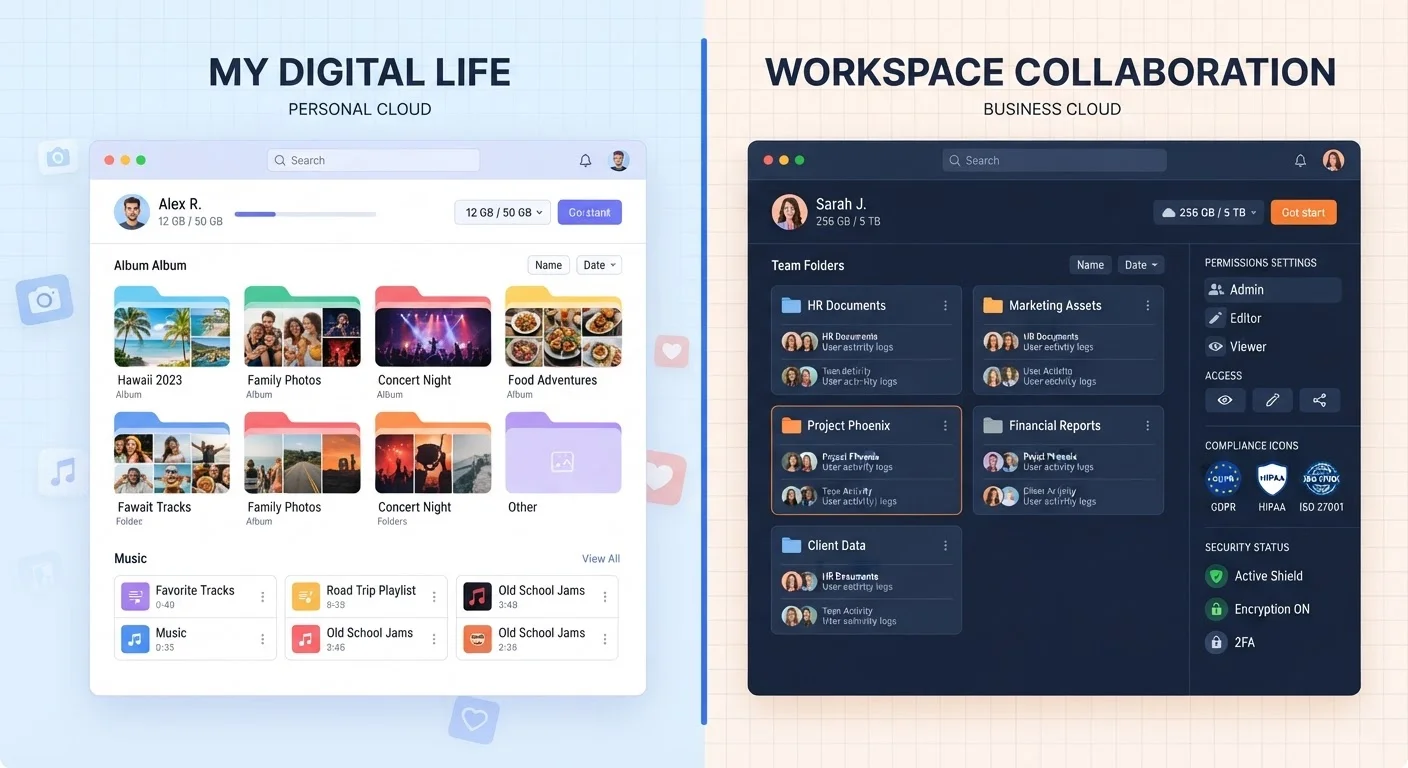
Photo credit: Telecom360.net | Connecting You To The Latest In Telecom
In this article
Consumer and enterprise cloud plans look similar on the surface. Here's what actually sets them apart.
Key Takeaways
- Personal cloud plans prioritize convenience and individual storage capacity; business plans emphasize control, compliance, and team management.
- Administrative controls - user provisioning, audit logs, and permission tiers - are exclusive to business-tier cloud services.
- Compliance certifications (HIPAA, SOC 2, GDPR) are typically only available on business or enterprise cloud tiers.
- Data ownership terms and provider access rights often differ significantly between consumer and business service agreements.
- Choosing the wrong tier can expose organizations to security gaps or leave individual users paying for features they'll never use.
The Surface-Level Similarities That Mask Real Differences
At a glance, personal and business cloud storage look nearly identical. Both offer remote file access, device sync, and folder sharing. Many services even share a brand name across both tiers - the same company's product marketed to individuals and enterprises alike. This surface similarity is precisely what makes choosing the wrong tier a common and costly mistake.
The divergence becomes clear once you look past raw storage capacity. Personal plans are designed around a single account holder and a handful of devices. Business plans are architected to manage dozens or hundreds of users, enforce access policies, and produce the audit documentation that regulators and legal teams require. As practical cloud storage scenarios illustrate, the right service depends heavily on who is storing what - and who else needs access to it.
| Personal Cloud Storage | Business Cloud Storage | |
|---|---|---|
| User management | Single account holder | Centralized admin console, multi-user provisioning |
| Access permissions | Basic folder sharing | Granular permission tiers per user or group |
| Audit logs | None or minimal | Detailed time-stamped access records |
| Compliance certifications | Not available | HIPAA, SOC 2, GDPR options on eligible plans |
| Data ownership terms | Broad provider rights common | Stronger ownership clauses in enterprise agreements |
| Version history & recovery | Limited, no SLA | Extended history, defined recovery SLAs |
| Data residency control | Not available | Region selection available on enterprise tiers |
| Primary use case | Personal files, photos, device sync | Team collaboration, regulated data, IT management |
Administration and Access Control: The Sharpest Dividing Line
The most consequential difference between personal and business cloud storage is the administrative layer. Business plans include a centralized admin console where IT staff - or an office manager - can provision new user accounts, revoke access instantly when someone leaves the organization, and set permission tiers so that a contractor can view files without being able to delete or download them.
Personal plans offer none of this. Sharing a folder with a family member or colleague is possible, but it relies on the individual account holder managing each relationship manually. There is no organization-wide policy, no automatic deprovisioning, and no record of who accessed what and when. For a solo user archiving vacation photos, that's fine. For a team handling client contracts, it's a meaningful operational gap - analogous to the distinction explained in our overview of enterprise vs. consumer mobile plans.
Audit Access Before You Commit
Before signing up for any cloud storage plan for organizational use, test the admin console with a trial account. Verify that you can create and remove users, set folder-level permissions, and export an access log. If a plan does not offer these controls in the trial, they are unlikely to appear after purchase.
Compliance, Audit Trails, and Data Residency
Regulated industries - healthcare, finance, legal services - face specific data handling obligations that personal cloud storage simply cannot satisfy. Certifications such as HIPAA (Health Insurance Portability and Accountability Act), SOC 2 (System and Organization Controls 2), and GDPR (General Data Protection Regulation) compliance are negotiated through business agreements and are not available on consumer tiers.
Beyond certifications, business plans typically offer detailed audit logs: time-stamped records showing which user accessed, modified, shared, or deleted a file. These logs matter during incident response, internal investigations, and external audits. Some business plans also allow organizations to specify data residency - restricting where data is physically stored to meet local regulatory requirements. Before uploading sensitive organizational files to any tier, it is worth reviewing what service agreements actually say about data access.
SOC 2
Audit standard required by many enterprise contracts
SOC 2 compliance requires an independent audit of a provider's security, availability, and confidentiality controls - a standard not offered on consumer-tier accounts.
99.9%+
Typical uptime SLA on business cloud tiers
Business and enterprise cloud agreements commonly include uptime SLAs above 99.9%, whereas consumer plans rarely include formal uptime commitments.
Data Ownership, Recovery, and Business Continuity
Consumer agreements often grant providers broad rights to scan content for service improvement, safety filtering, or advertising purposes - with terms that shift between updates. Business agreements, especially at the enterprise tier, typically include stronger data ownership language and explicit limits on provider access to stored content.
Recovery capabilities also diverge. Business plans commonly offer extended version history (enabling rollback after ransomware or accidental mass deletion), guaranteed restore windows, and service-level agreements (SLAs) that define uptime and recovery time objectives. Consumer plans may offer some version history, but SLAs are rare and recovery commitments informal. This matters alongside a broader point worth understanding: cloud storage is not the same as cloud backup, regardless of tier.
For organizations scaling across devices and teams, these structural differences mirror what separates business laptops from consumer models - the specifications may look comparable, but the policies and support infrastructure built around them are not.
Consumer Plans Can Expose Business Data
Using a personal cloud account for client contracts, employee records, or financial documents is a common shortcut with real legal risk. Consumer terms of service typically do not include the data processing agreements that regulations such as HIPAA and GDPR require. If your organization handles regulated data, verify that your storage provider offers a compliant business agreement - not just a higher storage quota.

Author
AI & Cloud Editorial Team
AI & Cloud Editorial Team is the collective byline for our editorial team and contributor network. Articles published under this byline or an editorial pen name are researched, written, and reviewed according to our editorial standards for clarity, consistency, and independence before publication.
View all articles →