
How Noise Cancellation Actually Works in Headphones
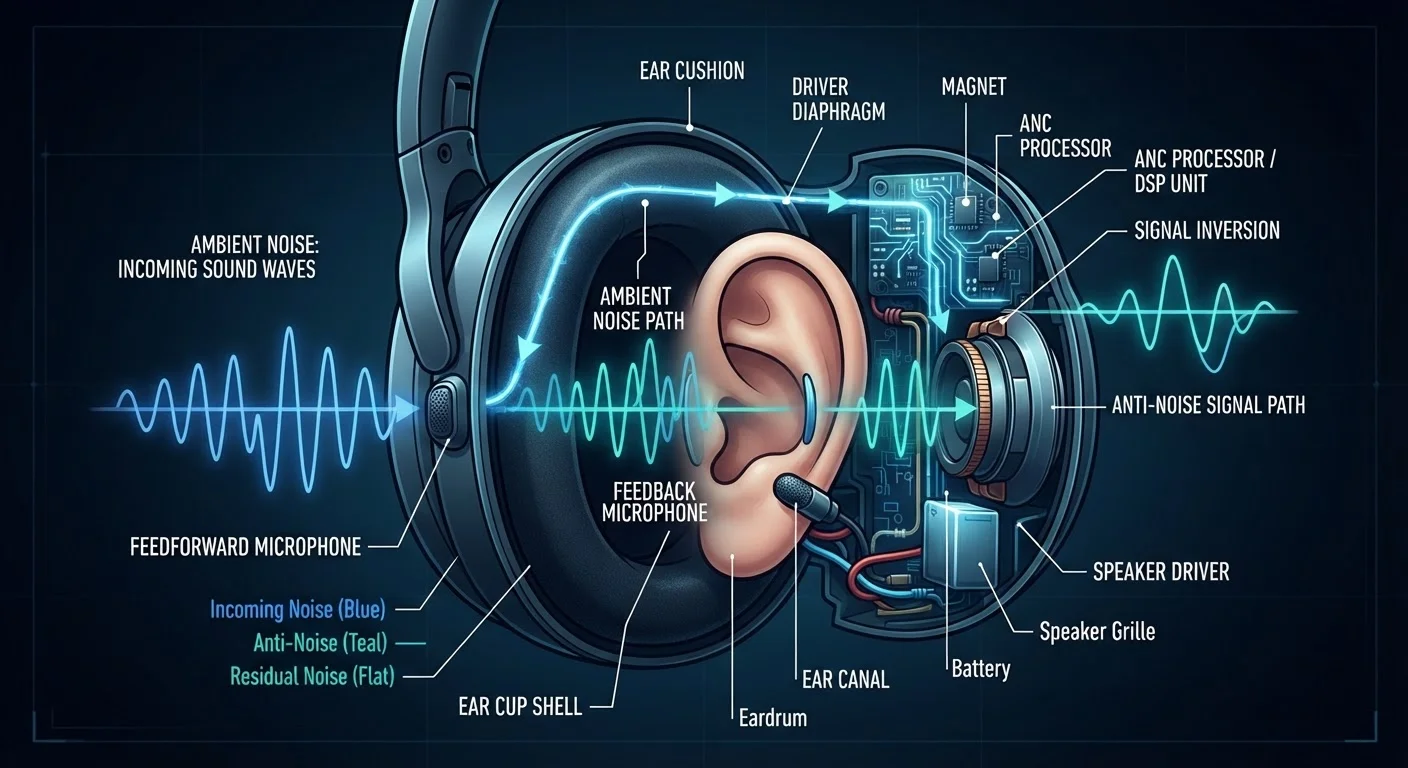
Photo credit: Telecom360.net | Connecting You To The Latest In Telecom
In this article
Explore the physics and signal processing behind active noise cancellation and why it works better in some environments than others.
Key Takeaways
- ANC works by generating sound waves that are the exact inverse of ambient noise, causing destructive interference.
- It performs best against consistent, low-frequency sounds like engine hum or air conditioning.
- Multiple microphones - feedforward, feedback, or hybrid - determine how accurately ANC can track noise.
- High-frequency and unpredictable sounds like voices are harder for ANC to cancel effectively.
- ANC processing introduces a small but measurable latency, which some listeners perceive as audio coloration.
The Physics Behind the Silence
Sound is a pressure wave - a series of compressions and rarefactions traveling through air. When two sound waves meet, they interact through a principle called superposition: their pressures add together at every point in space. Active noise cancellation exploits a specific case of this - destructive interference - where a wave and its exact inverse cancel each other out, producing silence.
In practice, ANC circuitry samples an incoming noise waveform, inverts it mathematically (flipping peaks to valleys and valleys to peaks), and plays that inverted signal through the headphone's speaker. When the original noise wave and the anti-noise wave combine at the listener's ear, their amplitudes partially or fully cancel. The key word is partially: perfect cancellation requires that the anti-noise signal match the original with near-perfect timing, amplitude, and shape - a difficult engineering challenge in a real-world, dynamic acoustic environment.
Destructive Interference Has Physical Limits
Perfect cancellation - where two waves completely nullify each other - only occurs at a single point in space. In a real ear canal, the geometry is complex and the listener moves, meaning the zone of cancellation is approximate rather than absolute. This is why even the most sophisticated ANC still allows some residual noise through.
Microphone Placement and ANC Architectures
The accuracy of ANC depends almost entirely on how well the system can sample the noise before it reaches your eardrum. Headphone designers use three main microphone architectures to solve this:
- Feedforward ANC: Microphones are mounted on the outside of the ear cup, capturing noise as it approaches. This gives the processor more time to generate an anti-noise signal but requires accurate prediction of how the sound will change as it enters the ear.
- Feedback ANC: A microphone is placed inside the ear cup, close to the driver. It monitors what the listener is actually hearing and makes real-time corrections. This is more accurate but has less time to react.
- Hybrid ANC: Both microphone positions are used simultaneously, combining the anticipatory advantage of feedforward with the corrective accuracy of feedback. Most high-performing over-ear headphones use this approach.
The number of microphones, their sensitivity, and the quality of the digital signal processor (DSP) chip that runs the inversion algorithm all contribute to how effective cancellation is across different frequencies. True wireless earbuds face unique constraints in fitting this hardware into a compact form factor, which is one reason ANC performance often differs between earbuds and full-size headphones.
20-30 dB
Typical ANC attenuation for low-frequency noise
Published acoustic engineering research consistently places effective ANC reduction in the 20-30 dB range for frequencies below 1 kHz under controlled conditions.
~1 kHz
Upper frequency limit for effective ANC
Most ANC implementations show diminishing effectiveness above approximately 1,000 Hz due to the timing and computational demands of inverting shorter wavelengths.
3-5 dB
Additional attenuation from hybrid vs. single-mic ANC
Acoustic testing comparisons generally show hybrid feedforward-feedback architectures outperform single-mic designs, particularly in the 500 Hz-1 kHz range.
Why ANC Struggles With Certain Sounds
ANC is not equally effective across the full spectrum of sound. It excels with low-frequency, consistent noise - the drone of a plane cabin, an HVAC system, or highway traffic - because these sounds are predictable enough for the DSP to build an accurate inverse signal. Higher-frequency sounds present two compounding problems: their shorter wavelengths make timing requirements far more demanding, and they change rapidly in ways that outpace the processing loop.
Human speech is a particularly difficult target. Voices occupy a broad frequency range (roughly 300 Hz to 3,400 Hz for core intelligibility), change constantly, and arrive from unpredictable directions. This is why ANC headphones worn in a loud café still let conversation through more than they suppress engine noise. The technology is not designed to silence speech - it is optimized for the types of noise where destructive interference is computationally achievable.
It's also worth distinguishing ANC from physical blocking. Passive isolation works through physical barrier attenuation, which is more consistent across frequencies but cannot be adjusted dynamically. Many headphones combine both approaches for broader noise reduction.
Fit Directly Affects ANC Performance
The physical seal between the ear cup or earbud tip and your ear is not cosmetic - it determines what the internal feedback microphone actually measures. A poor fit allows sound to bypass the ANC system entirely through acoustic leakage. If ANC feels less effective than expected, the ear tip size or ear cup pressure adjustment is often the first variable to check.
Signal Processing and Real-World Trade-offs
The ANC processing loop introduces a small amount of latency - the time between sampling the noise and playing back the anti-noise signal. In well-designed systems, this latency is kept below the threshold where it causes audible problems, but it is never zero. Some listeners perceive the interaction between the anti-noise signal and the audio playback as a subtle pressure sensation or a slight change in tonal character, particularly in the bass range.
Modern implementations use adaptive ANC, where algorithms continuously adjust the anti-noise filter based on real-time feedback from the listening environment and the fit of the ear seal. A loose seal changes how sound enters the ear cup, which alters what the feedback microphone detects - adaptive systems compensate for this automatically. Open-ear designs bypass the ear seal entirely, which is why ANC is not commonly found in bone conduction or open-back headphones.
Understanding these trade-offs helps contextualize why ANC performance varies so widely between devices - it is the result of specific hardware choices, DSP capability, and acoustic design, not a simple on/off feature. For a deeper look at how microphone arrays process sound in real time, the same signal processing principles appear across modern mobile audio hardware.
Frequently Asked Questions

Author
Consumer Electronics Editorial Team
Consumer Electronics Editorial Team is the collective byline for our editorial team and contributor network. Articles published under this byline or an editorial pen name are researched, written, and reviewed according to our editorial standards for clarity, consistency, and independence before publication.
View all articles →