
True Wireless Earbuds: What the Specs Sheet Doesn't Tell You
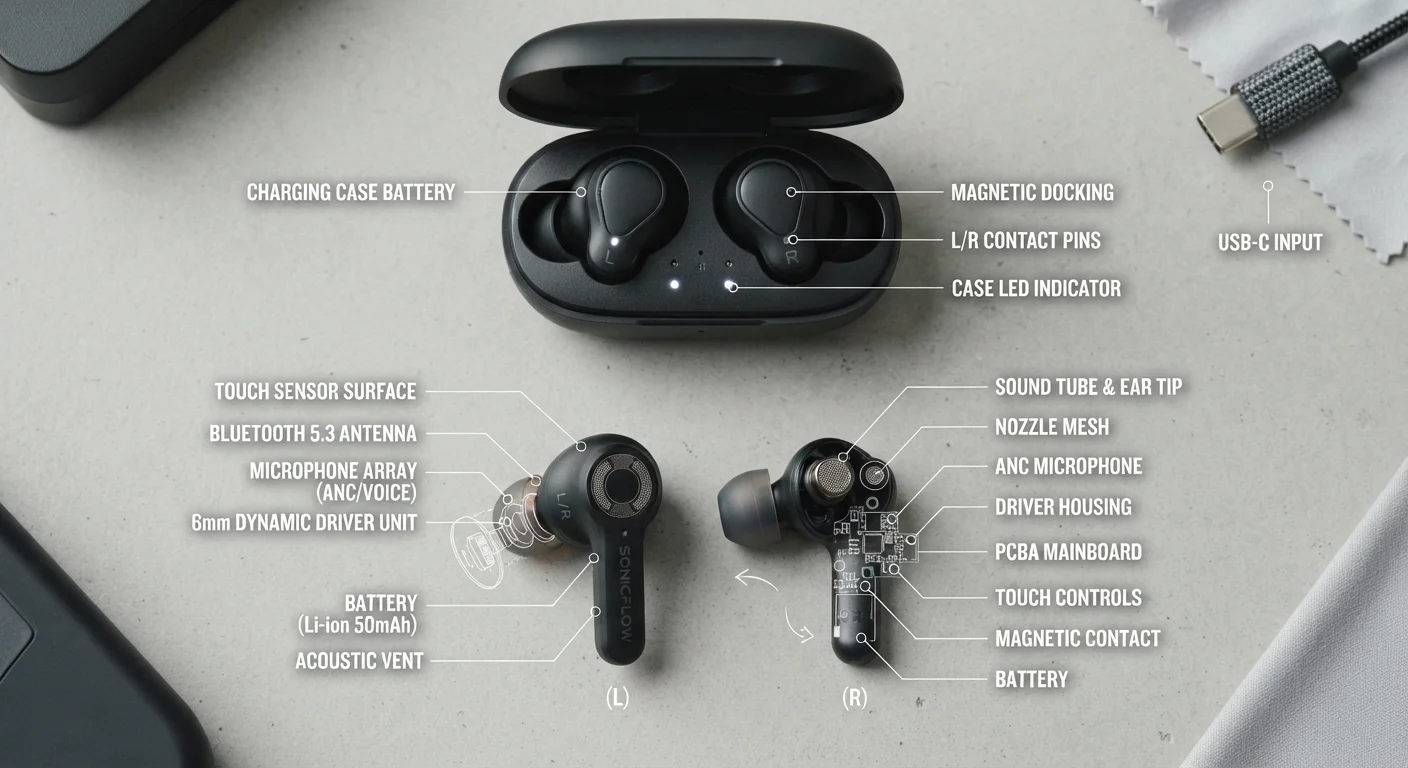
Photo credit: Telecom360.net | Connecting You To The Latest In Telecom
In this article
Driver size, codec support, latency, and IPX ratings all appear on spec sheets — but what do they actually mean for everyday listening?
Driver Size: Bigger Isn't Simply Better
Driver size is one of the first figures listed on any earbud spec sheet, typically measured in millimeters. A larger driver can move more air, which in theory produces stronger bass response - but the relationship between driver diameter and sound quality is far from linear. Acoustic tuning, the geometry of the ear canal seal, and the materials used in the driver membrane all shape the final sound as much as raw size does.
Dynamic drivers (the most common type) use a magnetic coil to vibrate a diaphragm. Balanced armature drivers, often found in professional in-ear monitors, are smaller but excel at mid and high-frequency clarity. Some earbuds combine both types in a hybrid configuration. None of these arrangements is universally superior - the implementation matters more than the spec alone.
For a broader look at how audio specs translate across mobile devices, see our guide to smartphone audio.
Dynamic Driver
A type of audio transducer that uses a magnetic coil and flexible diaphragm to produce sound. It is the most common driver type in consumer earbuds and headphones.
Balanced Armature
A compact driver design used mainly in hearing aids and professional in-ear monitors. It provides high accuracy at mid and high frequencies but typically lacks deep bass extension.
Codec
A compression algorithm that encodes and decodes audio data for Bluetooth transmission. Common codecs include SBC, AAC, aptX, and LDAC, each offering different trade-offs between file size and audio quality.
IPX Rating
An international standard indicating a device's tested resistance to water ingress. The 'X' denotes untested dust protection; the numeric suffix indicates the level of water resistance.
ANC (Active Noise Cancellation)
A technology that uses microphones to sample ambient sound and generates an opposing waveform to reduce perceived background noise during playback.
Latency
The delay between an audio signal being sent from a source device and the sound being produced by the earbuds. High latency causes audio to fall out of sync with video or interactive content.
Codecs, Latency, and the Wireless Chain
Bluetooth audio codecs determine how audio data is compressed and transmitted from a source device to the earbuds. SBC is the universal baseline supported by all Bluetooth audio devices. AAC offers improved quality at similar data rates and is widely used on iOS devices. aptX and its variants (aptX HD, aptX Adaptive) target higher fidelity and lower latency, primarily in the Android ecosystem. LDAC, developed by Sony, transmits the highest data volume and is often cited on spec sheets as a premium feature.
Codec support on the earbuds alone is insufficient - the source device must also support the same codec for it to activate. A pair of earbuds advertising LDAC will fall back to SBC when paired with a device that lacks LDAC output capability.
Latency - the delay between audio signal and playback - is another figure that requires context. Manufacturers sometimes quote "gaming mode" latency, which applies only in a specific reduced-quality mode. For video and general media, standard codec latency is typically what users will experience. Quoted figures below 40ms are uncommon in real-world conditions regardless of marketing claims.
| Universal Bluetooth audio codec | SBC (Subband Coding) (Bluetooth SIG specification) |
| Codec requiring source device match | Yes - both device and earbuds must support the same codec |
| Typical ANC effectiveness range | Low-frequency, steady noise (20-1,000 Hz) (General industry understanding) |
| IPX4 protection level | Splash resistant from any direction (IEC 60529 standard) |
| ANC impact on battery life | Typically reduces rated life by 20-40% (General observed range across consumer products) |
| LDAC maximum transmission rate | 990 kbps (Sony LDAC specification) |
IPX Ratings and Active Noise Cancellation: Understanding the Fine Print
IPX ratings indicate water resistance, not waterproofing. The "X" in IPX4 means dust ingress has not been tested - only water resistance is rated. IPX4 signifies protection against water splashing from any direction, while IPX7 indicates temporary submersion tolerance. These ratings are assessed under controlled lab conditions and do not account for repeated exposure, soap or chlorine, or aging seals.
Active Noise Cancellation (ANC) works by using external microphones to sample ambient sound and generate an inverse waveform, which is mixed into playback to cancel incoming noise. Spec sheets rarely disclose the frequency range over which ANC is effective. Most consumer ANC performs well on low-frequency, consistent sounds - aircraft cabin hum, air conditioning - and less reliably on sharp, unpredictable noises.
Transparency or passthrough modes use the same microphones to amplify external audio, effectively making the earbuds acoustically semi-open. The quality of this mode varies considerably between devices and is almost never quantified on spec sheets.
For patterns in how manufacturers present - and sometimes obscure - these figures, the article Spec Sheet Traps provides useful cross-category context.
20-40%
Battery life reduction with ANC enabled
A commonly observed range across consumer true wireless earbuds when active noise cancellation is switched on versus off.
IPX4
Most common water resistance rating for earbuds
IPX4 indicates splash resistance from any direction under IEC 60529 lab conditions - not submersion protection.
990 kbps
Peak LDAC Bluetooth audio data rate
Compared to SBC's typical ceiling of around 328 kbps, per Sony's published LDAC specification.
Battery Life Claims and What They Omit
Earbud battery life is almost always quoted under ideal conditions: moderate volume, ANC disabled, and a specific codec active. Real-world use with ANC enabled typically reduces rated battery life by 20-40%. Playback at higher volumes draws additional power from the driver amplifier.
Charging case capacity is expressed in milliamp-hours (mAh), but case-to-earbud charge cycles depend on each earbud's battery size, so raw mAh figures are not directly comparable across models. The combined stated figure (e.g., "30 hours total") bundles earbud and case together, which can obscure that the earbuds themselves might only last 5-6 hours per charge.
Wireless charging support for the case is a convenience feature and does not affect audio performance. Fast-charge claims (e.g., "10 minutes for 1 hour playback") are generally verifiable and often more reliable indicators of practical usability than total rated hours.
For related perspective on how numeric specs are framed across device categories, see Reading a Smartphone Spec Sheet Without Getting Misled. If you're exploring personal audio more broadly, Personal Audio for New Listeners maps out the wider landscape of listening formats.

Author
Consumer Electronics Editorial Team
Consumer Electronics Editorial Team is the collective byline for our editorial team and contributor network. Articles published under this byline or an editorial pen name are researched, written, and reviewed according to our editorial standards for clarity, consistency, and independence before publication.
View all articles →