
Personal Audio for New Listeners: Understanding the Choices Beyond Earbuds
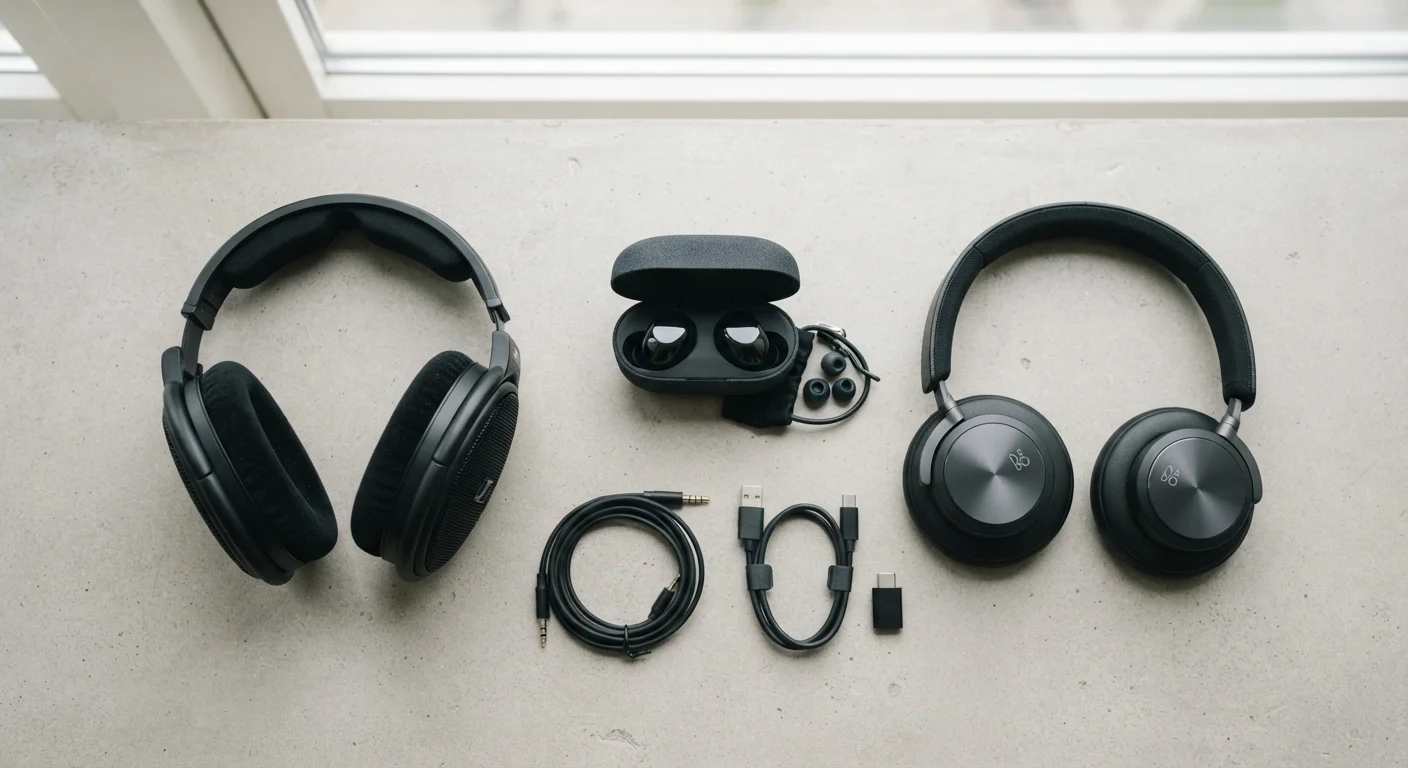
Photo credit: Telecom360.net | Connecting You To The Latest In Telecom
In this article
In-ear monitors, on-ear headphones, open-back cans — the personal audio world is wide. This guide maps the landscape for newcomers.
Key Takeaways
- Form factor - in-ear, on-ear, or over-ear - shapes comfort, isolation, and sound character before any spec matters.
- In-ear monitors differ from consumer earbuds in driver design, fit depth, and tuning precision.
- Open-back headphones prioritize a natural soundstage; closed-back designs prioritize isolation.
- Impedance and sensitivity determine how well a headphone pairs with a given source device.
- No single form factor is universally superior - the right choice depends on your environment and listening goals.
Why Form Factor Is the First Decision
Before driver type, impedance, or codec support enters the conversation, every new listener faces a more fundamental question: how does this device physically interact with your ear? That question defines everything downstream - sound signature, passive noise isolation, wearability during exercise, and how sound reaches your eardrum.
Personal audio hardware divides into three broad form factors: in-ear (seated inside the ear canal), on-ear (resting against the outer ear), and over-ear (enclosing the entire ear). Each creates a different acoustic environment, and each carries trade-offs in comfort, portability, and audio fidelity that no amount of clever engineering can fully eliminate.
Understanding these trade-offs before evaluating any specific product prevents the most common mistake newcomers make: choosing a device optimized for a use case that doesn't match their own.
Start With Your Use Case, Not Specifications
When first exploring personal audio, resist the urge to lead with technical specs. Identify the one or two environments where you'll use the device most, then use those scenarios to filter your form factor options. Specifications become meaningful context once you've narrowed the field.
In-Ear Monitors vs. Consumer Earbuds
In-ear monitors (IEMs) are designed to sit inside the ear canal, creating a physical seal using silicone or foam ear tips. This seal serves two purposes: it blocks ambient sound passively, and it couples the driver's output directly to the ear canal for more controlled bass response and detail retrieval.
Consumer earbuds - including many true wireless models - typically rest at the canal opening rather than sealing inside it. The fit is less secure and the acoustic chamber is less defined, which tends to produce a more relaxed, less precise sound. For a deeper look at what earbud spec sheets often omit, see True Wireless Earbuds: What the Specs Sheet Doesn't Tell You.
IEMs frequently use multiple drivers - combinations of dynamic and balanced armature units - each handling a different frequency range. This multi-driver architecture can reproduce fine detail across the frequency spectrum, though tuning choices vary widely between manufacturers.
Driver
The transducer inside a headphone or earbud that converts an electrical audio signal into sound waves you can hear.
Impedance
A measure of electrical resistance in the headphone circuit, expressed in ohms. Higher impedance typically requires a more powerful source to drive the headphone adequately.
Soundstage
The perceived sense of space and instrument placement in a stereo recording - how wide and three-dimensional the audio feels while listening.
Balanced armature
A compact driver type used in in-ear monitors that uses a tiny armature suspended between magnets, prized for detail and precision in a small package.
Passive isolation
Noise reduction achieved purely through the physical seal of the ear tip or ear cup, without electronic noise cancellation.
Frequency response
A description of how a headphone reproduces different pitches across the audible range, indicating whether bass, midrange, or treble are emphasized or recessed.
On-Ear and Over-Ear Headphones Explained
On-ear headphones (also called supra-aural) rest their ear cushions directly on the outer ear. They are generally more compact and portable than over-ear designs, but the contact pressure can cause discomfort during long sessions, and the imperfect seal allows more ambient sound through.
Over-ear headphones (circumaural) enclose the entire outer ear within a larger cup. The larger physical cavity allows for bigger drivers and more air movement, which can benefit bass extension and soundstage width. The closed space around the ear also creates more effective passive isolation in closed-back designs. The trade-off is size and weight - over-ear headphones are less suited to commutes or athletic use.
Driver size in over-ear designs commonly ranges from 40 mm to 50 mm, compared to the 6-10 mm drivers typical in IEMs. Larger drivers don't inherently guarantee better sound, but they do allow different acoustic engineering approaches.
Open-Back vs. Closed-Back: Soundstage and Isolation
Within the over-ear and on-ear categories, a further distinction shapes the listening experience profoundly: whether the ear cup is open-backed or closed-back.
Closed-back designs seal the driver in an enclosed chamber. This traps sound inside and blocks outside noise, making them practical in noisy or shared environments. The trade-off is that sound can feel more in-head - intimate but sometimes congested at busy mix points.
Open-back designs vent the rear of the ear cup to the outside air. This allows the driver to breathe, reducing internal reflections and creating a more expansive, natural soundstage - the perceived three-dimensional space of instruments in a recording. The cost is bidirectional: ambient noise enters, and your audio leaks to those nearby.
A related but distinct category is open-ear audio - devices like bone conduction headphones that don't cover the ear at all. Open-Ear Audio: How Bone Conduction and Air Conduction Headphones Differ is a useful reference for understanding those trade-offs separately.
Key Technical Concepts Every New Listener Should Know
Several technical terms appear repeatedly across headphone reviews and spec sheets. Understanding what they actually measure - and what they don't - helps calibrate expectations.
- Impedance (measured in ohms): Reflects how much electrical resistance the headphone presents to the source. Higher impedance headphones typically require more voltage to reach adequate volume and often benefit from a dedicated amplifier.
- Sensitivity (dB/mW): Indicates how loud a headphone gets per unit of power input. High-sensitivity headphones may be driven adequately by a smartphone; lower-sensitivity models may not.
- Frequency response: Describes how evenly (or unevenly) the headphone reproduces different pitches, from deep bass to high treble. Flat frequency response is valued in monitoring and reference applications; consumer tunings often boost bass and presence frequencies.
- Driver type: Dynamic, balanced armature, and planar magnetic drivers each convert electrical signals to sound through different physical mechanisms, each with distinct tonal and distortion characteristics.
One claim you'll encounter frequently in audio communities is that new headphones need extended playback - called burn-in - to reach their optimal sound. The evidence for this is thin. Myths About Headphone Burn-In and Whether It Changes Sound examines this claim in detail.
Frequency Response Graphs Are a Starting Point
Frequency response measurements give useful comparative data, but they are recorded with standardized test equipment - not your actual ear canal anatomy. Individual ear shape affects how sound arrives at your eardrum, meaning two listeners can perceive the same headphone differently. Use measurement data as a directional guide, not an absolute verdict.
Matching Your Listening Habits to the Right Device
No single form factor dominates every scenario. The more clearly you define how and where you listen, the more useful the form factor distinctions become.
| Use Case | Recommended Form Factor | Key Reason |
|---|---|---|
| Daily commute / transit | Closed-back IEM or closed-back on-ear | Passive isolation, compact size |
| Home critical listening | Open-back over-ear | Soundstage, low distortion at volume |
| Office / shared workspace | Closed-back over-ear | Isolation without leakage |
| Exercise / sport | IEM with secure fit tips | Stability, sweat resistance |
| Reference / studio monitoring | Flat-tuned IEM or open-back over-ear | Accurate frequency representation |
Compatibility with your source device also matters. If you primarily listen through a smartphone, check that the headphone's impedance and sensitivity align with a mobile output's lower power ceiling. Smartphone Audio: Microphone Arrays, Spatial Sound, and What Specs Don't Tell You provides useful context on what modern phones can and can't drive effectively.
Open-Ear Audio Explainer
A focused guide to bone conduction and air conduction headphones - explaining how each method works and the real-world trade-offs between them.
True Wireless Earbuds Spec Guide
Breaks down what driver size, codec support, latency figures, and IPX ratings actually mean for everyday listening - going beyond marketing language.
Headphone Burn-In Myth Analysis
An evidence-based look at whether extended playback actually changes how headphones sound, and what acoustic measurements show about the burn-in claim.
Frequently Asked Questions

Author
Consumer Electronics Editorial Team
Consumer Electronics Editorial Team is the collective byline for our editorial team and contributor network. Articles published under this byline or an editorial pen name are researched, written, and reviewed according to our editorial standards for clarity, consistency, and independence before publication.
View all articles →