
Phishing, Smishing, and Vishing: What Each Attack Actually Looks Like
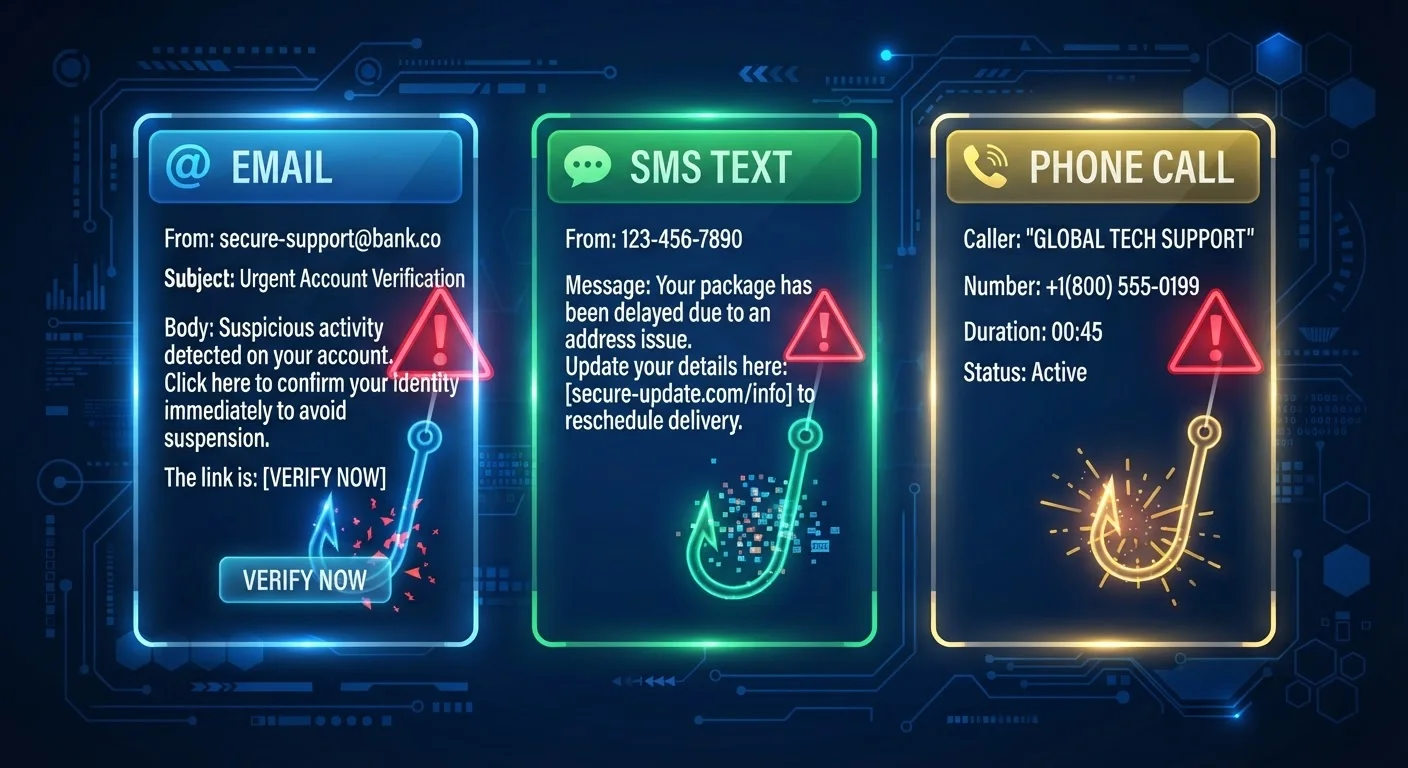
Photo credit: Telecom360.net | Connecting You To The Latest In Telecom
In this article
Learn how phishing, smishing, and vishing attacks differ, what they look like in practice, and why each one catches people off guard.
Key Takeaways
- Phishing, smishing, and vishing differ by delivery channel but share the same deceptive goal.
- Attackers craft convincing impersonations of banks, government agencies, and tech companies.
- Urgency and fear are the primary psychological levers used in all three attack types.
- Legitimate organizations will never demand immediate action or sensitive credentials over unsolicited contact.
- Recognizing the patterns of each attack type is the most reliable form of defense.
Phishing: The Email Deception That Still Works
Phishing is the oldest and most widely recognized of the three attack types, yet it remains one of the most effective. Attackers send emails designed to look like they come from a trusted source - a bank, a streaming service, a government agency, or even a colleague. The message typically presents a problem requiring immediate attention: a locked account, an unauthorized transaction, or a failed delivery.
What makes phishing succeed is the combination of visual credibility and manufactured urgency. Attackers replicate official logos, use domain names that closely mimic real ones (such as support-paypa1.com), and write subject lines calculated to trigger anxiety. The call to action usually leads to a spoofed login page that harvests credentials the moment they are entered.
Modern phishing attacks increasingly use spear phishing - a targeted variant that uses information specific to the victim, such as their name, employer, or recent purchases, gathered from data breaches or social media. This personalization dramatically increases the likelihood that a message will be trusted. For a broader look at threats targeting mobile users, see Digital Threats Every Smartphone User Should Know About.
Pause Before You Click or Reply
Attackers design their messages to short-circuit careful thinking by inducing panic or excitement. Before acting on any unexpected email, text, or call, take a full minute to verify the sender's identity through an independent channel - such as the organization's official website or a known phone number. This single habit disrupts the most common phishing scenarios.
Smishing: Why Text Messages Catch People Off Guard
Smishing - SMS phishing - exploits the way people interact with text messages differently from email. Most people apply more skepticism to email than to texts, partly because SMS has long been associated with person-to-person communication and two-factor authentication from services they actually use.
A typical smishing message impersonates a courier service, a bank fraud team, or a government benefits program. It might read: "Your package could not be delivered. Click here to reschedule: ." The link leads to a credential-harvesting page or, in some cases, initiates a drive-by download on vulnerable devices.
~3.4B
Phishing emails sent per day globally
Estimates from cybersecurity research organizations suggest billions of phishing emails circulate daily, making it one of the most prolific threat vectors in existence.
98%
Of SMS messages are opened by recipients
Industry research consistently shows SMS open rates far exceed email, which explains why smishing campaigns are growing in frequency among threat actors.
1 in 3
Data breaches involve social engineering
According to Verizon's annual Data Breach Investigations Report, a substantial proportion of confirmed breaches involve phishing or pretexting as the initial access method.
Smishing is particularly effective because phone numbers can be spoofed to display a recognizable name or number in the recipient's contact list, and because mobile screens often obscure the full URL of a link before it is tapped. Security teams at the U.S. Cybersecurity and Infrastructure Security Agency (CISA) regularly publish advisories on smishing campaigns targeting specific sectors, underscoring how widespread the threat has become.
Vishing: The Human Voice as a Social Engineering Tool
Vishing uses phone calls - and increasingly AI-generated voice messages - to extract sensitive information or prompt immediate financial action. The caller typically impersonates a bank fraud investigator, an IRS agent, a tech support representative, or even a family member in distress. Unlike phishing and smishing, vishing creates real-time social pressure; a caller can respond dynamically to skepticism, making the deception harder to dismiss.
A common vishing script opens with a spoofed caller ID showing a legitimate institution's phone number, then claims suspicious activity has been detected on the victim's account. The caller asks for the victim to "verify" their identity with account numbers, Social Security information, or one-time passcodes. These passcodes are often the final piece needed to bypass two-factor authentication in real time.
“The attacker doesn't need to break through your firewall if you hand them the keys yourself. Social engineering works because it targets the most complex system in any organization: human decision-making under pressure.”
— Bruce Schneier, Security technologist and author on cybersecurity and human factors
Voice cloning technology has introduced a newer variant where attackers use synthesized audio that sounds like a known person - a supervisor, a relative - to add another layer of believability. This intersects with a broader category of manipulation tactics; for a related look at how scripted call-based scams operate, see The Anatomy of a Tech Support Scam.
How to Recognize and Respond to Each Attack
Across all three attack types, a small set of warning signs appears consistently. Any unsolicited communication - email, text, or call - that creates urgency, threatens negative consequences, or requests sensitive information should be treated with immediate suspicion.
- For phishing emails: Check the sender's actual email address, not just the display name. Hover over links before clicking to preview the destination URL. When in doubt, navigate directly to the official website by typing the address manually.
- For smishing texts: Do not tap links in unexpected messages. Look up the organization's official number independently and contact them directly to verify any claimed issue.
- For vishing calls: Hang up on any unsolicited call that requests credentials or payment. Call the institution back using the number on their official website or the back of your card.
If you suspect you have already interacted with one of these attacks, prompt action matters. The steps to take after a suspected scam can help limit potential damage. Securing the device itself is equally important - Device Security guidance covers the foundational steps for locking down personal hardware after a suspected compromise.
Spoofed Numbers Are Not Proof of Legitimacy
Caller ID and SMS sender fields can be falsified with readily available tools, meaning a call or text that displays a real bank name or government agency number is not inherently trustworthy. Always independently verify the source using contact information obtained from the organization's official website rather than from the message itself.
Frequently Asked Questions
Author
Cybersecurity Editorial Team
Cybersecurity Editorial Team is the collective byline for our editorial team and contributor network. Articles published under this byline or an editorial pen name are researched, written, and reviewed according to our editorial standards for clarity, consistency, and independence before publication.
View all articles →