
Thermal Throttling: The Hidden Performance Factor No Spec Sheet Lists
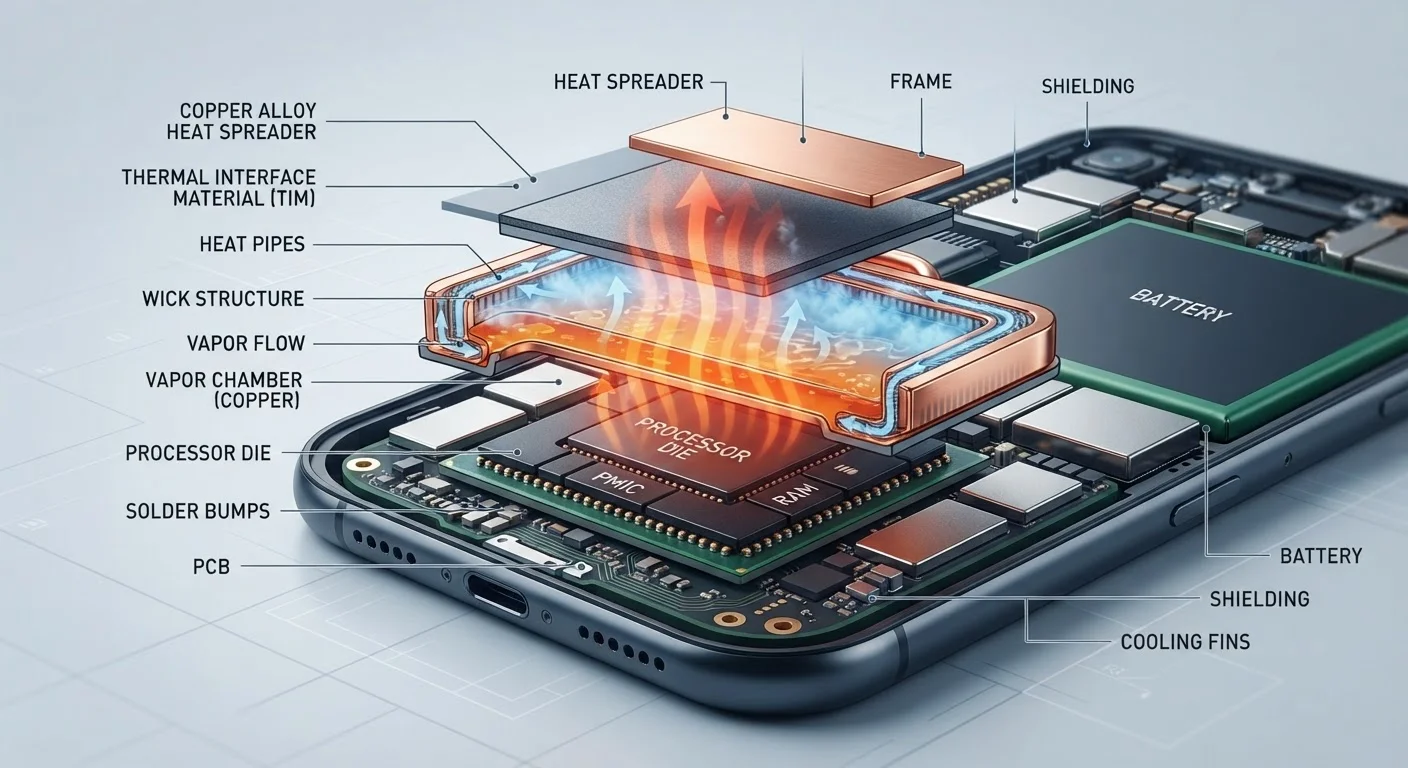
Photo credit: Telecom360.net | Connecting You To The Latest In Telecom
In this article
A phone's peak performance means little if heat forces it to slow down. Learn how thermal management shapes sustained speed during demanding tasks.
Key Takeaways
- A phone's peak benchmark score reflects only a brief performance window, not sustained real-world output.
- Thermal throttling is a built-in safety mechanism present in every modern smartphone processor.
- Sustained performance under load can drop significantly below advertised peak speeds due to heat.
- Physical design factors like chassis material and vapor chamber size directly affect throttling behavior.
- Longer tasks - gaming, video export, navigation - are where thermal limits become practically noticeable.
- Sustained performance benchmarks reveal throttling behavior that standard spec sheets never capture.
Why Peak Performance Numbers Can Mislead
Every smartphone spec sheet lists a processor model and, increasingly, a peak clock speed. What none of them list is how long the device can actually sustain that speed under real-world load. This gap between peak and sustained performance is where thermal throttling lives - and where many purchasing decisions go wrong.
When a chip operates at maximum clock speed, it generates heat proportional to that effort. In a compact smartphone chassis with limited surface area and no active cooling fan, that heat has few places to go. Once internal temperatures cross a threshold - typically somewhere between 80°C and 95°C at the die, depending on the SoC - the device's thermal management system intervenes and steps the processor down to a lower performance state.
The result: a phone that scores impressively in a 30-second benchmark may deliver noticeably lower performance during a 20-minute gaming session or while rendering a high-resolution video. Understanding this distinction is foundational to evaluating any smartphone's real capability. For a deeper look at how processor specs translate to everyday use, see our guide on what chip numbers actually mean.
How Throttling Works at the Hardware Level
Modern mobile processors - whether Qualcomm Snapdragon, Apple Silicon, MediaTek Dimensity, or others - integrate a thermal management unit alongside the compute cores. This unit continuously reads temperature sensors embedded across the chip die and communicates with the operating system's power management layer.
When temperatures approach the defined ceiling, the firmware reduces the processor's voltage and frequency in discrete steps. Performance-intensive cores may be throttled first, or the workload may be redistributed toward more power-efficient cores - a strategy that underpins big.LITTLE and similar heterogeneous architectures. The goal is to shed heat fast enough to avoid a hard cutoff while preserving as much performance as possible.
40-50%
Typical sustained performance drop under throttling
Independent hardware stress tests have consistently documented clock speed reductions of 40-50% from peak in thermally constrained mobile devices during extended workloads.
~10-15 min
Time before throttling becomes significant in gaming
Mobile hardware reviewers commonly observe that performance degradation from thermal throttling becomes measurable in continuous gaming workloads within 10-15 minutes of sustained play.
80-95°C
Typical chip die temperature throttling range
Most modern mobile SoCs begin stepping down performance states when on-die temperatures approach 80°C-95°C, with exact thresholds varying by manufacturer and chip design.
This is also why chassis design matters enormously. Vapor chambers - thin, sealed chambers containing a fluid that transfers heat rapidly across a larger surface area - help distribute thermal energy away from the chip before throttling kicks in. Graphite sheets serve a similar function at a lower cost. A phone with superior thermal dissipation hardware can sustain higher clock speeds for longer, even if its peak numbers are identical to a competitor. Our detailed coverage of how thermal management shapes sustained performance explores these engineering trade-offs further.
When Throttling Becomes Practically Noticeable
For most everyday tasks - web browsing, messaging, streaming video - thermal throttling is essentially invisible. These workloads are light enough that the processor never approaches its thermal ceiling, so it runs comfortably without intervention.
The experience changes markedly during sustained, compute-intensive tasks:
- Mobile gaming: GPU and CPU demands are continuous, and frame rates can drop perceptibly after 10-15 minutes as throttling reduces rendering headroom.
- Video encoding: Exporting or transcoding footage on-device taxes multiple processor components simultaneously, and processing time can extend significantly as performance steps down.
- Navigation with active apps: Running GPS, maps, cellular data, and screen simultaneously in warm ambient conditions compounds heat accumulation.
- Camera computational photography: Long burst sessions and complex scene processing generate short but intense thermal spikes.
Test Before Demanding Tasks Get Long
When evaluating a phone for use cases like gaming or video work, look for sustained-load test data rather than single-run benchmarks. Run the task for at least 15 minutes and monitor whether the device stays cool or becomes noticeably warm. Heat accumulation in the first session predicts how the device will behave daily under similar conditions.
If a phone slows during these kinds of tasks and you've ruled out software causes, thermal throttling is a strong candidate. The diagnostic checklist for sluggish performance can help separate software issues from hardware thermal limits.
How to Evaluate Throttling Behavior Before You Buy
Because spec sheets don't capture sustained performance, the most useful data comes from stress-test benchmarks that run repeated workload loops and measure how far performance drops from its peak. A device that sustains 85% of its peak throughput over a 20-minute loop behaves very differently in practice from one that falls to 55%, even if their single-run scores are similar.
Look specifically for:
- Sustained performance benchmarks from independent reviewers, not manufacturer-supplied figures.
- Thermal stability scores from tools that report loop-by-loop clock speed data.
- Ambient condition disclosures - devices tested in warm environments will throttle earlier and more severely.
Ambient temperature also matters for everyday use. Operating a phone in direct sunlight, in a hot car, or in a warm pocket can pre-load the thermal budget before any demanding task even starts - leaving less headroom before throttling begins. For a broader grounding in how software and hardware interact to shape performance, the complete introduction to smartphone software performance provides useful context.
Frequently Asked Questions

Author
Smartphones Editorial Team
Smartphones Editorial Team is the collective byline for our editorial team and contributor network. Articles published under this byline or an editorial pen name are researched, written, and reviewed according to our editorial standards for clarity, consistency, and independence before publication.
View all articles →