
The Protocols Behind Smart Home Compatibility: Matter, Zigbee, Z-Wave, and Wi-Fi
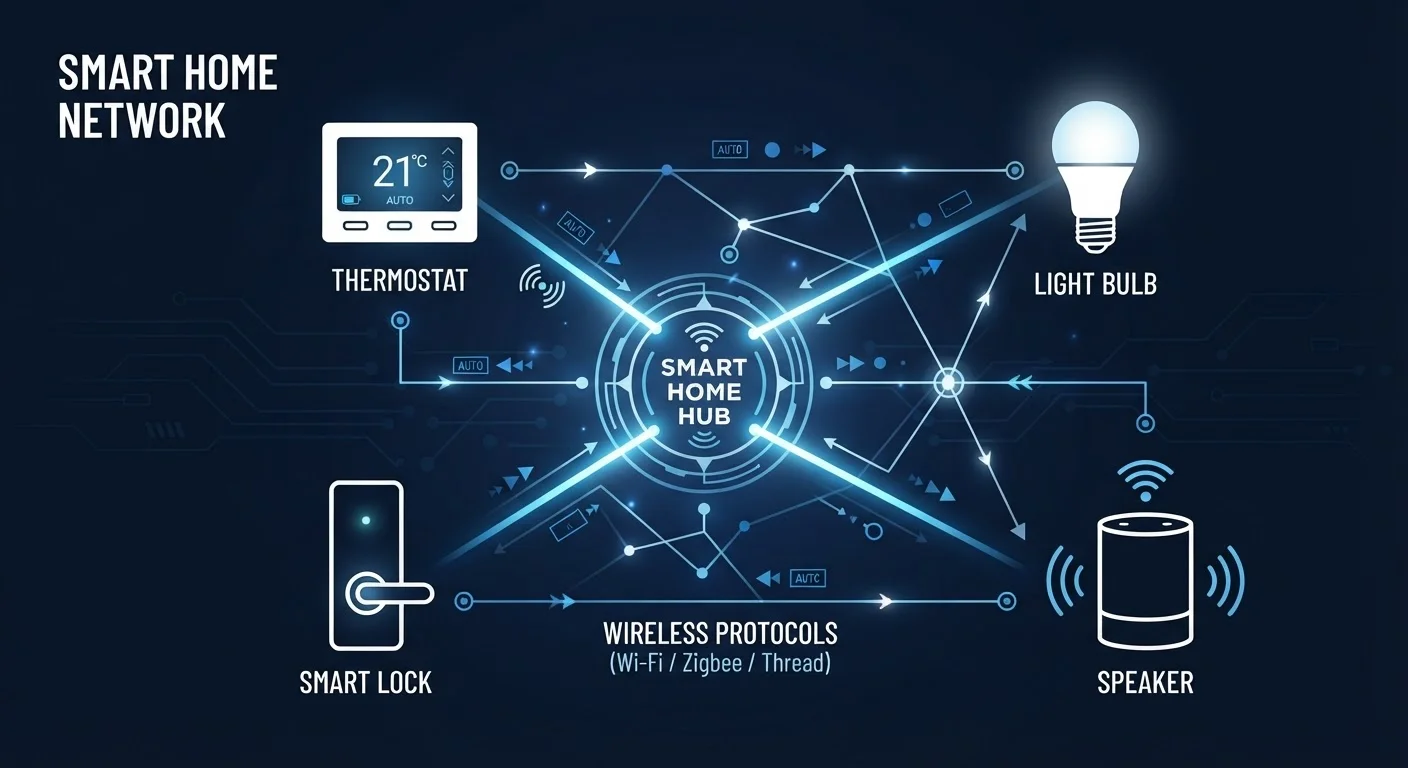
Photo credit: Telecom360.net | Connecting You To The Latest In Telecom
In this article
A reference guide to the four main smart home communication protocols, how they differ, and when each one applies.
Why Protocols Matter for Smart Home Compatibility
Every smart home device needs a language to communicate with hubs, apps, and other devices. That language is a wireless communication protocol - a defined set of rules governing how data is transmitted, at what frequency, and at what speed. Choosing incompatible protocols is among the most common reasons a smart home setup fails to function as expected.
There are four protocols that account for the vast majority of consumer smart home devices available today: Matter, Zigbee, Z-Wave, and Wi-Fi. Each was designed with different priorities - interoperability, range, power efficiency, or raw bandwidth - and each has meaningful trade-offs worth understanding before committing to a platform.
For broader context on how these protocols fit into full smart home ecosystems, see Smart Home Ecosystems Explained.
| Matter ratified | October 2022 (Connectivity Standards Alliance) |
| Zigbee frequency | 2.4 GHz (IEEE 802.15.4 standard) |
| Z-Wave US frequency | 908.42 MHz (Silicon Labs Z-Wave specification) |
| Zigbee max data rate | 250 Kbps (IEEE 802.15.4 standard) |
| Matter transport layers | Wi-Fi and Thread (IP-based) (CSA Matter specification) |
| Hub required | Yes for Zigbee and Z-Wave; No for Wi-Fi; Depends for Matter |
Protocol-by-Protocol Breakdown
Matter
Matter is an application-layer standard developed by the Connectivity Standards Alliance (CSA), with backing from Apple, Google, Amazon, and Samsung. Ratified in 2022, it is designed to run over existing transport protocols - primarily Wi-Fi and Thread - rather than replacing them. Its primary purpose is cross-platform interoperability: a Matter-certified device should work with any Matter-compatible hub regardless of brand. Matter does not define its own radio frequency; it relies on the IP layer, which distinguishes it from Zigbee and Z-Wave.
Zigbee
Zigbee operates on the 2.4 GHz frequency band and uses a mesh networking topology, meaning each powered device can relay signals to extend range. It supports low data rates (up to 250 Kbps) and is optimized for battery-powered sensors and low-latency control. Zigbee is governed by the CSA (the same body overseeing Matter) but requires a dedicated Zigbee coordinator - typically a hub - to manage the mesh. Interoperability between brands has historically been inconsistent due to application-profile fragmentation.
Z-Wave
Z-Wave operates on sub-GHz frequencies (typically 908.42 MHz in the US), which gives it a longer range and better wall penetration than 2.4 GHz protocols. It is a proprietary standard maintained by Silicon Labs and uses a mesh topology similar to Zigbee. Z-Wave's sub-GHz band avoids congestion from Wi-Fi and Bluetooth, making it a reliable choice for environments with heavy 2.4 GHz traffic. Z-Wave Plus (700 series and beyond) extended battery life and added backward compatibility requirements.
Wi-Fi
Wi-Fi connects smart devices directly to a home router, eliminating the need for a separate hub. It supports high bandwidth - sufficient for cameras, video doorbells, and displays - but carries a higher power draw, making it unsuitable for battery-powered sensors. Wi-Fi devices also add load to a home router; a congested network can introduce latency. For guidance on router infrastructure, see Mesh Wi-Fi vs. Traditional Routers.
Communication Protocol
A standardized set of rules that defines how data is formatted, transmitted, and received between devices. In smart home contexts, it determines which devices can communicate with which hubs or controllers.
Mesh Networking
A network topology in which each node (device) can relay data to other nodes, extending range without requiring a direct connection to a central hub. Zigbee and Z-Wave both use mesh topologies.
Thread
An IPv6-based mesh networking protocol designed for low-power IoT devices. Matter can run over Thread as its transport layer, enabling battery-efficient IP-connected devices.
Sub-GHz Frequency
Radio frequencies below 1 GHz, such as the 908 MHz band used by Z-Wave in the US. Sub-GHz signals travel farther and penetrate obstacles more easily than 2.4 GHz signals.
Coordinator (Zigbee)
The central device in a Zigbee network responsible for forming the network, assigning addresses, and managing communication between nodes. Typically built into a smart home hub.
Interoperability
The ability of devices from different manufacturers to communicate and work together without requiring brand-specific hardware or software. Matter was designed specifically to improve interoperability across smart home platforms.
Choosing the Right Protocol for Each Use Case
No single protocol is universally optimal. The right choice depends on the device type, power source, and existing infrastructure.
- Battery-powered sensors (door contacts, motion detectors, leak sensors): Zigbee or Z-Wave. Both offer low power consumption that Wi-Fi cannot match.
- High-bandwidth devices (cameras, video doorbells, smart displays): Wi-Fi is effectively the only viable option given streaming data requirements.
- Mixed-brand ecosystems: Matter simplifies integration when devices from different manufacturers must coexist under a single app or voice assistant.
- RF-congested environments: Z-Wave's sub-GHz band reduces interference risk in apartments or homes with many 2.4 GHz devices.
- Large homes requiring extended range: Zigbee and Z-Wave mesh networks self-extend as more devices are added - Wi-Fi does not inherently do this without additional access points.
Understanding the wireless trade-offs also applies beyond smart home devices. For a broader view of wired versus wireless home accessories, Wired vs. Wireless Home Accessories covers the core distinctions. Security implications of connecting multiple protocol types are addressed in Home Network Security.
Matter Does Not Replace Zigbee or Z-Wave
Matter operates at the application layer and relies on IP-based transports (Wi-Fi or Thread). It does not natively speak Zigbee or Z-Wave radio signals. Hubs that bridge Zigbee or Z-Wave devices into a Matter ecosystem use software translation, not a direct protocol conversion. Verify hub compatibility before assuming a Matter controller will manage existing Zigbee or Z-Wave devices.

Author
Consumer Electronics Editorial Team
Consumer Electronics Editorial Team is the collective byline for our editorial team and contributor network. Articles published under this byline or an editorial pen name are researched, written, and reviewed according to our editorial standards for clarity, consistency, and independence before publication.
View all articles →