
Storage on Smartphones: UFS, eMMC, and NVMe Compared
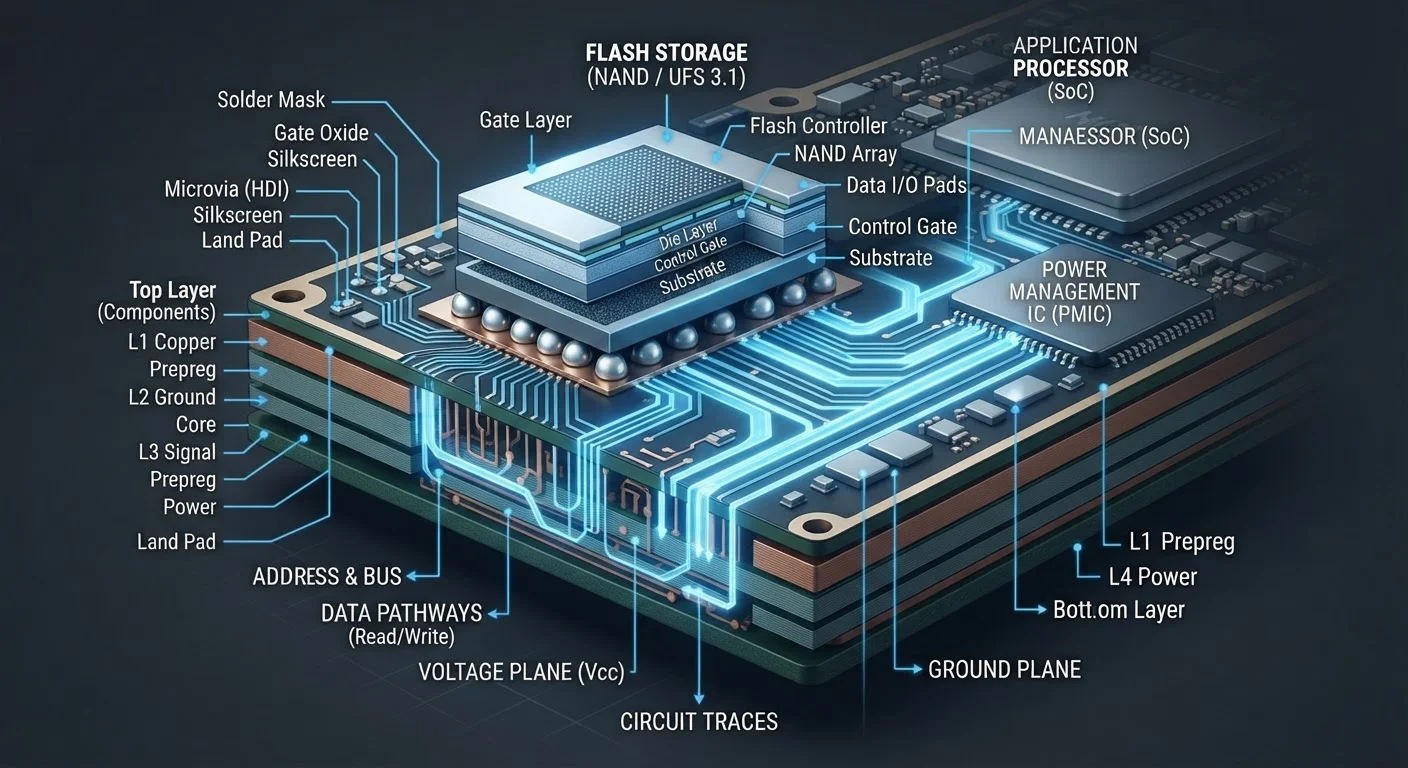
Photo credit: Telecom360.net | Connecting You To The Latest In Telecom
In this article
Internal storage types vary widely in speed and cost. Learn how UFS, eMMC, and NVMe flash differ and why the type matters for app loading times.
Key Takeaways
- UFS uses a full-duplex interface, allowing simultaneous reads and writes; eMMC does not.
- UFS 3.1 sequential read speeds can exceed 2,000 MB/s, compared to roughly 300 MB/s for eMMC 5.1.
- NVMe on mobile is uncommon and mainly appears in select high-end devices via PCIe connections.
- Storage type affects app launch times, game load screens, and large file transfer speeds noticeably.
- eMMC remains practical for light, everyday use cases where raw bandwidth is rarely the bottleneck.
- Checking a device's storage standard is a reliable proxy for overall system performance ambition.
Why Storage Technology Shapes Real-World Performance
When comparing smartphones, most buyers focus on processor speed and camera resolution. Yet the internal storage standard - the chip architecture that governs how data is read from and written to the device - has a measurable, direct impact on the experiences that matter most: how fast apps open, how quickly large photos save, and how smoothly the system runs when multitasking.
Three storage standards appear in mobile devices today: eMMC (embedded MultiMediaCard), UFS (Universal Flash Storage), and, in a smaller number of high-end devices, NVMe (Non-Volatile Memory Express). Each represents a distinct point in the evolution of flash memory interfaces, and each carries real-world trade-offs. For a broader look at how storage capacity interacts with app performance, see how storage thresholds affect read/write speeds.
| Criterion | UFS 3.1 | eMMC 5.1 |
|---|---|---|
| Interface mode | Full-duplex (serial) | Half-duplex (parallel) |
| Sequential read speed | ~2,100 MB/s | ~300-400 MB/s |
| Sequential write speed | ~1,200 MB/s | ~150-200 MB/s |
| Command queue support | Yes (multiple queues) | Limited |
| Simultaneous read/write | Yes | No |
| Typical device tier | Mid-range to flagship | Budget to entry-level |
| Power efficiency | Higher (optimized controllers) | Moderate |
| Component cost | Higher | Lower |
eMMC: Cost-Effective but Architecturally Limited
eMMC packages NAND flash memory and a controller into a single chip soldered directly onto the device board. It communicates over an 8-bit parallel bus and operates in half-duplex mode, meaning it can either read data or write data at any given moment - not both simultaneously. The eMMC 5.1 specification - the most widely deployed version in smartphones - delivers sequential read speeds of approximately 300-400 MB/s and sequential writes closer to 150-200 MB/s.
For everyday tasks like text messaging, light browsing, and streaming video, these figures are generally adequate. Bottlenecks become apparent when multiple storage operations compete: installing an app while the camera saves a burst of photos, for instance, forces the controller to serialize those requests, introducing perceptible lag. eMMC remains common in sub-$200 Android devices where it allows manufacturers to offer competitive hardware at lower price points. Understanding how storage fits alongside mobile RAM behavior helps explain why mid-range devices can still feel sluggish even with sufficient memory.
~7x
UFS 3.1 sequential read advantage over eMMC 5.1
Based on published specification ceilings: UFS 3.1 at ~2,100 MB/s versus eMMC 5.1 at ~300 MB/s sequential read.
300-400 MB/s
eMMC 5.1 peak sequential read speed
This represents the practical ceiling for eMMC 5.1, the most widely deployed eMMC version in budget Android smartphones.
2,100+ MB/s
UFS 3.1 sequential read throughput
UFS 3.1 specification allows sequential reads exceeding 2,100 MB/s, enabling faster app launches and file operations on flagship devices.
UFS: The Modern Standard for Mobile Throughput
UFS was designed specifically to overcome eMMC's half-duplex limitation. It operates over a serial interface using the SCSI command set and supports full-duplex communication - reads and writes can occur simultaneously. UFS also supports multiple command queues, allowing the controller to process several storage requests in parallel rather than sequentially.
The generational gains are significant. UFS 2.2, common in mid-range devices, typically achieves sequential reads of 1,200 MB/s or more. UFS 3.1, found in flagships from roughly 2020 onward, pushes sequential reads past 2,000 MB/s. UFS 4.0, which began appearing in 2023-era flagship chipsets, doubles that ceiling again. These figures translate into noticeably faster app launches, shorter game load screens, and smoother camera performance under sustained burst shooting. For context on how storage architecture relates to broader device performance, the detailed breakdown of UFS, eMMC, and NVMe in smartphone use covers practical implications in depth.
NVMe on Mobile: High Ceiling, Narrow Deployment
NVMe - the protocol that defines fast SSD performance in laptops and desktops - has made limited appearances in mobile hardware. It communicates over PCIe lanes directly to the processor, bypassing the legacy storage command overhead that even UFS carries. In controlled benchmarks, NVMe-based mobile storage has demonstrated sequential read speeds exceeding 3,500 MB/s.
However, NVMe integration in phones involves thermal, power, and physical footprint challenges that make it impractical for mainstream deployment. Select devices have used PCIe-connected storage internally, but the distinction between UFS 4.0 and NVMe narrows considerably in everyday mobile tasks. Most users will not encounter NVMe as a labeled, marketed feature in current retail devices. The standard remains more architecturally relevant to understanding where mobile storage is heading than what consumers currently need to evaluate.
NVMe vs. UFS: A Narrowing Gap in Practice
While NVMe theoretically outperforms UFS on raw throughput metrics, mobile workloads rarely saturate even UFS 3.1 bandwidth in day-to-day use. The more meaningful difference for most users is between UFS and eMMC, not between UFS and NVMe. NVMe's relevance in consumer mobile hardware remains limited to a handful of specialized or experimental device configurations.
For users weighing whether on-device storage even needs to be fast, the trade-offs between keeping files on the device versus offloading them are covered in cloud storage vs. local storage trade-offs.

Author
Consumer Electronics Editorial Team
Consumer Electronics Editorial Team is the collective byline for our editorial team and contributor network. Articles published under this byline or an editorial pen name are researched, written, and reviewed according to our editorial standards for clarity, consistency, and independence before publication.
View all articles →