
The Anatomy of a Smartwatch: Every Major Component Explained
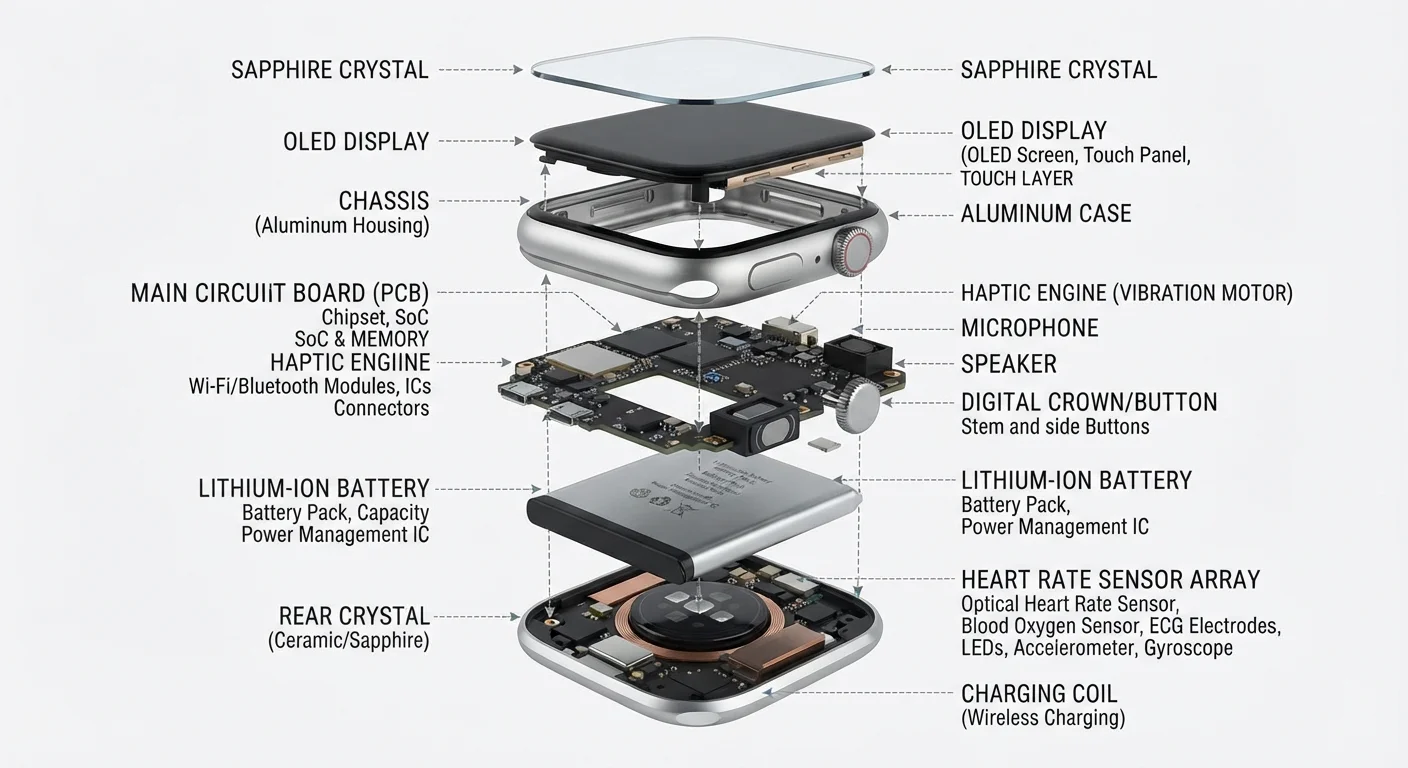
Photo credit: Telecom360.net | Connecting You To The Latest In Telecom
In this article
From the SoC to the crown mechanism, this reference breaks down every key hardware component inside a modern smartwatch.
The System-on-Chip: The Brain of the Watch
Every smartwatch centers on a System-on-Chip (SoC) - a single integrated circuit that combines the central processing unit, graphics processor, memory controller, and wireless radios. Because a watch operates under severe thermal and power constraints, SoC design for wearables prioritizes milliwatt-level efficiency over raw throughput.
The SoC governs how quickly the device responds to touch input, renders watch faces, and processes sensor data. A low-power companion core often handles always-on tasks - step counting, heart-rate sampling - while the main processor sleeps, a strategy that directly extends battery life. For a parallel breakdown of how mobile SoCs scale up for larger devices, see how smartphone chipsets are evaluated.
Display Technologies and the Cover Glass
Smartwatch displays use one of three dominant panel types. AMOLED (Active Matrix Organic Light-Emitting Diode) delivers deep blacks and vivid color by lighting each pixel individually, making it well-suited for always-on modes where most pixels remain dark. LCD panels require a continuous backlight, consuming more power but offering consistent brightness across the full panel. MIP (Memory-in-Pixel) reflective displays draw almost no power in ambient conditions and read clearly in sunlight, though color depth is limited.
The cover glass - typically hardened mineral glass or sapphire crystal - sits above the panel and determines scratch resistance and optical clarity. Sapphire rates 9 on the Mohs hardness scale, making it highly scratch-resistant, but it can be more brittle under point-impact forces than chemically strengthened glass alternatives.
SoC (System-on-Chip)
An integrated circuit that consolidates the CPU, GPU, memory interface, and wireless radios onto a single die. In wearables, SoC efficiency directly determines battery life and thermal output.
PPG (Photoplethysmography)
An optical technique that uses light to detect volumetric changes in blood flow near the skin surface. It is the primary method used in wrist-based heart-rate monitoring.
AMOLED
Active Matrix Organic Light-Emitting Diode. Each pixel emits its own light, enabling true blacks and low power draw when displaying dark content - ideal for always-on watch faces.
eSIM
An embedded SIM chip soldered directly to a device's circuit board. It stores carrier credentials digitally, enabling cellular connectivity without a removable physical SIM card.
IMU (Inertial Measurement Unit)
A sensor module combining an accelerometer and gyroscope to measure linear acceleration and rotational motion. It underpins step counting, fall detection, and activity classification.
MIP Display
Memory-in-Pixel is a reflective LCD technology that retains a static image without continuous power. It offers excellent outdoor readability and very low standby consumption at the cost of limited color range.
Digital Crown
A rotating physical input control on the side of a smartwatch, adapted from traditional mechanical watch design. It allows scroll and zoom interactions without covering the display with a finger.
Lithium-Polymer (LiPo) Battery
A rechargeable battery chemistry that can be manufactured in thin, flexible, custom shapes. Preferred in wearables because it conforms to the limited and irregular internal volume of a watch case.
Sensors, Crown, and Physical Inputs
The optical heart-rate sensor uses PPG technology - green LEDs illuminate capillaries in the wrist while a photodiode measures reflected light fluctuations corresponding to blood flow. Additional sensors commonly include a 6-axis IMU (accelerometer plus gyroscope), barometric altimeter, skin-temperature sensor, and electrical heart sensor for single-lead ECG. For a full breakdown of what each sensor actually detects and how accurate it is, see Wearable Sensors Decoded.
The digital crown - a rotating bezel or side button derived from traditional watchmaking - provides a physical input axis that complements touchscreen navigation without requiring the user to obstruct the display. Some designs replace or supplement this with a rotating physical bezel around the watch face itself.
9
Mohs hardness rating of sapphire crystal
Sapphire crystal cover glass sits just below diamond (10) on the Mohs scale, making it highly resistant to everyday scratching from keys and surfaces.
200-600 mAh
Typical smartwatch battery capacity range
Capacity is constrained by watch case volume; power management firmware and low-power sensor cores compensate for the small cell size.
6-axis
IMU sensor axes in mainstream smartwatches
A 6-axis IMU combines a 3-axis accelerometer with a 3-axis gyroscope, enabling accurate motion tracking across all planes of wrist movement.
Battery, Charging, and Connectivity
Smartwatch batteries are custom-shaped lithium-polymer cells, typically ranging from 200 mAh to 600 mAh depending on case size. Capacity is constrained by the watch's physical volume, which is why battery life - not raw specs - is the most meaningful way to compare power management across devices.
Charging is delivered through inductive (Qi-compatible or proprietary) coils or magnetic pogo-pin connectors. Some devices integrate fast charging circuitry, recovering a significant charge percentage in under 30 minutes.
Wireless connectivity typically includes Bluetooth 5.x for phone pairing, Wi-Fi 802.11b/g/n for independent data sync, and optionally LTE via an embedded eSIM. An eSIM (embedded SIM) is a software-programmable SIM soldered to the board, eliminating a physical card slot and allowing cellular connectivity without a paired phone. Understanding how smartwatch and fitness band hardware priorities differ can sharpen your buying decision - compare the two form factors here.
For a broader view of how all these components interact end-to-end, Wearable Technology End to End covers the full pipeline from sensor to insight. As AI-driven health features increasingly depend on this hardware foundation, understanding their real-world limits is equally important.

Author
Consumer Electronics Editorial Team
Consumer Electronics Editorial Team is the collective byline for our editorial team and contributor network. Articles published under this byline or an editorial pen name are researched, written, and reviewed according to our editorial standards for clarity, consistency, and independence before publication.
View all articles →